
Ancient Music: Insights from the World's Oldest Instruments
Discovered in Slovenian and German caves, Ice Age bone flutes are forcing archaeologists to reconsider the cognitive sophistication and cultural complexity of early modern humans in Europe.
Introduction
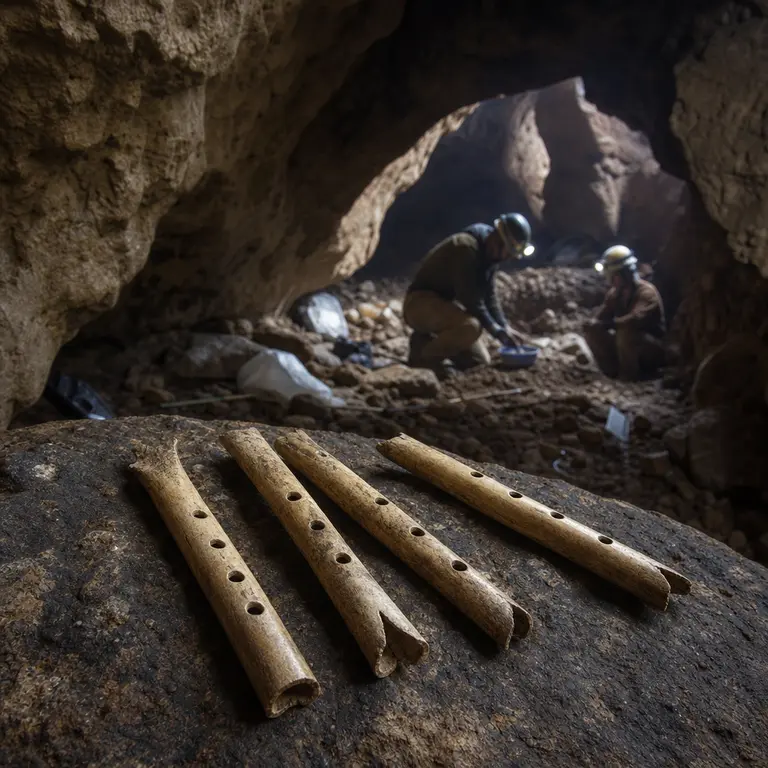
In 2008, archaeologists excavating Hohle Fels cave in the Swabian Jura region of southwestern Germany unearthed a small, fragile object that would quietly detonate decades of assumptions about prehistoric human life. The object was a flute, carved from the hollow wing bone of a griffon vulture, fitted with five finger holes and two V-shaped notches at the blowing end. It was approximately 43,000 years old. A companion piece found nearby was fashioned from mammoth ivory, requiring its maker to laboriously split a curved tusk, hollow it, and rejoin the halves with a birch tar adhesive so precise that researchers initially missed the seam. These instruments are now considered the oldest confirmed musical objects ever found, and their existence raises a question that paleontologists and cognitive scientists are still debating: What does it mean that humans were making music before they developed agriculture, writing, or permanent settlements?
The discovery at Hohle Fels did not emerge from nowhere. Archaeologists had long suspected that music predated written history, but suspicion is not evidence, and organic materials decay across millennia with uncooperative thoroughness. Bone and ivory survive under the right conditions, which is why caves have become the unlikely archives of our earliest cultural record. The Swabian Jura sites, clustered within a relatively small geographic area, have yielded not only flutes but figurative sculpture and personal ornaments from the same stratigraphic layers, suggesting that the people who made these objects were not isolated experimenters but members of a culture in which symbolic production was already a normal and perhaps essential part of life. The flutes, in other words, are not anomalies. They are data points in a pattern that researchers are still learning to read.
The Divje Babe Controversy
The German finds, while extraordinary, are not even the most contested bone flute in the archaeological record. That distinction belongs to a fragment of a cave bear femur recovered from Divje Babe cave in Slovenia in 1995 by archaeologist Ivan Turk. The object, dated to between 50,000 and 60,000 years ago, bears four holes arranged in a linear pattern consistent with a diatonic scale. The staggering implication, if the holes are artificial, is that the instrument was made not by Homo sapiens but by Neanderthals, who occupied the site during the relevant period. The claim immediately split the scientific community. Critics argued that the holes were puncture marks left by cave hyenas gnawing on the bone, a mundane explanation that requires no revision of our understanding of Neanderthal cognition. Supporters, including a 2023 analysis by researchers at the University of Ljubljana using CT scanning and biomechanical modeling of hyena bite geometry, concluded that the hole spacing and angles are inconsistent with carnivore predation and are more likely the result of deliberate perforation.
The debate remains unresolved, but the stakes are enormous. A Neanderthal flute would push intentional music-making back by at least 10,000 years, to before the arrival of modern humans in Europe, and would require a fundamental reassessment of what Neanderthal minds were capable of. For much of the twentieth century, Neanderthals were portrayed in both popular and scientific literature as cognitively limited relatives, capable of functional tool use but lacking the symbolic imagination that supposedly distinguished Homo sapiens. That picture has been eroding steadily. Evidence of Neanderthal pigment use, shell ornamentation, and eagle-talon jewelry has accumulated over the past two decades, and the Divje Babe fragment fits into a broader pattern of findings suggesting Neanderthal cognition was considerably richer than the old model allowed. Whether or not the Slovenian bone is ultimately accepted as a flute, the conversation it has generated has been scientifically productive in ways that extend well beyond the object itself.
What the Instruments Reveal About Cognition
The cognitive demands of flute construction are not trivial, and it is worth dwelling on them in some detail. To carve a functional wind instrument from bone or ivory, a maker must hold in mind an acoustic goal, understand the relationship between hole placement and pitch, possess the fine motor control to execute precise cuts in hard material, and likely have some tradition of musical knowledge to draw upon. The process is not one of spontaneous inspiration but of accumulated technique, which implies transmission across generations and therefore a form of cultural continuity. The mammoth ivory flute from Hohle Fels is particularly instructive in this regard. Ivory does not split cleanly along natural lines the way bone does, so the craftsperson had to plan the instrument’s geometry before beginning, then join two separately carved halves with enough precision to produce an airtight seal. The birch tar used as adhesive was itself a processed material requiring controlled heating, which means the flute’s construction involved multiple distinct technical operations carried out in a planned sequence.
Nicholas Conard of the University of Tübingen, who led the Hohle Fels excavations, argues that the flutes are evidence of a fully modern symbolic and creative capacity already present in the earliest anatomically modern humans to enter Europe, a population sometimes called the Aurignacian culture after the archaeological tradition they represent. The instruments suggest these people were not behaviorally primitive newcomers slowly developing culture on European soil, but arrived with a rich cognitive toolkit already assembled. This has implications for where and when the toolkit was developed, drawing attention back to Africa and the period before the out-of-Africa dispersal. Some researchers have proposed that the behavioral modernity visible in the European record at 43,000 years ago reflects a long prior development in African populations, one that is harder to trace archaeologically because the relevant African sites are fewer in number and less well preserved. The flutes, on this reading, are the visible tip of a much older cognitive iceberg.
Sound, Ritual, and Social Bonding
Why music at all? Evolutionary musicologists have proposed several non-exclusive hypotheses, and none of them has achieved consensus, which is itself informative about how difficult it is to assign a single adaptive function to something as multidimensional as musical behavior. Steven Mithen of the University of Reading has argued that music and language share deep cognitive roots and may have co-evolved as mechanisms of social cohesion in small hunter-gatherer groups. Music’s ability to synchronize emotional states across individuals, a phenomenon sometimes called entrainment, would have had obvious adaptive value in groups that depended on coordinated hunting, collective childcare, and alliance maintenance. Shared rhythmic experience can reduce perceived boundaries between individuals and generate a sense of collective identity that is difficult to achieve through language alone. In small mobile groups living under conditions of significant environmental stress, that kind of social glue may have been as important to survival as any technological innovation.
Others point to the archaeological context of the flutes themselves. Hohle Fels and the nearby sites of Vogelherd and Hohle Stein were not merely campsites but appear to have been repeatedly visited locations associated with the deposition of figurative art, including the famous Venus of Hohle Fels and numerous carved animal figures. This suggests the caves may have served a ritual or ceremonial function, and music may have been integral to whatever practices took place there. The acoustic properties of many decorated Paleolithic caves have also attracted scholarly attention. Researchers studying sites including Lascaux in France and Altamira in Spain have noted that painted chambers frequently correspond to areas of particularly strong resonance, where sound reverberates and amplifies in ways that would have been immediately perceptible to anyone producing noise inside them. This raises the possibility that the selection of surfaces for painting was partly guided by acoustic experience, and that sound and image were deliberately combined in ways we can only partially reconstruct from the physical evidence that remains.
A Living Research Frontier
The bone flutes of the Ice Age have recently acquired new relevance as advances in ancient DNA analysis and high-resolution dating techniques continue to refine our picture of early human population movements in Europe. The period between 45,000 and 40,000 years ago was one of the most consequential in human prehistory. Modern humans were expanding westward across a continent still inhabited by Neanderthals, and the two populations overlapped for perhaps 5,000 years, long enough for interbreeding, now confirmed in the genomes of all living non-African humans. Whether music played any role in that contact, as a marker of group identity, a tool of communication across language barriers, or simply a shared human capacity that both populations possessed independently, is a question that current evidence cannot resolve. What it can do is frame the question in ways that earlier generations of researchers lacked the tools to ask.
Experimental archaeology has added another dimension to the research. Scholars, including Anna Friederike Potengowski, have constructed replicas of the Aurignacian flutes using period-appropriate tools and materials, demonstrating that the instruments are fully functional and capable of producing a range of tones sufficient for melodic expression. Playing these replicas in cave environments similar to the original sites produces an experience that is, by multiple accounts, acoustically striking in ways that are difficult to convey in print. The resonance of stone chambers, the way sound behaves differently at different depths within a cave system, and the disorienting effect of music produced in total darkness all suggest that the experience of Paleolithic musical performance was probably quite unlike anything we associate with music in the modern world. That strangeness is itself a reminder of how much interpretive distance separates us from the people who made these objects.
Conclusion
The bone flutes of the Ice Age are remarkable objects on their own terms, but their deepest significance lies in what they imply about the relationship between music and human identity. The impulse to organize sound into something intentional, repeatable, and communicable is not a recent innovation layered onto a fundamentally utilitarian human nature. It appears to be ancient, widespread, and connected to some of the most distinctively human capacities we possess, including the ability to plan across time, to transmit knowledge between generations, and to create shared emotional experience through coordinated behavior. Whether Neanderthals participated in that impulse, as the Divje Babe fragment tantalizingly suggests they might have, or whether it was the exclusive property of our own lineage, the fact that the earliest modern humans in Europe were already making sophisticated musical instruments tells us something important about what culture is and where it comes from.
Music, in this light, is not an ornament added to human life once the necessities are secured. It appears to have been present at the foundation, bound up with the same cognitive capacities that gave rise to language, art, and ritual. The caves of the Swabian Jura and the Slovenian karst are not footnotes to human history. They are among its earliest chapters, and they were written, at least in part, in sound.
Sources & Further Reading
- Conard, Nicholas J., Maria Malina, and Susanne C. Münzel. New flutes document the earliest musical tradition in southwestern Germany. Nature, 2009. https://www.nature.com/articles/nature08169
- Turk, Ivan, ed. Mousterian Bone Flute. Znanstvenoraziskovalni Center SAZU, 1997.
- Ježek, Matija, et al. The Divje Babe flute: New analyses confirm it is a Neanderthal instrument. PLOS ONE, 2023. https://doi.org/10.1371/journal.pone.0286067
- Mithen, Steven. The Singing Neanderthals: The Origins of Music, Language, Mind and Body. Weidenfeld and Nicolson, 2005.