
The Poison Squad: America's First Human Drug Trials
In 1902, a U.S. government chemist fed chemical preservatives to twelve young men to prove food adulteration was killing Americans — launching the modern era of food safety regulation.
Introduction
Harvey Washington Wiley was not the kind of man who worked quietly. As chief chemist of the U.S. Department of Agriculture from 1883 onward, he spent nearly two decades watching American food manufacturers adulterate their products with industrial chemicals that had never been tested on human beings. Borax was blended into butter. Formaldehyde was added to milk to mask spoilage. Copper sulfate was used to make canned peas appear a more appealing shade of green. Salicylic acid was dumped into meat products as a preservative. None of these additives were disclosed to consumers. None had been evaluated for long-term safety. And no federal law existed to stop any of it.
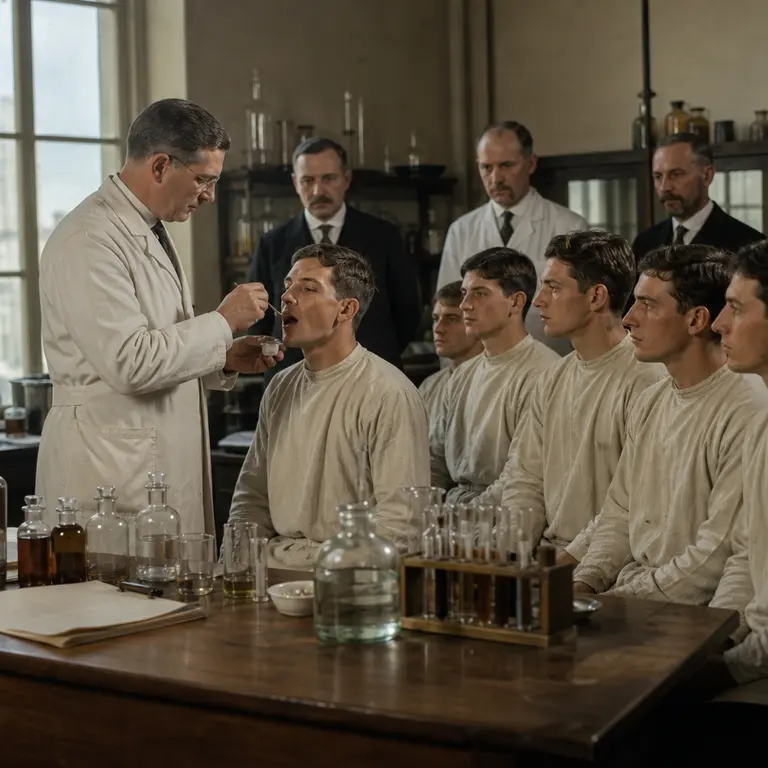
Wiley’s frustration with Congress, which repeatedly refused to act on food purity legislation despite mounting chemical evidence, led him to a radical decision. If lawmakers would not believe his laboratory analyses, perhaps they would believe a controlled human experiment conducted in plain sight. In 1902, he recruited twelve healthy young men, mostly clerks from the Department of Agriculture, and began feeding them measured doses of common food preservatives alongside their regular meals. He called the group his Hygienic Table Trials. The press, with characteristic flair, called them the Poison Squad. What followed was one of the most unusual and consequential experiments in the history of American public health, one that helped reshape the relationship between the federal government, the food industry, and the citizens who consumed what that industry produced.
The Experiment at the Bureau of Chemistry
The trials ran in phases between 1902 and 1907, each phase targeting a different additive. Borax came first. Participants ate meals prepared in a dedicated kitchen in the basement of the Bureau of Chemistry building in Washington, D.C. Every dish was weighed, every bodily output was carefully measured, and every symptom was recorded in detailed logs that survive today in the National Archives. The men signed consent forms, a practice that was genuinely unusual for the era, and agreed to eat nothing outside of the supervised meals during the trial periods. They were, in effect, living instruments of federal research, their bodies standing in for the bodies of every American who ate commercially processed food without knowing what was in it.
The results with borax were troubling. At higher doses, participants reported nausea, persistent headaches, and significant loss of appetite. When the dosing stopped, symptoms resolved, suggesting a direct causal relationship. Wiley moved on to salicylic acid, sulfuric acid, sodium benzoate, and formaldehyde in subsequent phases. The formaldehyde trials produced the most dramatic results: vomiting, severe gastric distress, and what Wiley described in his reports as a general depression of the vital functions. Several participants had to withdraw from that phase entirely, unable to continue without risking serious harm.
What made the Poison Squad genuinely unusual in the history of science was its deliberately public character. Wiley understood that the experiment needed an audience to have political effect. He invited journalists to observe the meals. He released interim reports to the press. Newspapers across the country ran stories about the young men eating chemically laced food in the name of public health. Cartoonists drew them as skeletal figures seated at a grim table. Popular songs were written about them. The Poison Squad became a genuine cultural phenomenon at a moment when muckraking journalism was already reshaping American politics, and Wiley was shrewd enough to understand that scientific data alone would never be sufficient to move a Congress heavily influenced by food industry interests.
The Industrial Food System They Were Fighting
To understand why Wiley’s experiment was necessary, it helps to understand the scale of adulteration in the American food supply during the late nineteenth century. The industrialization of food production had outpaced any regulatory framework by a considerable margin. Canning technology, developed in the early 1800s, had expanded rapidly after the Civil War, and manufacturers competed ferociously on price in a market with no meaningful oversight. The easiest way to cut costs was to extend shelf life with cheap industrial chemicals rather than investing in improved sanitation or refrigeration infrastructure.
Milk adulteration was particularly dangerous and particularly widespread. In urban areas, milk was frequently diluted with water, then dosed with formaldehyde, sold commercially under the brand name Preservaline, to prevent visible spoilage from becoming apparent before the product reached consumers. Infant mortality rates in American cities during this period were staggering by any measure, and contaminated milk was among the leading causes. Wiley’s colleague, the public health researcher Charles A. Harrington, had documented formaldehyde’s destructive effects on digestive enzymes as early as 1896, but his findings reached no legislative audience and produced no regulatory response.
The meat industry presented a parallel and equally urgent crisis. Upton Sinclair’s 1906 novel The Jungle described Chicago slaughterhouse conditions in terms that horrified the reading public, but Sinclair was primarily writing about sanitation and labor exploitation. Wiley’s concern was chemical: the routine use of preservatives to make spoiled or borderline meat appear and smell fresh enough to sell. The two crises reinforced each other politically in ways that neither Wiley nor Sinclair had fully anticipated, and together they created the conditions for legislative change that had been impossible to achieve through scientific argument alone.
It is worth noting that adulteration was not confined to the products most associated with scandal. Coffee was routinely extended with roasted chicory, acorns, or dried figs. Candy was colored with lead-based pigments. Vinegar was synthesized from industrial acids rather than fermented from fruit. Spices were bulked out with sawdust or floor sweepings. The problem was not confined to a few unscrupulous operators but was structural, embedded in a competitive market that rewarded cost reduction and faced no meaningful penalty for deception.
From Experiment to Law
The Pure Food and Drug Act passed on June 30, 1906, the same day as the Federal Meat Inspection Act. Wiley had lobbied for food purity legislation for more than two decades, and the Poison Squad trials had been central to his public campaign by making abstract chemical dangers visible and human. The 1906 law prohibited the manufacture, sale, or transportation of adulterated or misbranded food and drugs in interstate commerce. It was the first federal consumer protection law of its kind in the United States, and it established a precedent that would eventually lead to the creation of the Food and Drug Administration as a permanent regulatory body.
Wiley’s role after the law passed was complicated and ultimately frustrating. He became the first administrator of what would eventually become the FDA, but he clashed repeatedly with industry lobbyists and with officials in the Taft administration who sought to water down enforcement through narrow regulatory interpretations. He resigned in 1912, frustrated that the law he had spent his career fighting for was being applied in ways that largely protected the interests of the industries it was meant to regulate. His critics within government argued that he was an ideological crusader rather than a dispassionate scientist. His defenders argued, with considerable justification, that he was simply being outmaneuvered by the industries he had spent his career opposing, and that his instincts about chemical safety were more often correct than the regulatory compromises that replaced them.
The Poison Squad participants themselves were largely forgotten by history. Their names appear in Wiley’s original reports filed with the Bureau of Chemistry, but they received no public recognition or lasting compensation for their service. Several continued working as government clerks for the rest of their careers, their contribution to American food safety unacknowledged in any official record. One participant, a man named Claude Moody, was reportedly still alive in the 1940s and gave a brief interview in which he recalled the borax meals as tasting faintly of soap, a detail that somehow captures the mundane strangeness of the entire enterprise.
The Overlooked Women Who Extended the Work
Wiley’s Poison Squad has received most of the historical attention devoted to this period, but a parallel and equally important body of research was being conducted by women working largely outside official government channels and without access to federal resources. Ellen Swallow Richards, the first woman admitted to MIT and the founder of what she called home economics as a scientific discipline, was conducting systematic analyses of food adulteration in Massachusetts during the same period. Her 1885 survey of food samples collected from across the state documented widespread contamination and was used by Massachusetts legislators to pass one of the earliest state-level food purity laws in the country, predating the federal act by more than two decades.
Alice Lakey, a New Jersey civic activist with no formal scientific training, organized a national letter-writing campaign to Congress in 1905 that historians credit with breaking a legislative logjam that had stalled Wiley’s bill for years. The General Federation of Women’s Clubs, which Lakey mobilized with considerable organizational skill, represented roughly two million women voters in states where women had at least partial suffrage. Their pressure was a material political force, not merely symbolic support, and congressional records from the period show that the volume of constituent correspondence on food safety was genuinely influential in moving legislators who had previously been indifferent or actively hostile to the legislation.
These contributions were minimized in the official histories of the Pure Food and Drug Act, which centered Wiley as a lone scientific crusader and largely erased the coalition work that made the law politically possible. Revisionist scholarship since the 1980s has worked to restore a more accurate picture of the diverse actors who produced the 1906 law, though the popular narrative continues to treat it primarily as the achievement of one determined chemist with a dramatic experiment at his disposal.
Present-Day Resonance and Recent Scholarship
In 2018, journalist Deborah Blum published The Poison Squad, a full-length narrative history of Wiley’s trials and the broader campaign for the Pure Food and Drug Act. The book was a finalist for the PEN/E.O. Wilson Literary Science Writing Award and brought renewed public attention to an episode that had faded from popular memory despite its significance. Blum’s research drew on previously underexamined Bureau of Chemistry records held at the National Archives, including the original meal logs and symptom diaries from the trials themselves, documents that give the experiment a granular human texture that Wiley’s published reports deliberately suppressed in favor of clinical detachment.
The centennial of the FDA, observed in 2006, prompted a wave of institutional histories that reassessed Wiley’s legacy with fresh eyes. The FDA’s own historians have noted that the Poison Squad trials represent one of the earliest examples of a controlled dietary intervention study in American public health, predating the randomized controlled trial methodology that became standard in mid-twentieth century medicine by several decades. The ethical framework Wiley used, including informed consent, voluntary participation, and documented protocols, was imperfect by modern standards but was genuinely ahead of its time for 1902, when human experimentation in medicine typically involved no formal consent process whatsoever.
The questions Wiley was asking have not gone away, and in some respects they have become more pressing rather than less. Debates over food additive safety, the adequacy of long-term human exposure data, and the structural influence of industry on regulatory science remain active and contested in contemporary food policy research. The FDA’s Generally Recognized as Safe designation, the regulatory category that governs most food additives currently used in American products, has been criticized by researchers at the Environmental Defense Fund and elsewhere for relying heavily on manufacturer self-reporting rather than independent testing. It is a structural problem that Wiley, who distrusted industry-generated data from the very beginning of his career, would have recognized with something between grim satisfaction and despair. The names of the chemicals have changed. The fundamental tension between commercial interest and public safety has not.
Sources & Further Reading
- Blum, Deborah. The Poison Squad: One Chemist's Single-Minded Crusade for Food Safety at the Turn of the Twentieth Century. Penguin Press, 2018.
- Anderson, Oscar E. The Health of a Nation: Harvey W. Wiley and the Fight for Pure Food. University of Chicago Press, 1958.
- U.S. Food and Drug Administration. 'The History of FDA's Fight for Consumer Protection.' FDA.gov, 2018. https://www.fda.gov/about-fda/fda-history
- Levenstein, Harvey. Revolution at the Table: The Transformation of the American Diet. University of California Press, 2003.