
Lunar Seismic Activity Linked to Underground Salt Deposits
Moonquakes are caused because the Moon's surface is shrinking like a grape due to cooling of an ocean of molten rock beneath its surface.
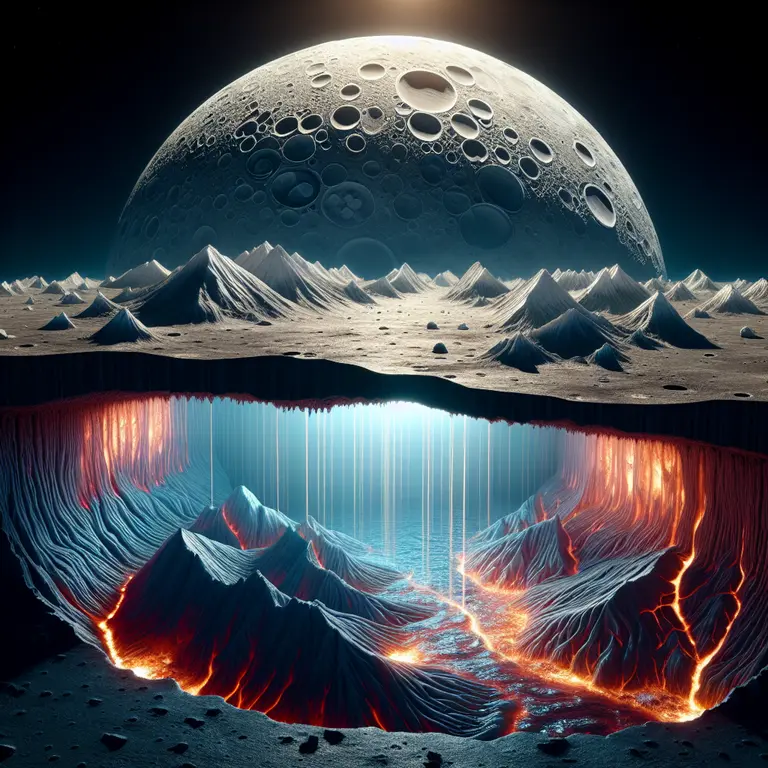
The Moon Is Still Alive: What Moonquakes Reveal About Our Restless Satellite
For most of human history, the Moon was regarded as a static, unchanging body — a frozen relic of the early solar system hanging silently in the sky. That assumption began to unravel in 1969, when NASA engineers placed seismometers on the lunar surface as part of the Apollo missions. What those instruments recorded over the following years fundamentally changed how scientists think about Earth’s nearest neighbor. The Moon, it turned out, was not silent at all. It shook, rumbled, and trembled in ways that bore a striking resemblance to Earth's seismic activity. These moonquakes, as they came to be known, have since become one of the most revealing windows into the Moon’s interior structure, its geological past, and its surprisingly dynamic present. Far from being a dead world, the Moon continues to evolve — and understanding how and why it does so carries profound implications for the future of space exploration.
Four Distinct Types of Moonquakes
The seismometers deployed during the Apollo missions between 1969 and 1972 collected data for nearly a decade, and that data revealed that lunar seismic activity falls into four distinct categories, each with its own origin and character.
Deep moonquakes are the most frequently recorded type and originate more than a kilometer below the lunar surface, in some cases hundreds of kilometers down. They tend to occur in regular patterns and are thought to be triggered by tidal forces — the gravitational pull that Earth exerts on the Moon as the two bodies orbit one another. This tidal flexing stresses the rock deep within the lunar interior, causing it to slip and generate seismic waves. Because the Moon lacks the water and softer sedimentary layers that dampen seismic energy on Earth, these waves can travel enormous distances and persist for surprisingly long periods.
Shallow moonquakes are far less frequent but considerably more powerful. They occur less than a kilometer beneath the surface and can register magnitudes comparable to moderate earthquakes on Earth. Their cause is not yet fully understood, but scientists suspect they are connected to the ongoing cooling and contraction of the lunar crust — a process that will be examined in greater detail shortly. What makes shallow moonquakes particularly striking is how long they last. On Earth, a moderate earthquake might shake the ground for a minute or two before the energy dissipates. On the Moon, a shallow quake can cause the surface to reverberate for up to ten minutes, a consequence of the Moon’s dry, rigid, and highly elastic rock structure.
The remaining two types are more straightforward in their origins. Meteorite strikes generate seismic vibrations whenever space rocks collide with the lunar surface, which happens with considerable regularity given the Moon’s lack of a protective atmosphere. Thermal quakes, meanwhile, result from the dramatic temperature swings the Moon experiences during its roughly 29-day cycle of day and night. Surface temperatures can swing from around 250 degrees Fahrenheit in direct sunlight to nearly negative 290 degrees Fahrenheit in darkness. This extreme thermal cycling causes the outer crust to expand and contract, generating small but detectable tremors near the surface.
The Cooling Moon: A World Slowly Shrinking
Among the most thought-provoking findings to emerge from lunar seismic research is the connection between moonquakes and the Moon’s long-term thermal evolution. Like all planetary bodies, the Moon formed in an extraordinarily hot state, and it has been gradually losing that heat into the cold vacuum of space ever since. The consequences of this cooling process are visible not only in seismic data but on the surface itself.
NASA’s Lunar Reconnaissance Orbiter, which has been mapping the Moon in extraordinary detail since 2009, has identified thousands of narrow tectonic features called thrust faults scattered across the lunar surface. These faults form when one section of the crust is pushed upward over an adjacent section, creating stair-step-like cliffs known as scarps. The existence of these features tells a clear story: as the Moon’s interior cools, it contracts, and the rigid outer crust buckles under the resulting compressive stress. Scientists estimate that this process has reduced the Moon’s overall diameter by roughly 150 feet over several billion years — a modest figure in absolute terms, but geologically significant.
A useful analogy is the transformation of a grape into a raisin. As moisture evaporates from the grape’s interior, the outer skin wrinkles and folds in response to the shrinking volume beneath it. The Moon’s thrust fault scarps are, in essence, the wrinkles of a cooling world. What makes this finding especially remarkable is that the process appears to be ongoing. Some of the thrust faults identified by the Lunar Reconnaissance Orbiter show signs of very recent activity, and several of them correlate spatially with the locations of shallow moonquakes recorded by the Apollo seismometers. This suggests that the Moon is not merely a passive remnant of ancient geological processes but continues to deform and shift in the present day.
The Hidden Interior: Heat, Crystals, and Geological Memory
To understand what is driving the Moon’s continued thermal evolution, scientists have had to look beneath its powdery outer surface and into its deep interior. The Moon’s structure, as currently understood, consists of a thin crust overlying a thick rocky mantle, with a core at its center that is thought to contain both a solid inner region and a partially molten outer layer.
One of the more intriguing hypotheses about the Moon’s early history concerns a lunar magma ocean. Shortly after the Moon formed, likely from debris ejected during a massive collision between a proto-Earth and a Mars-sized body, its entire surface is believed to have been covered by a global ocean of molten rock. As this magma ocean cooled over hundreds of millions of years, minerals began to crystallize and separate according to their densities. Lighter minerals floated upward to form the crust, while denser minerals sank to form the mantle. This crystallization process released heat, and the residual warmth from that ancient event is still slowly working its way out of the Moon’s interior today.
The gradual solidification of any remaining molten material within the deep interior continues to release energy, contributing to the heat flux that drives the Moon’s ongoing contraction. Each small release of that stored thermal energy can trigger a moonquake, linking events hundreds of kilometers underground to the tremors recorded at the surface. In this sense, moonquakes are not merely geological curiosities — they are echoes of the Moon’s birth, still reverberating billions of years later.
Implications for Future Exploration
The practical stakes of understanding lunar seismic activity have grown considerably as space agencies and private companies plan a new era of human presence on the Moon. NASA’s Artemis program aims to return astronauts to the lunar surface within this decade, and proposals for permanent lunar bases have moved from science fiction into engineering discussion. In that context, moonquakes are no longer just a scientific fascination — they are a design challenge.
Structures built on the Moon will need to withstand not only the thermal extremes of the lunar environment but also the possibility of seismic events that can cause the ground to shake for extended periods. The long duration of lunar tremors, combined with the Moon’s lack of natural damping mechanisms, means that buildings, equipment, and infrastructure must be engineered with a different set of assumptions than those used for construction on Earth. Understanding where thrust faults are located, which regions of the surface are most seismically active, and how often significant quakes occur will be essential information for selecting safe landing and habitation sites.
Beyond the practical concerns, the study of moonquakes contributes to a broader scientific project: understanding how rocky worlds evolve over time. The Moon serves as a natural laboratory for planetary science precisely because it preserves a geological record that Earth, with its active plate tectonics and erosive atmosphere, has largely erased. By reading that record through seismic data, scientists gain insight not only into the Moon’s history but into the processes that shaped all the terrestrial planets, including Earth itself.
Conclusion
The discovery of moonquakes transformed the Moon from a symbol of celestial stillness into a world with an active geological identity. From the tidal stresses that trigger deep interior tremors to the slow, relentless cooling that wrinkles the surface with thrust faults, the Moon continues to change in ways that are both scientifically fascinating and practically important. As humanity prepares to return to the lunar surface and eventually establish a sustained presence there, the lessons encoded in those seismic signals will prove indispensable. The Moon has been speaking for billions of years. We are only just learning to listen.