
Point Nemo: Earth's Spacecraft Graveyard in the Pacific
Far beyond the crowded low-Earth orbital lanes lies Point Nemo, the oceanic pole of inaccessibility — a remote Pacific location that has quietly served as the world's designated spacecraft cemetery for decades, with hundreds of decommissioned satellites and space stations deliberately plunged into its depths.
The Most Remote Place on Earth Has a Second Life
In the vast southern Pacific Ocean, roughly equidistant from the coasts of South America, New Zealand, and Antarctica, lies a coordinate that holds a peculiar distinction. Point Nemo — named after Jules Verne’s fictional submarine captain — sits at approximately 48°52.6’S, 123°23.6’W, and is the furthest point on Earth’s surface from any landmass. The nearest humans to this location are often not on any continent at all, but aboard the International Space Station passing overhead at roughly 400 kilometers altitude. That geographic isolation, however, has made it something far stranger than a literary reference: it is the world’s official spacecraft cemetery, accumulating the wreckage of the space age for more than thirty years.
Since 1971, space agencies, including NASA, the European Space Agency, Roscosmos, and JAXA, have deliberately targeted this patch of ocean for controlled reentries of decommissioned spacecraft. The logic is ruthlessly practical. Satellites and space stations that survive atmospheric reentry — and many large components do — must land somewhere. Choosing the least inhabited ocean region on the planet minimizes risk to human populations, shipping lanes, and coastal ecosystems. The nearest inhabited land, Ducie Island in the Pitcairn group, lies over 2,700 kilometers away. What began as an informal operational preference has gradually solidified into something approaching institutional policy, even if no single international treaty has ever formally designated the region for this purpose.
The name itself carries a certain literary irony. Captain Nemo, Verne’s brooding anti-hero, commanded his submarine Nautilus through the unexplored depths of the world’s oceans, cataloging wonders invisible to the surface world. The coordinate named in his honor now conceals its own catalog of wonders — though these are the detritus of ambition rather than its instruments. It is a place defined entirely by absence: absence of land, absence of life in any meaningful ecological density, absence of human witness. And into that absence, decade after decade, we have been dropping our machines.
What Lies on the Ocean Floor
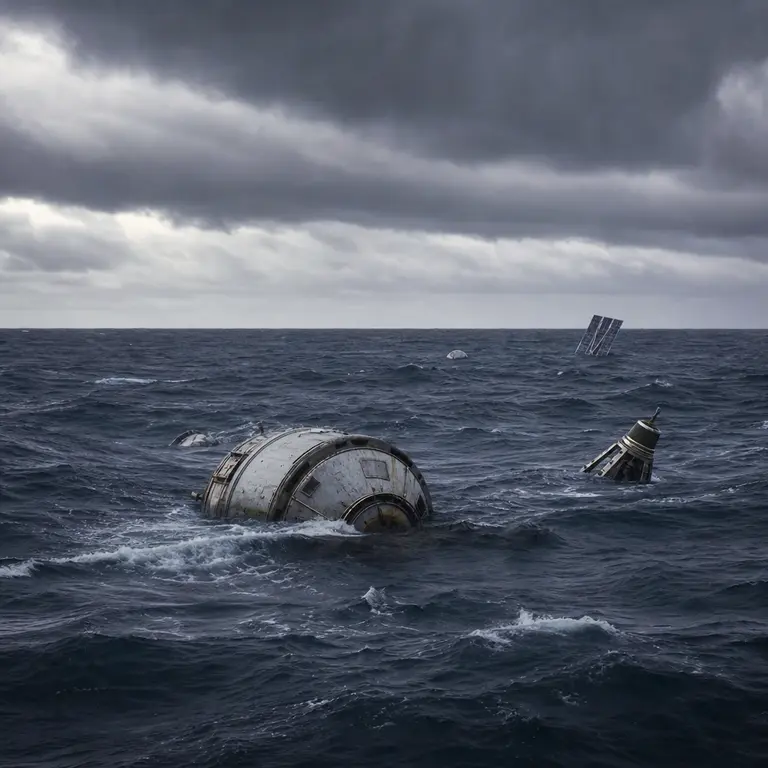
By conservative estimates, more than 300 spacecraft now rest on the seafloor beneath Point Nemo, at depths reaching approximately 4,000 meters. The inventory is extraordinary by any measure. Russia’s Mir space station, once the largest human-made object in orbit and home to cosmonauts for fifteen continuous years, was deorbited here in March 2001. Its controlled reentry scattered debris across a 1,500-kilometer corridor before the bulk of the 120-tonne structure plunged into the sea. Six Russian Salyut space stations preceded it in the same waters. Dozens of Progress resupply vehicles, ATV cargo ships from Europe, and HTV freighters from Japan have followed the same trajectory downward.
The debris field is not concentrated in a single point but dispersed across a broad region formally designated in orbital mechanics planning as the South Pacific Ocean Uninhabited Area. Spacecraft approaching reentry are tracked by ground stations around the world, and mission controllers calculate deorbit burn maneuvers to steer them toward this corridor with considerable precision. The margin for error is not generous: a miscalculation of even a few hundred kilometers could redirect tons of metal toward populated coastlines or active shipping routes. When the Chinese space station Tiangong-1 failed in 2018 and underwent an uncontrolled reentry, the global attention that focused on the uncertainty of its landing zone served as a sharp reminder of exactly what controlled reentries to Point Nemo are designed to prevent. The anxiety generated by that single uncontrolled event illustrated how much the world has come to quietly depend on this arrangement.
What is perhaps most striking about the debris field is how little is known about its precise contents and condition. No submersible has ever been sent to document what lies on the seafloor below Point Nemo. The depths involved place the wreckage well beyond casual investigation, and the remoteness of the location makes any scientific expedition enormously expensive and logistically complex. We know what was sent there from orbital tracking records, but we do not know what survived reentry in recognizable form, how the materials have degraded over decades of immersion, or what chemical signatures the accumulated hardware has introduced into the sediment. In a real sense, Point Nemo is an archive that no one has read.
The Biology of the Abyss Beneath
What makes the Point Nemo region particularly suitable as a disposal zone extends well beyond its geographic remoteness. Oceanographers have long recognized it as one of the most biologically impoverished regions of the world’s oceans, a fact that carries significant weight in any environmental assessment of the site. It lies within the South Pacific Gyre, a vast rotating system of ocean currents that acts as a near-impenetrable barrier to nutrient flow from surrounding waters. The surface waters here are sometimes described as an oceanic desert: warm, exceptionally clear, and almost entirely devoid of the phytoplankton blooms that underpin productive marine ecosystems. Nutrient concentrations, particularly those of nitrates and phosphates, which are essential to primary productivity, are among the lowest recorded anywhere in the global ocean.
This biological barrenness has a cascading effect through the food web. Where phytoplankton cannot thrive, zooplankton have little to consume. Where zooplankton are scarce, the fish and marine mammals that depend on them are largely absent. The South Pacific Gyre is, in ecological terms, closer to a liquid desert than to the teeming ocean most people imagine when they think of the Pacific. Satellite chlorophyll measurements confirm that the waters around Point Nemo are among the clearest and least productive on the planet, with some readings approaching the theoretical minimum for biological activity in open ocean.
This biological barrenness matters enormously for the spacecraft cemetery designation. Regulatory frameworks governing ocean disposal, including the London Protocol of 1972 and its subsequent amendments, technically prohibit the deliberate introduction of waste into the marine environment. Spacecraft reentries occupy a legally ambiguous category, however — they are not classified as dumping in the conventional sense under existing treaty language, and no dedicated international agreement specifically governs the deliberate targeting of ocean zones for reentry debris. The region's low ecological sensitivity has historically reinforced the informal consensus among space agencies that Point Nemo is the least harmful available target, a judgment that has never been seriously challenged in international forums.
Nevertheless, as the number of spacecraft grows and materials accumulate, marine scientists have begun raising questions that the operational community has been slow to address. Residues of hydrazine, a highly toxic propellant used in attitude control thrusters, may persist in sediment for extended periods. Exotic alloys developed for thermal resistance in aerospace applications contain elements — beryllium, hafnium, and rhenium — whose long-term behavior in deep-ocean chemistry is not well characterized. Microplastic contamination from ablated thermal protection materials during reentry is another concern that has received almost no dedicated research. The scientific literature on Point Nemo’s seafloor environment is, to put it plainly, nearly nonexistent.
The Future of the Graveyard
The coming decade will test Point Nemo’s capacity and the assumptions underlying its use as never before. The International Space Station, which weighs approximately 420 tonnes and spans 109 meters across its solar array truss, is scheduled for decommissioning no earlier than 2030. NASA has contracted with SpaceX to conduct the controlled reentry using a purpose-built deorbit vehicle, a mission of considerable technical complexity. Engineers estimate that between 80 and 90 tonnes of the station’s structure will survive the thermal violence of reentry and reach the ocean surface at high velocity. The debris corridor planned for this single event will be among the largest ever calculated for any spacecraft reentry, and the targeting precision required will demand extraordinary coordination among American, European, Japanese, and Canadian partner agencies over years.
The ISS reentry will be a defining moment for the Point Nemo tradition, both technically and symbolically. The station represents the largest and most complex structure humanity has ever assembled in orbit, and its deliberate destruction will mark the end of an era in human spaceflight. That it will end at the bottom of the most remote ocean on Earth, joining the accumulated hardware of thirty years of space operations, carries a weight that transcends engineering logistics. There is something genuinely strange about the fact that the machines which connected humanity to the cosmos will ultimately rest in the one place on Earth most completely disconnected from human presence.
Beyond the ISS, the proliferation of large commercial satellite constellations is generating a new class of disposal challenge that existing frameworks were not designed to address. Most small satellites in low-Earth orbit are engineered to deorbit passively through atmospheric drag within five years of end of life, burning up completely during reentry and leaving no surface debris. But as commercial platforms grow larger and more capable, and as the industry moves toward multi-tonne spacecraft carrying substantial propellant loads and sophisticated structural components, the pressure on Point Nemo as a controlled reentry destination will intensify considerably. The economics of commercial spaceflight also introduce new actors with varying levels of institutional commitment to responsible disposal practices.
Some aerospace engineers have proposed on-orbit servicing and refueling as a long-term alternative to disposal, extending the operational lives of spacecraft and reducing the volume of material that requires deorbiting. Others advocate for dedicated deorbit vehicles that could shepherd defunct satellites to precise reentry trajectories regardless of their original design. Proposals for active debris removal, using robotic spacecraft to capture and redirect derelict hardware, have attracted growing interest from space agencies and private investors alike. These approaches remain largely developmental, however, and the timescales involved in bringing them to operational maturity suggest that Point Nemo will continue receiving spacecraft for the foreseeable future.
The most remote place on Earth has become, through a combination of practical necessity and institutional inertia, one of the defining artifacts of the space age. It is a place that no human being has ever visited or is likely to visit, that no camera has documented, and that no treaty formally governs. Beneath four kilometers of cold water, in a region so biologically sparse that it barely registers as living ocean, the hardware of human ambition accumulates in silence. The machines that once watched the Earth from above now lie beneath it, in the one place where their presence disturbs almost nothing — or so we have chosen to assume.
Sources & Further Reading
- Aerospace Corporation. Reentry and Risk: Spacecraft Disposal and the South Pacific Ocean Uninhabited Area. The Aerospace Corporation, 2022. https://aerospace.org
- NASA. International Space Station Transition Report. NASA, 2022. https://www.nasa.gov/international-space-station/
- van der Helm, Ewoud, et al. The South Pacific Gyre as an Oceanic Desert: Nutrient Dynamics and Biological Productivity. Deep-Sea Research, 2018.
- UNEP/IMO. London Protocol on the Prevention of Marine Pollution by Dumping of Wastes and Other Matter. International Maritime Organization, 1996. https://www.imo.org