
Space Debris Crisis: Managing Earth's Crowded Orbits
Thousands of defunct satellites, rocket stages, and debris fragments form a growing orbital graveyard that now threatens active space infrastructure and may trigger a catastrophic cascade known as Kessler Syndrome.
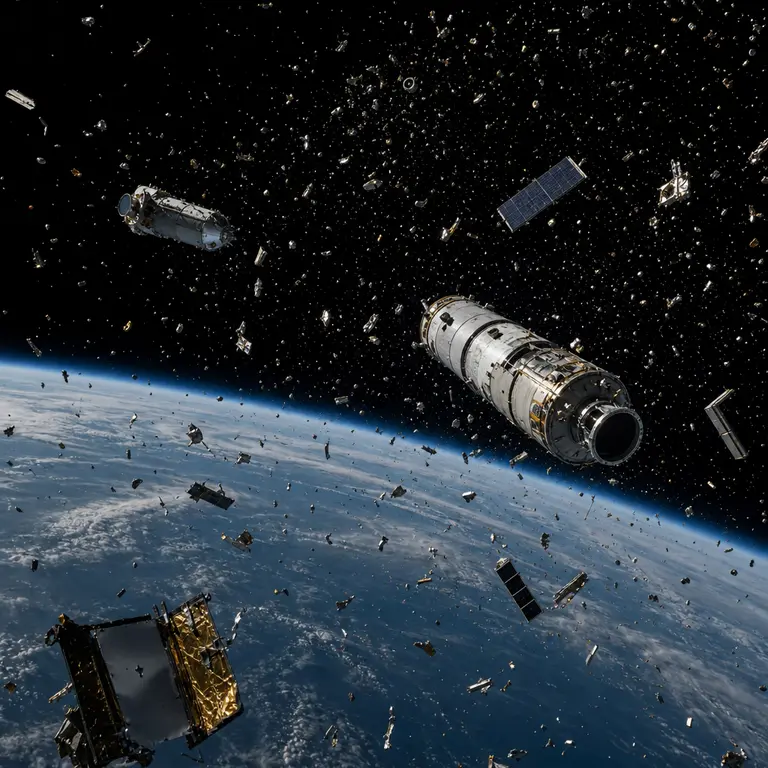
At any given moment, roughly 27,000 tracked objects larger than 10 centimeters are hurtling around Earth at speeds exceeding 28,000 kilometers per hour. They include dead satellites, discarded rocket upper stages, fragments from antisatellite missile tests, and even a spatula lost during a 2006 spacewalk. The United States Space Surveillance Network tracks these objects continuously, but an estimated 500,000 additional fragments between 1 and 10 centimeters remain untracked — each one capable of punching through a spacecraft wall like a high-velocity bullet. The total mass of human-made material in orbit now exceeds 9,000 metric tons, a figure that has climbed sharply since the first commercial mega-constellations began launching in 2019.
What makes this situation particularly alarming is not any single piece of debris, but the compounding mathematics of proximity. As more objects populate low Earth orbit, the probability of collisions rises nonlinearly, and each collision generates thousands of new fragments, which in turn raise the probability of further collisions. The orbital environment humanity has built over seven decades of spaceflight is, in a very real sense, approaching a threshold beyond which it may become self-destructive. Understanding how we arrived here, what the physics of the problem actually demands, and what tools exist to address it requires moving beyond the simple image of floating junk and into a more uncomfortable reckoning with the limits of human foresight in the face of exponential growth.
Kessler Syndrome: A Self-Perpetuating Catastrophe
In 1978, NASA scientist Donald J. Kessler published a paper with Burton Cour-Palais in the Journal of Geophysical Research proposing a scenario that has since come to be known as the Kessler effect. Kessler Syndrome describes a cascade effect in which the density of objects in low Earth orbit reaches a tipping point where collisions become self-sustaining. Each impact produces debris clouds that trigger further impacts, eventually rendering entire orbital shells unusable for centuries. Kessler did not predict this to be inevitable, but rather a threshold that could be crossed if debris generation outpaced natural atmospheric drag, which gradually pulls objects below roughly 600 kilometers altitude back into the atmosphere.
The 2009 collision between the active Iridium 33 communications satellite and the defunct Russian Kosmos 2251 military satellite produced approximately 1,800 trackable fragments and remains the only accidental hypervelocity collision between two intact satellites on record. In 2007, China’s deliberate destruction of its own Fengyun-1C weather satellite during an antisatellite test generated more than 3,000 trackable pieces and is still considered the single most debris-generating event in spaceflight history. Together, these two events added roughly 40 percent more tracked fragments to low Earth orbit over three years.
What Kessler himself has noted in more recent interviews is that his original paper was not intended as a doomsday prediction but as a mathematical boundary condition — a description of what the physics would inevitably produce if certain density thresholds were crossed. The unsettling development of the past decade is that serious researchers no longer debate whether those thresholds exist, but whether we have already crossed them in certain orbital bands. Some models produced by NASA’s Orbital Debris Program Office suggest that even if humanity were to stop launching satellites entirely today, the existing debris population in certain altitude ranges would still generate enough collisions over the coming centuries to sustain a slow-motion cascade. The question is no longer purely hypothetical. It has become operational.
The Peculiar Physics of Orbital Decay
Not all orbits are equally dangerous or equally self-cleaning. Objects at altitudes below 600 kilometers experience sufficient residual atmospheric drag to naturally deorbit within years to decades. At 800 kilometers, an uncontrolled object may persist for a century. At 1,000 kilometers, the timescale stretches to thousands of years. This creates a counterintuitive geography of risk: the most crowded and most hazardous debris environments are not necessarily the lowest orbits, but intermediate ones where objects linger long enough to accumulate.
The Sun plays a surprising role in this dynamic. During periods of high solar activity, Earth's outer atmosphere expands slightly, increasing drag on objects in low orbit and accelerating their reentry. Solar cycle 25, which began in late 2019 and reached an unexpectedly strong peak in 2024, has measurably increased the decay rate of debris in the 400 to 600 kilometer range — a modest but real natural cleaning mechanism. Scientists at the European Space Agency have been incorporating solar flux forecasts into debris lifetime models with increasing precision.
There is an additional layer of physical complexity that rarely enters public discussion: the role of electrostatic charging and solar radiation pressure on very small fragments. Objects smaller than a centimeter in diameter can be nudged into slightly different orbital planes by the cumulative pressure of sunlight and by charge interactions with Earth’s magnetic field over long timescales. This means that the debris population is not static even between collisions. It drifts, spreads, and redistributes itself in ways that are difficult to model with precision, creating pockets of unexpectedly elevated risk in orbital regions that might appear relatively clear on a simple density map. The practical implication is that satellite operators cannot rely on historical traffic data alone when planning orbital insertion. The environment is dynamic in ways that ground-based intuitions about traffic management do not easily capture.
Understanding the physics also clarifies why debris removal is so much harder than it might initially appear. A piece of debris in orbit is not simply sitting still waiting to be collected. It is moving at roughly 8 kilometers per second along a precise trajectory governed by gravitational mechanics. To rendezvous with it, a removal spacecraft must match that trajectory exactly, which requires expending significant fuel. The cost of reaching and capturing even a single large object is therefore not trivial, and the energy budget of any removal mission scales in ways that make bulk cleanup operations economically daunting under current propulsion technology.
Active Debris Removal: Science Fiction Becoming Policy
For decades, debris removal was discussed as a theoretical necessity with no practical pathway. That has changed rapidly. In 2021, Japanese startup Astroscale launched ELSA-d, the first dedicated debris removal demonstration mission, which used magnetic capture technology to simulate docking with a defunct satellite. The European Space Agency’s ClearSpace-1 mission, contracted to a Swiss startup and scheduled for launch in 2026, aims to physically capture and deorbit a 112-kilogram Vega rocket adapter left in orbit in 2013 — the first active debris removal mission targeting a real piece of space junk.
The engineering challenges are formidable. Defunct objects are tumbling unpredictably, often at several rotations per minute, and were never designed to be grabbed. Proposed capture mechanisms include robotic arms, harpoons, nets, electrostatic tethers, and even high-powered lasers that ablate surface material to create a gentle thrust. Each approach carries its own set of complications. Nets and harpoons risk creating additional fragments if the target object is structurally fragile. Robotic arms require a level of precision docking that has only been demonstrated under controlled conditions. Laser ablation, while elegant in theory, demands power levels and pointing accuracy that push current spacecraft capabilities to their limits.
A 2023 report from the Inter-Agency Space Debris Coordination Committee, which includes all major space agencies, concluded that removing just five massive derelict objects per year from critical orbital bands would be sufficient to stabilize the debris environment over the next 200 years — a surprisingly achievable target that nonetheless remains unfunded at the required scale. The gap between what is technically necessary and what is financially and politically committed is, at present, enormous. Several national space agencies have issued calls for proposals and conducted feasibility studies, but no government has yet committed to a sustained, multi-year active removal program with a defined budget and schedule. The technology is advancing faster than the institutional will to deploy it.
The Legal Vacuum at the Edge of Space
Perhaps the most underappreciated dimension of the orbital debris crisis is its legal one. Under the 1967 Outer Space Treaty, nations retain jurisdiction and ownership over objects they launch indefinitely. This means a defunct Soviet satellite from 1974 remains, under international law, Russian property and cannot be removed, altered, or destroyed by another party without consent. No binding international framework currently compels satellite operators to deorbit their hardware within any specific timeframe, though the United States Federal Communications Commission adopted a landmark rule in 2022 requiring American operators to deorbit low Earth orbit satellites within five years of mission end, down from the previous 25-year guideline.
The commercial boom in satellite constellations has made this governance gap urgent. SpaceX’s Starlink constellation alone has launched more than 6,000 satellites since 2019, with regulatory approval for tens of thousands more. Amazon’s Project Kuiper, OneWeb, and several Chinese state-backed networks are adding thousands more. Even with aggressive deorbit compliance, the sheer number of operational satellites now constitutes a new and permanent background population against which debris events occur. The orbital environment of 2025 is categorically different from that of 2015, and the regulatory frameworks governing it were written for a world where launching a single satellite was a national achievement rather than a routine commercial transaction.
The deeper legal problem is one of incentive structure. A satellite operator who fails to deorbit a spacecraft imposes costs on every other user of that orbital band, but bears very little of that cost directly. This is a textbook commons problem, and the history of commons problems in other domains — fisheries, atmospheric carbon, groundwater — does not inspire optimism about voluntary compliance alone. Several legal scholars have proposed mechanisms borrowed from environmental law, including bonding requirements that operators must post before launch and forfeit if they fail to deorbit on schedule, or liability frameworks that assign financial responsibility for collision damage caused by derelict objects. None of these proposals has yet been adopted in binding form by any major spacefaring nation.
Conclusion
The orbital debris crisis is not a distant or hypothetical problem. It is a present condition that is worsening with each launch, each aging satellite, and each year that binding international governance remains absent. The physics of the situation is unforgiving: orbital mechanics do not negotiate, and the cascade dynamics that Kessler described nearly fifty years ago are not suspended while committees deliberate. The tools to address the problem exist or are within reach. Active removal technology is advancing. Solar dynamics provide modest natural assistance. Engineering solutions ranging from drag sails to electrodynamic tethers are being tested in orbit. The five-objects-per-year stabilization target identified by the international coordination committee is not an impossible standard. What is missing is not capability but commitment — the kind of coordinated, funded, legally binding commitment that humanity has occasionally managed to produce when the stakes have been made sufficiently clear.
The orbital shells surrounding Earth are a shared resource of extraordinary value. Weather forecasting, global navigation, communications, climate monitoring, and financial transaction timing all depend on infrastructure that operates in the environment now being degraded. The cost of losing reliable access to low Earth orbit would not be measured in satellite replacement budgets but in the disruption of systems so deeply embedded in daily life that most people are unaware of their dependence on them. That invisibility is itself part of the problem. The highway overhead is cluttered, the speed limits are unenforced, and the cleanup crews are still waiting for authorization to begin.
Sources & Further Reading
- Kessler, D.J. and Cour-Palais, B.G. Collision Frequency of Artificial Satellites: The Creation of a Debris Belt. Journal of Geophysical Research, 1978.
- European Space Agency. ESA's Annual Space Environment Report. ESA Space Debris Office, 2024. https://www.esa.int/Space_Safety/Space_Debris
- Inter-Agency Space Debris Coordination Committee. IADC Space Debris Mitigation Guidelines. IADC, 2023. https://www.iadc-home.org
- United States Federal Communications Commission. Mitigation of Orbital Debris in the New Space Age. FCC, 2022. https://www.fcc.gov/document/fcc-updates-orbital-debris-mitigation-rules