
The Smell of Space: Astronauts Report a Cosmic Stench
Returning astronauts consistently describe space as having a distinct smell — seared metal, gunpowder, and sweet decay. Scientists are now closing in on the molecular chemistry behind this cosmic odor.
 Watch on YouTube
 Watch on Rumble
Introduction
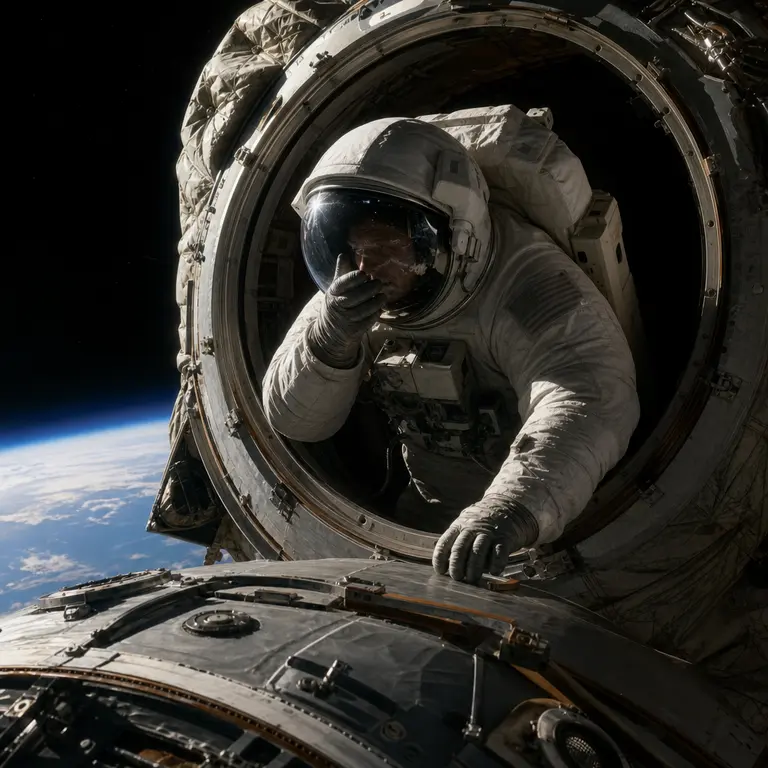
When astronauts return from spacewalks and cycle through the airlock, they report something that no training manual prepared them for: space smells. Not the vacuum itself, of course — there are no molecules in open space to stimulate olfactory receptors — but the equipment, suits, and tools brought back inside carry a persistent, unmistakable odor. Astronauts from NASA, ESA, and Roscosmos have independently described it using remarkably similar language: burnt gunpowder, hot metal, seared steak, and a faint sweetness underneath. Don Pettit, a NASA astronaut who has logged over 370 days in orbit, wrote in detail about the smell clinging to his gloves after EVA work, describing it as a mix of welding fumes and a faint whiff of raspberries.
The consistency of these reports across nationalities and missions spanning several decades has transformed what might have been dismissed as anecdotal curiosity into a legitimate subject of astrochemical inquiry. The question is no longer whether space has a smell, but what molecular compounds are responsible for delivering it. That shift — from dismissal to investigation — reflects a broader trend in modern science, where the subjective testimonies of trained observers are increasingly treated as data rather than noise. The smell of space is now a research problem, one that sits at the intersection of organic chemistry, astrophysics, materials science, and sensory biology.
Understanding why space smells the way it does requires thinking about chemistry at cosmological scales. It means examining what the universe is actually made of at the molecular level, how those molecules interact with spacecraft surfaces, and why the human nose happens to be sensitive to compounds that form in the hearts of dying stars. The answer, it turns out, is both stranger and more illuminating than the question first suggests.
Polycyclic Aromatic Hydrocarbons and Dying Stars
The leading scientific explanation centers on polycyclic aromatic hydrocarbons, or PAHs — a class of organic molecules that form when carbon-rich material is exposed to intense radiation and incomplete combustion. PAHs are extraordinarily abundant in the interstellar medium, estimated to account for roughly 10-20% of all carbon in the galaxy. They are produced in the outer layers of dying stars, in stellar nebulae, and in the dense molecular clouds that eventually collapse to form new solar systems. In other words, these are among the most common large organic molecules in the known universe, and they have been drifting through space since long before Earth existed.
When high-energy ultraviolet radiation from stars bombards these compounds, it can fragment them into reactive ions and radicals. Some of these fragments, when they deposit onto spacecraft surfaces during extravehicular activity, may undergo secondary reactions upon re-entry into the oxygen-rich atmosphere of the ISS. The resulting volatile compounds could be what astronauts are actually detecting. Notably, one specific PAH derivative — naphthalene — carries a sharp, almost medicinal odor, while anthracene and phenanthrene derivatives can produce smells reminiscent of coal tar and combustion. The metallic, gunpowder-like character of the reported smell aligns well with what organic chemists would predict from the partial oxidation and fragmentation of these aromatic ring structures.
The raspberry-and-rum component of the smell has a more precise molecular candidate: ethyl formate, an ester abundant in the Sagittarius B2 molecular cloud near the galactic center. This compound, which genuinely smells of raspberries and rum, was confirmed in the cloud via radio telescope spectroscopy in 2009 by researchers at the Max Planck Institute for Radio Astronomy. The Sagittarius B2 cloud is one of the largest and most chemically complex molecular clouds in the Milky Way, containing dozens of identified organic compounds, including alcohols, aldehydes, and amino acid precursors. Whether trace quantities of ethyl formate reach spacecraft surfaces in detectable amounts remains an open question, but its confirmed presence in the interstellar medium makes it a plausible contributor to the olfactory profile astronauts describe.
What makes this line of inquiry genuinely remarkable is the implication it carries about cosmic chemistry. The building blocks of smell — volatile organic compounds capable of binding to olfactory receptors — are not biological inventions. They are stellar byproducts, formed in the same nuclear and photochemical processes that built the elements inside us. The fact that space smells like something recognizable is not so much a coincidence as a consequence of shared chemistry.
Atomic Oxygen and the Chemistry of Erosion
A second mechanism involves atomic oxygen, which exists in low Earth orbit at altitudes between roughly 200 and 700 kilometers in a highly reactive, unbound state. Unlike the stable O2 molecules we breathe, atomic oxygen is a single, unpaired atom with considerable chemical aggression. It attacks polymer surfaces, oxidizes metals, and degrades exposed materials at a measurable rate — a well-documented problem for spacecraft thermal blankets and solar panels. Engineers designing long-duration missions must account for atomic oxygen erosion when selecting materials, because exposure over months or years can significantly degrade structural and thermal properties.
When atomic oxygen reacts with carbon-based materials in spacesuits and equipment, it can produce a variety of volatile organic compounds through oxidation. Some of these — including aldehydes, ketones, and short-chain carboxylic acids — carry the sharp, metallic, or slightly sweet odors that astronauts describe. In this interpretation, the smell does not come from interstellar space per se, but from the chemical aftermath of the unique oxidative environment of low Earth orbit acting on human-made materials. The suits themselves become reactive surfaces, accumulating and transforming the chemical signatures of their environment with every hour spent outside the station.
This mechanism was partly confirmed by materials science experiments aboard the ISS, including the MISSE (Materials International Space Station Experiment) series, which has documented the surface chemistry changes induced by atomic oxygen exposure since 2001. Samples of polymers, composites, and coatings placed on the exterior of the station and later retrieved show measurable changes in surface chemistry, mass loss, and optical properties. The volatile byproducts of these reactions have not yet been fully cataloged for their olfactory impact, but the chemistry is consistent with the reported sensory experience. A more complete analysis of the gaseous compounds released when EVA equipment is brought back inside the station would likely resolve several outstanding questions about which mechanism — interstellar deposition or orbital oxidation — contributes more substantially to the smell.
The two explanations are not mutually exclusive. It is entirely plausible that astronauts are detecting a composite odor produced by both processes simultaneously: interstellar organic molecules deposited during EVA activity and then partially transformed by atomic oxygen reactions on the suit surface before being carried back inside. The nose, in this scenario, is registering the combined output of stellar nucleosynthesis and low-orbit atmospheric chemistry in a single inhalation.
Perfumers, NASA, and the Commercial Frontier
The cultural and commercial dimensions of this phenomenon are surprisingly developed. In 2008, NASA contracted with Steven Pearce, a chemist and perfumer at Omega Ingredients in the United Kingdom, to recreate the smell of space for use in astronaut training simulations. Pearce drew on astronaut testimonies and his knowledge of volatile-compound chemistry to produce a blend intended to psychologically prepare crew members for the olfactory reality of EVA work. The project was never commercialized as a consumer product, but it demonstrated that the smell is specific enough to be reproducible and consistent across independent testimonies to warrant simulation. That a space agency found it worthwhile to hire a perfumer reflects how seriously the reported experience is now taken.
The science of olfaction itself adds another layer of complexity to this story. Human smell receptors number around 400 functional types, and the brain integrates their signals into unified perceptual experiences that are notoriously difficult to describe in language. The fact that astronauts from different cultural backgrounds, speaking different languages, reach for the same metaphors — gunpowder, metal, char, sweetness — suggests they are detecting real and consistent chemical signals rather than constructing impressions from expectation. Cross-cultural convergence in sensory description is one of the stronger informal indicators that an experience has a shared physical cause.
More recently, the intersection of astrochemistry and sensory science has attracted broader institutional interest. The James Webb Space Telescope, operational since 2022, is capable of detecting the spectral signatures of complex organic molecules in exoplanet atmospheres and protoplanetary discs with unprecedented sensitivity. Some researchers have noted that JWST could, in principle, detect the molecular precursors of smell across interstellar distances — not to suggest that alien life smells like raspberries, but to recognize that the universe is chemically richer in olfactory-relevant compounds than previously appreciated. Instruments designed to map the chemistry of distant nebulae are, incidentally, cataloging the molecular vocabulary of smell at cosmic scales.
There is also a growing field of astrobiology that takes seriously the idea that complex organic chemistry in the interstellar medium may represent a prebiotic reservoir — a library of molecular structures from which life can draw. The same compounds that give space its characteristic smell are, in many cases, structurally related to amino acids, lipids, and nucleotide precursors. The line between astrochemistry and biochemistry is thinner than it once appeared.
Conclusion
The smell of space is, in this sense, not a curiosity but a data point. It tells us that the interstellar medium is not sterile or inert, but populated with complex organic chemistry that touches everything passing through it — including, briefly, the gloves of the humans we send out to explore it. What began as an offhand observation by astronauts trying to describe something unexpected has opened into a genuine scientific question with implications for our understanding of cosmic chemistry, planetary formation, and the distribution of organic molecules across the galaxy.
There is something philosophically striking about the fact that the universe announces itself to human senses not through sight or sound but through smell — the oldest and most chemically direct of our perceptual faculties. The olfactory system evolved to detect volatile molecules at trace concentrations, a survival tool for navigating a world of predators, food, and mates. That this same system turns out to be sensitive to the molecular signatures of stellar death and interstellar clouds is not something evolution planned for. It is simply a consequence of the fact that the universe makes the same kinds of molecules everywhere, and that some of those molecules are small enough, volatile enough, and reactive enough to reach a human nose.
The next time an astronaut peels off a glove after a spacewalk and pauses at the smell, they are not experiencing a malfunction or an artifact. They are, in a very literal sense, smelling the galaxy.
Sources & Further Reading
- Pearce, Steven. Recreating the Smell of Space. Omega Ingredients / NASA Contract, 2008.
- Pettit, Don. Saturday Morning Science in Space. NASA ISS Science Blog, 2012. https://www.nasa.gov/mission_pages/station/research/news/satmorning.html
- Belloche, A., Menten, K.M., et al. Detection of Amino Acetonitrile in Sgr B2(N). Astronomy and Astrophysics, 2008. https://doi.org/10.1051/0004-6361:200810203
- de Graauw, T., et al. MISSE Materials Experiment Results. NASA Technical Reports, 2005. https://ntrs.nasa.gov/