
Fungal Adaptation: Resilient Colonizers on the ISS
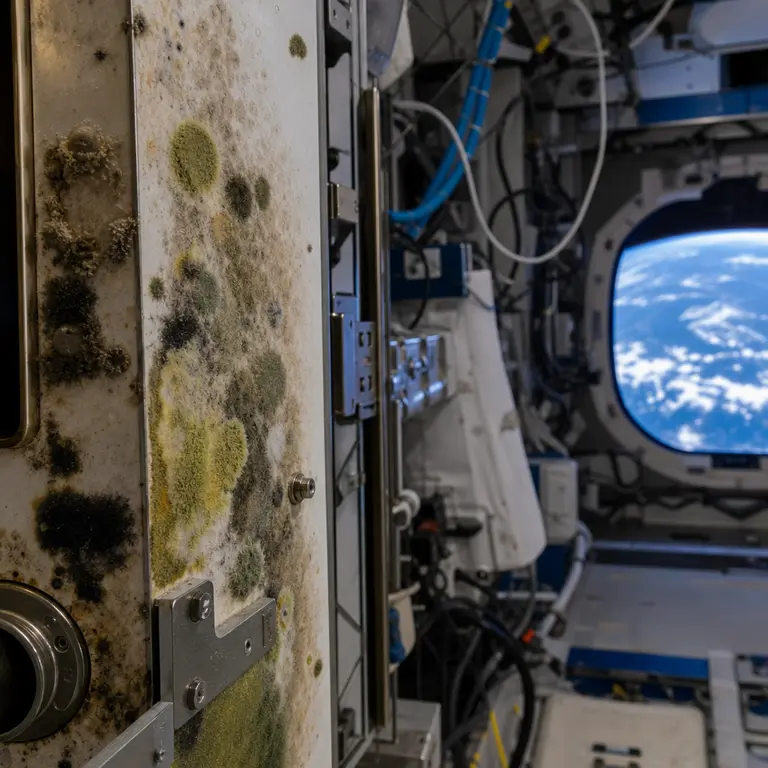
Resilient mold species aboard the International Space Station are not just surviving microgravity and radiation — they may be actively degrading hardware and evolving new traits that concern scientists preparing for deep-space missions.
 Watch on YouTube
 Watch on Rumble
Introduction
The International Space Station is one of the most hostile environments humans have ever occupied. Microgravity warps fluid dynamics in ways that have no analog on Earth, cosmic radiation bombards every exposed surface around the clock, and the atmosphere is a sealed loop recycled thousands of times over the course of a mission. Crew members operate in a world where even the behavior of liquids and gases defies intuition, where the immune system gradually weakens under the combined stress of confinement and radiation, and where a mechanical failure in the wrong system could end lives within minutes. Yet despite all this and rigorous sterilization protocols applied before every launch, the station has never been truly sterile. Dozens of fungal species have taken up permanent residence aboard humanity’s most advanced outpost, and recent microbiome surveys suggest they are not merely passive passengers along for the ride. They are adapting to their environment in ways that scientists are only beginning to understand.
A 2023 study published in the journal Microbiome cataloged over 55 bacterial and fungal species collected from ISS surfaces across multiple sampling campaigns conducted over several years. Among the most persistent were Aspergillus and Penicillium species, organisms common on Earth but exhibiting measurable changes in behavior in orbit. Researchers from NASA’s Jet Propulsion Laboratory found that some strains showed increased resistance to multiple antibiotics and antifungals compared to their Earth-based counterparts. That finding carries direct implications for crew health on missions lasting years rather than months, and it raises a question that the space medicine community is increasingly taking seriously: what happens when the microbes we carry with us stop responding to the tools we have to control them?
What the Mold Is Actually Doing to the Station
Fungal contamination aboard spacecraft is not a new discovery, nor is it a problem unique to the ISS era. Soviet cosmonauts aboard the Mir space station documented mold colonies growing behind instrument panels as early as the 1980s, decades before the current generation of researchers began cataloging ISS microbiomes with genomic precision. Post-decommission inspections of Mir found that fungi had etched into rubber seals, optical glass, and even metallic surfaces through a process called biodeterioration, a slow but relentless chemical assault driven by the metabolic activity of living organisms. The station’s designers had not anticipated that life would find a way to digest the hardware around it. On the ISS, similar damage has been documented, though the full extent of structural degradation attributable to biological activity remains difficult to quantify in a station that is still in active use.
The mechanism behind this damage is not mysterious, but it is easy to underestimate. Certain fungal species produce organic acids as metabolic byproducts, compounds that in open environments would disperse harmlessly into the surrounding air or soil. In the enclosed, humidity-regulated environment of the ISS, these acids accumulate on surfaces and slowly degrade polymers, insulation materials, and adhesives. Over months and years, the cumulative effect can compromise the integrity of materials that engineers assumed would remain stable for the station’s operational lifetime. The problem is compounded by microgravity, which alters convection patterns and allows moisture to accumulate in corners and crevices where it would naturally drain under normal gravity conditions. These microenvironments become ideal incubators for fungal growth, sheltered from cleaning efforts and rich in the humidity that many species require.
One species in particular has drawn significant scientific attention. A 2018 report in the journal npj Microgravity noted that Cladosporium sphaerospermum, one of the most abundant fungal species found on the station, is radiotropic, meaning it actively grows toward ionizing radiation rather than away from it. The organism appears to use melanin in its cell walls to convert gamma radiation into chemical energy, a process that researchers have described as analogous to photosynthesis. Where plants harvest visible light, this fungus harvests radiation that would be lethal or deeply damaging to most other living things. This trait makes it exceptionally well-suited for survival in space and nearly impossible to eliminate through conventional decontamination methods. You cannot simply turn off the radiation to starve it out. On the ISS, the radiation is a permanent feature of the environment, and for Cladosporium sphaerospermum, it appears to be a resource.
Evolution Under Pressure
Perhaps the most unsettling aspect of ISS fungal biology is the rate at which these organisms appear to be changing. The station’s environment imposes extreme selective pressure across multiple dimensions simultaneously: low nutrient availability, elevated and chronic radiation exposure, microgravity-induced changes in convection and fluid behavior, and regular chemical cleaning with antifungal agents. Organisms that cannot adapt to these conditions are outcompeted by those that can. What this means in practice is that the ISS is not simply hosting fungi. It is inadvertently running a continuous, accelerated evolutionary experiment on them.
A 2021 study by researchers at the University of Southern California examined Aspergillus niger samples cultured aboard the ISS and compared their genomes with those of Earth-based control strains grown under standard laboratory conditions. The differences were significant. The ISS strains showed upregulation of genes associated with stress resistance, cell wall reinforcement, and secondary metabolite production. Secondary metabolites are a broad category of compounds that organisms produce not for basic survival but for competitive advantage, communication, or defense. In fungi, this category includes mycotoxins, compounds that can be harmful to human respiratory and immune systems when inhaled or ingested in sufficient quantities. While the concentrations of mycotoxins measured on the station remain below clinically dangerous thresholds, the direction of change is what concerns researchers. The organisms are not static. They are moving, generation by generation, toward greater resilience and greater chemical complexity. The question of what these organisms might look like after a three-year Mars transit, with no opportunity for outside intervention, is not one that current data can fully answer.
NASA has responded to these findings with a combination of engineering and surveillance. The agency has developed new antimicrobial surface coatings designed to inhibit fungal adhesion, and UV-C light treatment protocols are being evaluated as a supplementary decontamination strategy. More significantly, NASA’s GeneLab platform is now continuously sequencing microbial samples from the station to track evolutionary drift in near real time, creating a longitudinal record of how these organisms change over the course of the station’s operational life. It is, in effect, a surveillance system for evolution, an acknowledgment that the biological environment of the ISS is not fixed but dynamic.
What This Means for Mars and Beyond
The fungal problem aboard the ISS is best understood not as an isolated maintenance issue but as a preview of a much larger challenge facing crewed deep-space exploration. A mission to Mars would last approximately two to three years in total, encompassing the transit to the planet, surface operations, and the return journey. During that entire period, there would be no possibility of resupply, no rapid crew evacuation, and no access to medical facilities beyond what the mission carries. If a fungal species evolves sufficient virulence or hardware-degrading capability during that window, the crew would have limited options and no external support. The consequences of a serious fungal infection in a crew member whose immune system has been weakened by months of radiation exposure and confinement, far from any hospital, are difficult to overstate.
There is also a planetary protection dimension to this problem that extends beyond crew health. International guidelines maintained by COSPAR, the Committee on Space Research, require that spacecraft sent to potentially habitable worlds carry fewer than 300,000 bacterial spores per vehicle. The intent is to prevent Earth organisms from contaminating other worlds before scientists have had the opportunity to determine whether indigenous life exists there. Fungal contamination standards, however, are less precisely defined, and critics of the current framework argue that it significantly underestimates fungal resilience. A 2024 review published in the journal Astrobiology called for updated planetary protection policies that specifically address radiotropic and extremophilic fungi, noting that some ISS strains have already demonstrated tolerance to conditions more extreme than those found on the Martian surface. If such an organism were to reach Mars aboard a crewed or robotic mission, and if Mars harbors any form of microbial life, the scientific consequences could be irreversible.
Conclusion
The irony is not lost on astrobiologists working at the intersection of space biology and planetary science. Humanity’s most sophisticated outpost in space, built and maintained at enormous cost and effort, has become an unintentional laboratory for engineering organisms that might one day survive on another world. The same selective pressures that make the ISS dangerous for its crew are producing organisms of remarkable resilience, organisms that grow toward radiation, digest metal and glass, and alter their own chemistry in response to stress. They were not designed for space. They were simply given enough time and pressure to find their way there.
The challenge for the next generation of space medicine and mission design is to take these organisms seriously as a variable in long-duration spaceflight, not as a nuisance to be periodically cleaned away, but as a dynamic biological force that will continue to change for as long as it is given the opportunity. The fungi did not ask to go to space. But they appear to be making the most of the journey.
Sources & Further Reading
- Checinska Sielaff, A. et al. Characterization of the total and viable bacterial and fungal communities associated with the International Space Station surfaces. Microbiome, 2019. https://doi.org/10.1186/s40168-019-0666-x
- Dadachova, E. et al. Ionizing Radiation Changes the Electronic Properties of Melanin and Enhances the Growth of Melanized Fungi. PLOS ONE, 2007. https://doi.org/10.1371/journal.pone.0000457
- Marciano, C. et al. Genomic and phenotypic changes in Aspergillus niger after spaceflight. npj Microgravity, 2021. https://doi.org/10.1038/s41526-021-00140-w
- NASA GeneLab. Space Biology Datasets and Microbial Tracking. NASA Open Science, ongoing. https://genelab.nasa.gov