
Fungi Thriving: Surviving Innovating on the Space Station
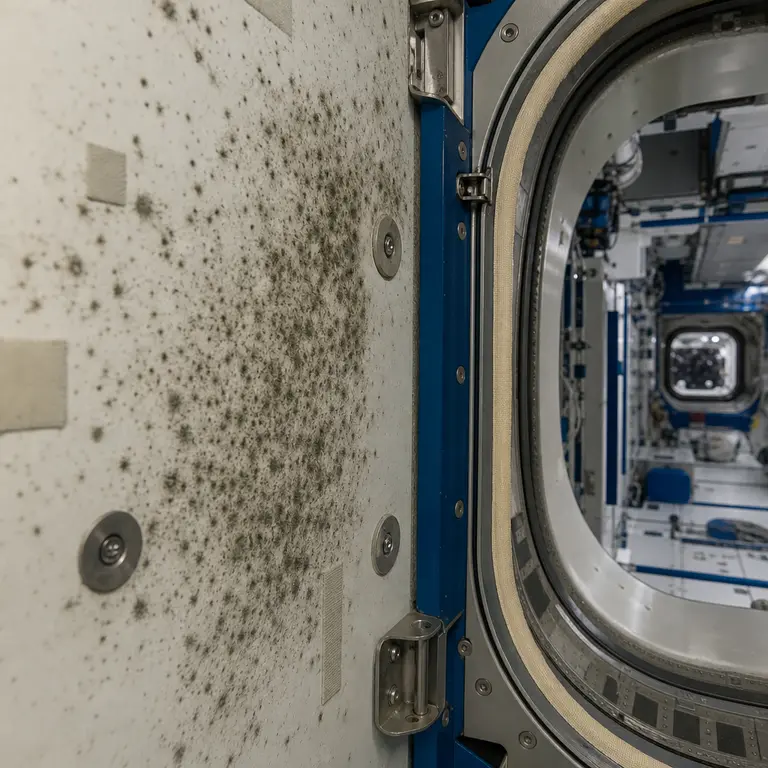
Resilient mold species aboard the International Space Station are not merely surviving microgravity and radiation — they are adapting, evolving, and potentially degrading the station's very infrastructure.
 Watch on YouTube
 Watch on Rumble
Introduction
The International Space Station is one of the most hostile environments humans have ever occupied continuously. Bathed in cosmic radiation, subject to temperature swings of more than 270 degrees Celsius between sunlit and shadowed passes, and sealed in a pressurized metal shell for over two decades, it seems an unlikely place for biological flourishing. And yet, aboard the station right now, dozens of fungal species are not just surviving — they are thriving, mutating, and in some cases consuming the very materials that keep the crew alive.
Researchers from NASA and the Russian space agency Roscosmos have cataloged more than 60 species of fungi and bacteria aboard the ISS over the years. Among the most persistent are Aspergillus and Penicillium species, along with Cladosporium sphaerospermum — a melanin-rich black mold that has attracted extraordinary scientific attention for its apparent ability to feed on ionizing radiation through a process called radiosynthesis, broadly analogous to photosynthesis in plants. What began as a contamination concern has evolved into one of the most scientifically provocative questions in modern astrobiology: what does it mean when life not only endures the most extreme conditions humans can engineer, but appears to flourish within them?
Radiotrophic Fungi and the Chernobyl Connection
The story of radiation-eating fungi did not begin in orbit. It began in the ruins of Chernobyl’s Reactor No. 4, where in 1991, researchers discovered dense black mold growing on the walls of the most radioactive areas of the destroyed plant. Remote-controlled robots sent in to survey the damage returned with something unexpected in their sample collections — not the sterile, scorched environment scientists had anticipated, but a thriving biological community clinging to the most lethally irradiated surfaces on Earth. Subsequent analysis showed that Cladosporium sphaerospermum and related species were not merely tolerating the radiation — they appeared to be using it metabolically. Their melanin pigment, the same compound that darkens human skin in response to ultraviolet exposure, was apparently converting gamma radiation into chemical energy through a mechanism that remains incompletely understood but is thought to involve the oxidation of melanin molecules and their subsequent use in cellular energy production.
This discovery was formally published in 2007 in the journal PLOS ONE, and it upended long-standing assumptions about the biological limits of life. Prior to this finding, ionizing radiation was understood almost universally as a destructive force — something that shattered DNA, disrupted cellular machinery, and killed living organisms at sufficient doses. The Chernobyl fungi suggested that at least some organisms had evolved not just to tolerate radiation but to exploit it, turning a lethal environmental condition into a metabolic resource.
When the same species turned up aboard the ISS growing in corners, on rubber seals, and behind equipment panels, scientists recognized that something significant was happening. A 2020 study published in bioRxiv examined samples of C. sphaerospermum cultured aboard the station and found that it not only survived but appeared to grow more robustly in the radiation environment of low Earth orbit than in control samples maintained on the ground. The station sits in a region of space where radiation exposure is roughly 40-80 times higher than at Earth’s surface, yet the fungus responded to this environment with increased vitality rather than cellular distress.
The implications of this finding are dual-edged. On one hand, such organisms might one day be engineered as biological radiation shields for deep-space missions — thin living films capable of absorbing harmful cosmic rays and converting that energy into something biologically useful. On the other hand, the same fungi are actively degrading polymers, rubber gaskets, optical lenses, and even some metal alloys aboard the station through a process called biodeterioration. The organism that might one day protect astronauts from radiation is simultaneously dismantling the vehicle they depend on for survival.
What the Fungi Are Actually Destroying
The Soviet space program encountered microbial biodeterioration as early as the Mir space station era, and the problem proved more serious than mission planners had anticipated. Cosmonauts reported clouding of porthole glass, corrosion on aluminum panels, and progressive degradation of rubber seals — all attributable to microbial colonies that had established themselves in the warm, humid interior of the station. When Mir was deorbited and allowed to burn up over the Pacific Ocean in 2001, post-mission analysis confirmed that fungi had penetrated deep into insulation materials and electrical cable sheathing, in some cases reaching the conductive cores of wiring bundles. The station had been alive in a way its designers had never intended.
The ISS has inherited this problem and, in some respects, amplified it. NASA’s internal documentation and peer-reviewed publications have confirmed that biofilm communities — layered colonies of bacteria and fungi that adhere to surfaces and secrete protective matrices — colonize water recycling systems, air filters, and cooling loops throughout the station. These biofilms can reduce the efficiency of water purification membranes, introduce trace organic contaminants into the drinking water supply, and physically block the microfluidic channels of sensitive scientific instruments. In 2018, a study published in npj Microgravity found that microbial communities in space adopt a more robust, three-dimensional biofilm architecture than their Earth-based counterparts. The researchers concluded that this was likely a consequence of microgravity itself: on Earth, convective fluid flow constantly disturbs and disrupts developing biofilms, but in the absence of gravity-driven convection, the communities are free to construct denser, more architecturally complex, and more chemically protective colonies.
Fungal acids produced during metabolic activity can etch polycarbonate and acrylic surfaces, which is particularly concerning given that the station’s windows and some instrument housings are made from these materials. The fungi are not acting with intent, of course, but the effect is as systematic as any engineered corrosion process. They are, in the most literal sense, eating the station from the inside — and doing so more effectively in the conditions of space than they would on the ground.
Implications for Deep Space and Future Missions
With NASA’s Artemis program targeting a return to the Moon and eventual crewed missions to Mars, the microbial ecology of long-duration spacecraft has moved from a housekeeping concern to a mission-critical engineering challenge. A Mars transit vehicle would spend roughly seven months in deep space each way, far beyond the reach of any resupply mission and without the possibility of emergency evacuation. If fungal biodeterioration were to compromise a critical seal or a water recycling component during that transit, the consequences could be catastrophic. The margin for biological interference in a deep-space vehicle is essentially zero.
Researchers at the NASA Ames Research Center and the European Space Agency are currently investigating several mitigation strategies with varying degrees of promise. These include antimicrobial surface coatings that incorporate copper nanoparticles and silver ions — both of which have well-documented biocidal properties — as well as ultraviolet sterilization cycles designed to periodically purge surfaces of biological accumulation. There is also growing interest in the deliberate introduction of competitive probiotic bacterial strains engineered to outcompete harmful fungi for available nutrients and surface area. The logic is borrowed from ecological management on Earth: rather than attempting to sterilize an environment completely, which is both difficult and potentially counterproductive, engineers would instead shape the microbial community toward a less destructive equilibrium.
Perhaps the most ambitious proposals come from researchers working at the intersection of synthetic biology and aerospace engineering. CRISPR-based genetic modification is being explored as a means of creating space-hardy microorganisms that could be deliberately introduced into spacecraft to perform useful functions — nitrogen fixation, organic waste processing, or even pharmaceutical synthesis during long missions — while being genetically constrained from producing the acids and enzymes responsible for structural biodeterioration. The idea of a designed shipboard microbiome, carefully curated and genetically bound, represents a fundamental reconceptualization of the relationship between spacecraft and biology.
Perhaps the most counterintuitive proposal of all comes from astrobiologists who argue that rather than treating the fungi as adversaries to be eliminated, future missions should study them as models of biological resilience and potentially incorporate them into spacecraft design. If C. sphaerospermum can be reliably harnessed as a radiation-absorbing material, future habitats on the Moon or Mars might incorporate living fungal layers as a functional component of their structural architecture. This concept is already being explored in a terrestrial context by companies like Ecovative Design, which has collaborated with NASA on the development of mycelium composites — materials grown from fungal networks that are lightweight, structurally robust, and capable of being shaped into complex forms. A habitat wall that is partly alive, capable of self-repair, and able to absorb radiation rather than merely deflect it, represents a genuinely novel approach to the problem of keeping humans safe in space.
Conclusion
The fungi aboard the International Space Station are a reminder that life does not wait for permission. In the most precisely engineered environment humans have ever created — a structure designed and maintained with extraordinary care to exclude biological variables — biology is quietly asserting itself, corroding aluminum, etching acrylic, consuming radiation, and building architectural communities in the gaps between instruments. The microorganisms that hitched rides to orbit on equipment, clothing, and human bodies have found a home in conditions that should, by any reasonable prior expectation, have been inhospitable.
What makes this story genuinely significant is not merely the contamination problem it presents, though that problem is real and serious. It is what these organisms reveal about the nature of life itself — its flexibility, its opportunism, and its capacity to locate metabolic possibility in environments that appear, from the outside, to offer none. The same properties that make C. sphaerospermum a threat to spacecraft integrity also make it a candidate for some of the most innovative proposals in the history of human space exploration. The fungi aboard the ISS are simultaneously a challenge to manage and a phenomenon to understand, and the distance between those two framings may define how humanity approaches the biological dimensions of its long-term future in space.
Sources & Further Reading
- Dadachova, E. et al. Ionizing Radiation Changes the Electronic Properties of Melanin and Enhances the Growth of Melanized Fungi. PLOS ONE, 2007. https://doi.org/10.1371/journal.pone.0000457
- Shunk, G.K., Gomez, X.R., Averesch, N.J.H. A Self-Replicating Radiation-Shield for Human Deep-Space Exploration: Radiotrophic Fungi can Attenuate Ionizing Radiation aboard the International Space Station. bioRxiv, 2020. https://doi.org/10.1101/2020.07.16.205534
- Kastner, M. et al. Microbial Monitoring of the International Space Station. npj Microgravity, 2018. https://www.nature.com/articles/s41526-018-0053-2
- NASA Technical Reports Server. Biological Contamination Control for Outbound and Inbound Planetary Spacecraft. NASA, 2020. https://ntrs.nasa.gov