
The Satellite That Listens for Dead Stars Exploding
How NASA's Swift Observatory, originally designed to detect gamma-ray bursts, became one of the most versatile astronomical instruments ever built, reshaping our understanding of the violent universe.
 Watch on YouTube
 Watch on Rumble
A Machine Built for Catastrophe
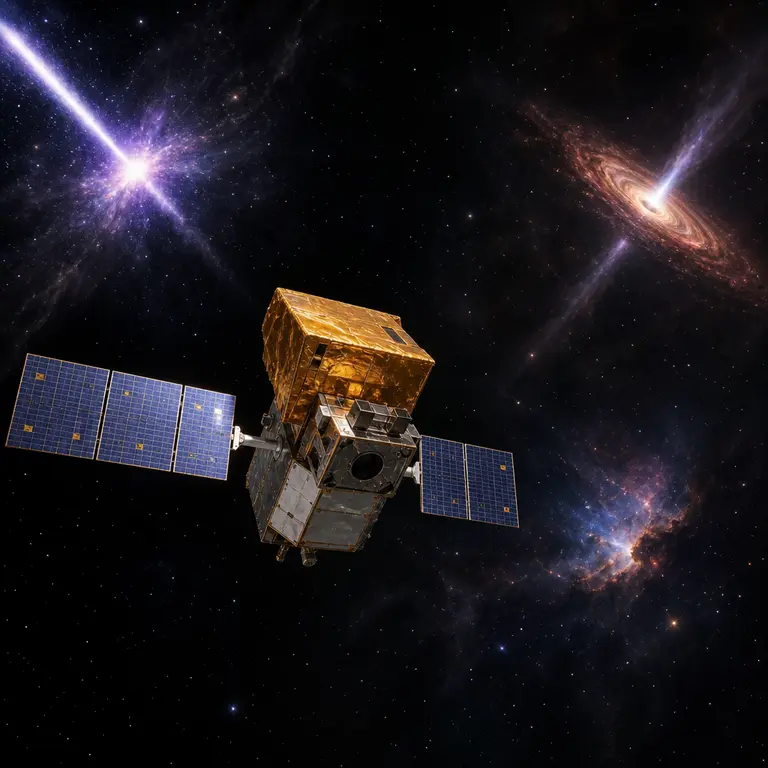
On November 20, 2004, a spacecraft the size of a small school bus was launched from Cape Canaveral aboard a Boeing Delta 7320 rocket. Its name was Swift, and its mission was singular in its ambition: to catch the universe in the act of destroying itself. Gamma-ray bursts, the most energetic explosions known to science, release more energy in a few seconds than the Sun will emit over its entire ten-billion-year lifetime. They are so bright that they can briefly outshine entire galaxies containing hundreds of billions of stars. Before Swift, astronomers had only seconds to react before these events faded into the noise of the cosmos, leaving few clues about their origins, mechanisms, or relationship to the broader structure of the universe. Swift was designed to change that entirely, transforming the study of these fleeting catastrophes from a discipline of incomplete glimpses into a systematic science.
The problem Swift was built to solve had plagued astrophysics for decades. Gamma-ray bursts were first detected accidentally in the late 1960s by Vela satellites, American military spacecraft designed to monitor Soviet nuclear tests from orbit. The satellites detected brief, intense flashes of gamma radiation, but they were not coming from Earth. They were coming from space. The discovery was classified for several years before being published in 1973, and the scientific community spent the following three decades debating what these events were, where they came from, and how they could possibly produce so much energy. Ground-based telescopes were too slow to catch the optical afterglows before they faded. Earlier space observatories lacked the ability to repoint quickly enough to study the same event across multiple wavelengths. Swift was the instrument purpose-built to break that stalemate.
Built through a collaboration between NASA, Pennsylvania State University, the Los Alamos National Laboratory, the Goddard Space Flight Center, and international partners in the United Kingdom and Italy, Swift carried three instruments that worked in coordination: the Burst Alert Telescope, the X-ray Telescope, and the Ultraviolet/Optical Telescope. When the BAT detected a burst, the spacecraft could autonomously rotate to point its more sensitive instruments at the source within 90 seconds, faster than any ground-based observatory could respond. This autonomous rapid-response capability was genuinely unprecedented in space astronomy. No spacecraft before it had been engineered to identify a transient event, calculate its position, physically reorient itself, and begin follow-up observations entirely without human input, all within the time it might take a person to make a cup of coffee. That engineering achievement alone represented a fundamental shift in how space observatories could operate.
The Unexpected Science of a Dying Universe
What no one fully anticipated was how Swift would transform fields far beyond its original mandate. In 2008, Swift detected GRB 080319B, a gamma-ray burst so luminous it was briefly visible to the naked eye from Earth despite originating 7.5 billion light-years away, more than halfway across the observable universe. It became the most distant object ever visible without a telescope, a record that stunned the astronomical community and appeared in Nature that same year. The event prompted immediate reflection on a deeply unsettling implication: that a sufficiently powerful gamma-ray burst occurring within a few thousand light-years of Earth and oriented toward us could strip away the ozone layer and trigger a mass extinction event. Some paleontologists have since proposed that the Ordovician mass extinction, which occurred approximately 445 million years ago and eliminated around 85 percent of marine species, may have been initiated by exactly such an event.
But Swift’s greatest scientific surprises came from what it found while watching the afterglows of bursts. In 2005, the telescope began documenting a phenomenon called X-ray flares, violent re-brightenings occurring minutes to hours after the initial explosion. These had never been observed in detail before and suggested that the central engine powering gamma-ray bursts, likely a newly formed black hole or a rapidly spinning neutron star called a magnetar, remained active far longer than theoretical models had predicted. Prior to Swift, the consensus view held that the central engine switched off almost immediately after the initial burst. The X-ray flare data demolished that assumption. This forced a substantial revision of burst models that had been considered largely settled, and the debate over whether black holes or magnetars power different classes of bursts continues to animate the field today.
Swift also became an accidental monitor of tidal disruption events, the technical term for what happens when a star wanders too close to a supermassive black hole and is torn apart by tidal forces. The resulting radiation flare, which can last for months, was first systematically cataloged by Swift. By 2022, the observatory had documented dozens of these events, giving astronomers a large enough statistical sample to begin to understand the population of dormant black holes lurking at the centers of galaxies. Before Swift, tidal disruption events were largely theoretical curiosities. The observatory turned them into a measurable population with identifiable characteristics, opening an entirely new window onto the demographics of black holes across cosmic history.
The Gravitational Wave Connection
Perhaps the most consequential chapter in Swift’s history began on August 17, 2017. The LIGO and Virgo gravitational wave detectors registered a signal designated GW170817, the first confirmed detection of two neutron stars merging. Approximately 1.7 seconds later, Swift’s BAT detected a short gamma-ray burst from the same region of sky. This was not a coincidence. It was confirmation of a theory that had existed for decades but never been directly proven: that short gamma-ray bursts are produced by neutron star mergers. The 1.7-second delay between the gravitational wave signal and the gamma-ray detection was itself a significant finding, constraining the difference in travel speed between gravitational waves and light to less than one part in a thousand trillion, placing tight limits on alternative theories of gravity that had predicted the two would travel at different velocities.
The event, occurring in the galaxy NGC 4993 approximately 130 million light-years away, was observed across the entire electromagnetic spectrum within hours, creating what astronomers called the golden era of multi-messenger astronomy. Swift’s rapid localization of the burst allowed ground-based telescopes to be pointed at the correct position before the optical counterpart faded. The observation confirmed that neutron star mergers are a primary site of r-process nucleosynthesis, the astrophysical process responsible for creating heavy elements, including gold, platinum, and uranium. In other words, Swift helped confirm that most of the gold on Earth was forged in collisions between neutron stars billions of years ago. The kilonova, the optical transient produced by the merger and observed in the days following the event, showed spectroscopic signatures of strontium and other heavy elements being synthesized in real time. It was the first direct observational proof of where the periodic table’s heaviest elements come from.
The implications of GW170817 extended well beyond nuclear astrophysics. The combined gravitational wave and electromagnetic observations allowed astronomers to independently measure the Hubble constant, the rate at which the universe is expanding, using a method entirely different from any previously employed. The value they obtained sat between two competing measurements that had been in tension for years, adding a new data point to one of the most contested questions in modern cosmology. None of this would have been possible without Swift’s ability to localize the gamma-ray burst quickly enough to enable the coordinated observational campaign that followed.
A Tool That Outlived Its Mission
Swift was designed to operate for two years. As of 2024, it has been operational for nearly two decades. The spacecraft has detected more than 1,600 gamma-ray bursts, observed tens of thousands of X-ray sources, and contributed to over 15,000 published scientific papers. Its longevity is partly a product of careful engineering and partly a result of the scientific community repeatedly making the case for its continued funding. Each time NASA has reviewed the mission, the breadth of Swift’s ongoing contributions has been sufficient to justify continued operation, a testament to how thoroughly the observatory embedded itself into the infrastructure of modern astrophysics.
In recent years, Swift has been applied to problems its designers never imagined. It has monitored the X-ray behavior of exoplanet host stars to assess the habitability of their planetary systems, since the X-ray and ultraviolet radiation environment around a star determines whether an orbiting planet can retain its atmosphere over geological timescales. It has tracked the X-ray outbursts of accreting binary stars. It has observed comets. In 2022, it detected a gamma-ray burst designated GRB 221009A, nicknamed the BOAT (Brightest Of All Time), an event so energetic that it temporarily blinded several space-based detectors and saturated Swift’s own instruments. The burst originated 2.4 billion light-years away and released more energy in a few hundred seconds than the Sun will produce in ten billion years. The event was so unusual that it prompted immediate debate about whether standard gamma-ray burst models were adequate to explain it, and analysis of its afterglow data is still ongoing.
The instrument has also played a quiet but essential role in time-domain astronomy, the emerging field focused on understanding how celestial objects change over time rather than treating the sky as static. Swift’s archive of X-ray observations stretching back nearly twenty years has become a reference baseline against which new transient events are compared. When a new X-ray source appears, or an existing one behaves unexpectedly, Swift’s historical data provides context that no other observatory can supply. That archive, accumulated over two decades of continuous operation, may ultimately prove to be one of the mission’s most enduring scientific contributions.
The People Behind the Machine
The principal investigator for Swift was Neil Gehrels, a NASA astrophysicist at Goddard Space Flight Center who spent more than a decade shepherding the mission from concept to launch. Gehrels was known within the community not only for his scientific contributions but for his unusual ability to build international collaborations without the political friction that often derails complex multi-institution projects. He held together a team spanning multiple continents, funding agencies, and institutional cultures, and he did so with a reputation for scientific rigor and genuine generosity toward younger researchers. His death in February 2017 came just months before the neutron star merger that Swift helped characterize, the discovery many considered the culmination of everything the mission had been built to find. The timing carried a particular weight for those who had worked alongside him.
The mission was renamed the Neil Gehrels Swift Observatory in his honor in January 2018. The renaming was formally approved by NASA and reflects recognition that the observatory’s scientific output was inseparable from the institutional vision he sustained throughout its development and early operational life. The scientists who work with Swift’s data today, many of them graduate students when the spacecraft launched, continue to find new uses for an instrument that has already rewritten textbooks several times over. Some of them are now training their own students using data from a spacecraft that was supposed to have retired before those students began their undergraduate degrees.
What Swift represents, beyond its specific discoveries, is a model for how scientific instruments can be designed with enough flexibility to remain relevant as the questions science asks continue to evolve. It was built to catch the universe as it destroyed itself, and it succeeded. But it also helped confirm where gold comes from, revealed that black holes remain active longer than anyone expected, and provided astronomers with their first systematic census of stars being consumed at the centers of galaxies. A machine built for catastrophe turned out to be one of the most productive scientific instruments ever placed in orbit, not because it did exactly what it was designed to do, but because the universe kept offering it new catastrophes to witness.
Sources & Further Reading
- Gehrels, N., et al. The Swift Gamma-Ray Burst Mission. The Astrophysical Journal, 2004. https://doi.org/10.1086/422091
- Abbott, B.P., et al. Multi-messenger Observations of a Binary Neutron Star Merger. The Astrophysical Journal Letters, 2017. https://doi.org/10.3847/2041-8213/aa91c9
- NASA Goddard Space Flight Center. Neil Gehrels Swift Observatory Mission Overview. NASA, 2024. https://swift.gsfc.nasa.gov
- Bloser, P.F. et al. The Swift BAT Instrument. Space Science Reviews, 2005.