
The Neutrino Detector Buried Under the Mediterranean
Deep beneath the Mediterranean Sea, a telescope unlike any other hunts for the universe's most elusive particles — and may soon reshape our understanding of cosmic violence.
 Watch on YouTube
 Watch on Rumble
Fishing for Ghosts in the Deep Sea
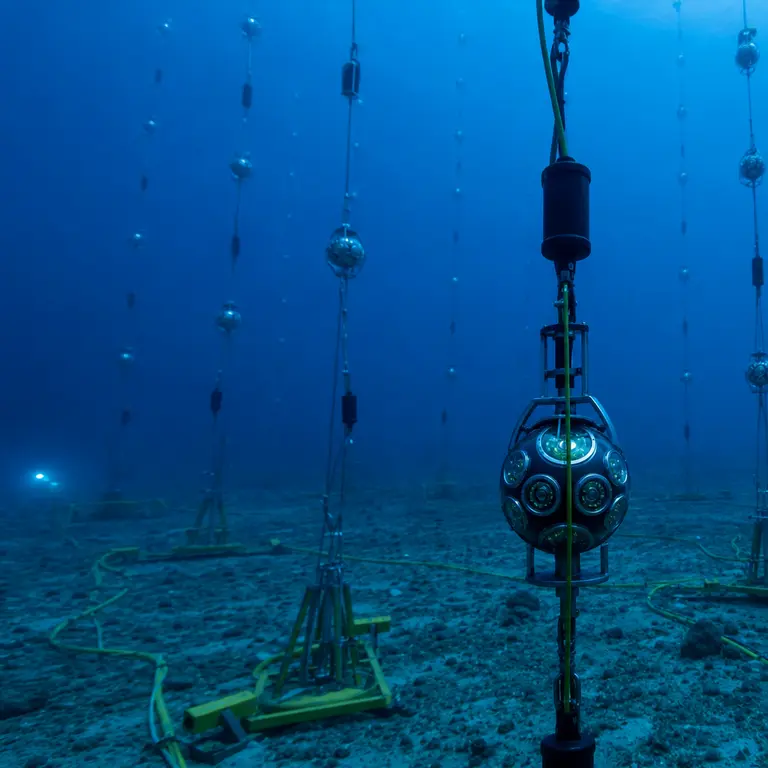
Somewhere between the coast of Sicily and the seafloor of the Ionian Sea, at a depth of 3,500 meters, a structure the size of a city block sits anchored in perpetual darkness. It is called KM3NeT — the Cubic Kilometer Neutrino Telescope — and it is not looking at the sea around it. It is looking through the entire planet Earth at the sky on the other side. This improbable instrument, built by a collaboration spanning 17 countries and dozens of research institutions, represents one of the most ambitious scientific undertakings of the 21st century: the attempt to read the universe using particles so elusive that no material in nature can reliably stop them.
To understand why such a machine exists, and why it was built on the floor of the Mediterranean Sea, requires a brief detour into one of the stranger corners of modern physics — the world of the neutrino.
The Ghost Particle and Why It Matters
Neutrinos are among the most abundant particles in the universe, yet they interact so rarely with ordinary matter that trillions pass through your body every second without leaving a trace. They were first proposed theoretically by Wolfgang Pauli in 1930 as an accounting trick to explain missing energy in radioactive decay, and Pauli himself expressed doubt that they would ever be directly detected. He was wrong, but barely. It took until 1956 for Frederick Reines and Clyde Cowan to experimentally confirm their existence, using a nuclear reactor as a neutrino source and a large tank of water as a detector. Reines received the Nobel Prize for the work in 1995, nearly four decades after the discovery.
What makes neutrinos so difficult to detect also makes them scientifically irreplaceable. Because they interact only through the weak nuclear force and gravity, they pass through virtually everything without being absorbed, scattered, or deflected. A sheet of lead one light-year thick would stop only about half of the neutrinos passing through it. This imperviousness is precisely what makes them valuable as cosmic messengers. When a supernova explodes, for instance, roughly 99 percent of the energy released escapes not as light, but as a burst of neutrinos that exits the dying star seconds before the optical explosion even begins. The detection of neutrinos from Supernova 1987A — a total of 24 events across three separate detectors — gave physicists their first direct look inside a stellar collapse and confirmed theoretical models developed over decades.
High-energy cosmic neutrinos, the kind KM3NeT is designed to detect, are different in character from those produced by nearby stars or nuclear reactors. They are thought to originate in the most violent environments the universe contains: the relativistic jets of active galactic nuclei, the shock waves of supernova remnants, the accretion disks surrounding supermassive black holes, and possibly the aftermath of neutron star mergers. Detecting them requires extraordinary volumes of ultra-transparent material — and the deep Mediterranean, with its exceptional optical clarity and near-total absence of bioluminescent noise at depth, turns out to be one of the best neutrino detectors nature has accidentally provided. The KM3NeT collaboration began deploying its first detection units in 2016 and has been expanding ever since.
How to Build a Telescope That Faces Downward
The fundamental trick of deep-sea neutrino astronomy is counterintuitive: you point your detector at the ground. When a high-energy neutrino traveling from a distant cosmic source passes through Earth and collides with a nucleus in the seawater or the seafloor rock beneath the detector, it produces a charged particle called a muon. This muon travels faster than light moves through water — not faster than light in a vacuum, but faster than the reduced speed of light in a dense medium — and that violation produces a cone of faint blue light called Cherenkov radiation, the optical equivalent of a sonic boom. The same principle underlies the eerie blue glow visible inside water-cooled nuclear reactors.
KM3NeT’s detection units consist of strings of glass spheres, each about 17 centimeters in diameter, housing 31 small photomultiplier tubes that detect individual photons. By recording the precise timing and geometry of Cherenkov light cones across thousands of these sensors, physicists can reconstruct the direction from which the original neutrino originated, with an accuracy of fractions of a degree. The Earth itself acts as a filter, blocking the far more numerous cosmic ray muons produced in the atmosphere above, ensuring that only neutrinos — which pass through the planet effortlessly — reach the detector from below.
Engineering an instrument at this depth presents challenges that go well beyond the physics. The pressure at 3,500 meters exceeds 350 atmospheres, sufficient to crush conventional electronics. Each glass sphere must maintain a hermetic seal while housing sensitive electronics that operate continuously for years without maintenance. The detection units' strings are deployed from ships on the surface and anchor to the seafloor, where they unfurl autonomously in the current. Calibration is performed using known light sources and the well-understood properties of atmospheric muons, which serve as a constant reference signal while simultaneously being rejected as background noise.
The project is actually two instruments in one. ARCA, the Astroparticle Research with Cosmics in the Abyss component, is optimized for detecting very high-energy neutrinos from astrophysical sources such as supernova remnants, active galactic nuclei, and gamma-ray bursts. ORCA, the Oscillation Research with Cosmics in the Abyss component, uses a denser array to study the quantum-mechanical behavior of neutrinos as they oscillate among three flavors — electron, muon, and tau — a phenomenon that implies neutrinos have mass, something not predicted by the original Standard Model of particle physics. The discovery that neutrinos oscillate, and therefore must have nonzero mass, earned Takaaki Kajita and Arthur McDonald the 2015 Nobel Prize in Physics, and ORCA is designed to measure the precise parameters of that oscillation with unprecedented accuracy.
A Coincidence That Shook the Field
In February 2023, the KM3NeT collaboration reported a result that immediately attracted global attention. A single neutrino event detected by the ARCA array, designated KM3-230213A, was reconstructed with an energy exceeding 100 petaelectronvolts — roughly 100 quadrillion electron volts. To put this in perspective, the Large Hadron Collider at CERN accelerates protons to energies of around 6.5 teraelectronvolts, or 6,500 billion electron volts. The Mediterranean neutrino carried approximately 15 million times as much energy as that.
This makes it the highest-energy neutrino ever detected, surpassing even the famous IceCube events that first demonstrated the detection of astrophysical neutrinos in 2013. IceCube, KM3NeT’s Antarctic counterpart, is buried two kilometers beneath the South Pole ice sheet and instruments a full cubic kilometer of glacial ice with over 5,000 optical sensors. Its detection of the first confirmed astrophysical neutrinos represented a landmark in observational astronomy. The KM3-230213A event exceeds those detections by a significant margin, entering an energy regime that existing theoretical models struggle to fully explain.
A particle carrying that much energy cannot be produced by any known process occurring within our galaxy under normal circumstances. Its direction of origin, once reconstructed, pointed toward a region of sky consistent with several candidate sources, including a blazar — a galaxy with a supermassive black hole whose relativistic jet happens to point almost directly at Earth. Blazars have long been suspected as sources of ultra-high-energy cosmic rays and neutrinos, and a previous IceCube event had already been tentatively associated with a blazar designated TXS 0506+056. The result was published in Nature in early 2025 and immediately prompted follow-up searches across electromagnetic wavelengths, with astronomers training gamma-ray satellites and radio arrays toward the candidate source region.
What This Means for Multi-Messenger Astronomy
The detection of ultra-high-energy neutrinos matters far beyond particle physics. Neutrinos, unlike light or even gamma rays, are not deflected by magnetic fields and are not absorbed by the dense clouds of gas and dust that obscure the most violent regions of the universe. A neutrino arriving at Earth carries a straight-line record of its origin and the process that produced it, potentially tracing it back to sources billions of light-years distant. In this sense, every high-energy neutrino is a message in a bottle from the extreme universe, and reading those messages requires instruments capable of catching particles that arrive perhaps once per year per cubic kilometer of detector material.
Astronomers are now attempting to correlate KM3NeT detections with observations from gamma-ray satellites, gravitational-wave detectors such as LIGO and Virgo, and radio telescope arrays, in a strategy called multi-messenger astronomy. The underlying hope is that simultaneous detection of gravitational waves, gamma rays, and neutrinos from a single cosmic event — perhaps a neutron star merger or the collapse of a massive star — would provide an unprecedented three-dimensional portrait of the universe's most energetic phenomena. A partial version of this vision was realized in 2017, when gravitational waves and electromagnetic radiation from a neutron star merger were detected simultaneously for the first time. Adding neutrinos to such a coincident detection would complete the picture in ways that no single channel of observation could achieve alone.
There are deeper theoretical stakes as well. Some models of new physics beyond the Standard Model predict that neutrinos traveling cosmological distances might interact with the diffuse neutrino background, producing characteristic absorption features in their energy spectra. Others suggest that at extreme energies, the behavior of neutrinos might reveal subtle violations of Lorentz invariance — the principle that the laws of physics are the same in all directions and at all velocities — which certain quantum gravity theories predict at the Planck scale. KM3NeT’s data will constrain or confirm these possibilities as its dataset grows.
The full KM3NeT array, when complete, will instrument approximately one cubic kilometer of Mediterranean water with roughly 6,000 digital optical modules. At that scale, statistically meaningful samples of ultra-high-energy neutrinos should accumulate over years, allowing the construction of the first neutrino sky map with genuine source resolution. Patterns will emerge from what is currently a sparse collection of individual events, and the brightest neutrino sources in the sky may turn out to be objects already familiar to astronomers, or something entirely unexpected.
The Mediterranean, long known as the cradle of Western civilization, may turn out to be equally important as the cradle of a new kind of astronomy — one conducted not with mirrors and lenses, but with glass spheres and the ghostly afterglow of particles that barely know the universe exists. Three and a half kilometers below the surface, in water so still and dark that individual photons can be tracked over distances of hundreds of meters, a machine built by human hands is slowly learning to read signals from the most violent events in the cosmos. It is, by any measure, one of the more extraordinary things our species has ever attempted.
Sources & Further Reading
- KM3NeT Collaboration. 'Observation of an Ultra-High-Energy Cosmic Neutrino with KM3NeT.' Nature, 2025. https://www.nature.com/articles/s41586-025-08543-1
- Adrian-Martinez, S. et al. 'Letter of Intent for KM3NeT 2.0.' Journal of Physics G: Nuclear and Particle Physics, 2016. https://iopscience.iop.org/article/10.1088/0954-3899/43/8/084001
- Aartsen, M.G. et al. 'Evidence for High-Energy Extraterrestrial Neutrinos at the IceCube Detector.' Science, 2013. https://www.science.org/doi/10.1126/science.1242856
- KM3NeT Collaboration. Official Project Website. https://www.km3net.org