
Vera Rubin's Dark Matter Discovery: Skepticism to Legacy
Vera Rubin's galaxy rotation curves didn't just hint at dark matter — they demolished a century of assumptions about what the universe is made of, and her story reveals how institutional resistance shaped one of science's most consequential revisions.
 Watch on YouTube
 Watch on Rumble
A Measurement Nobody Wanted to Believe
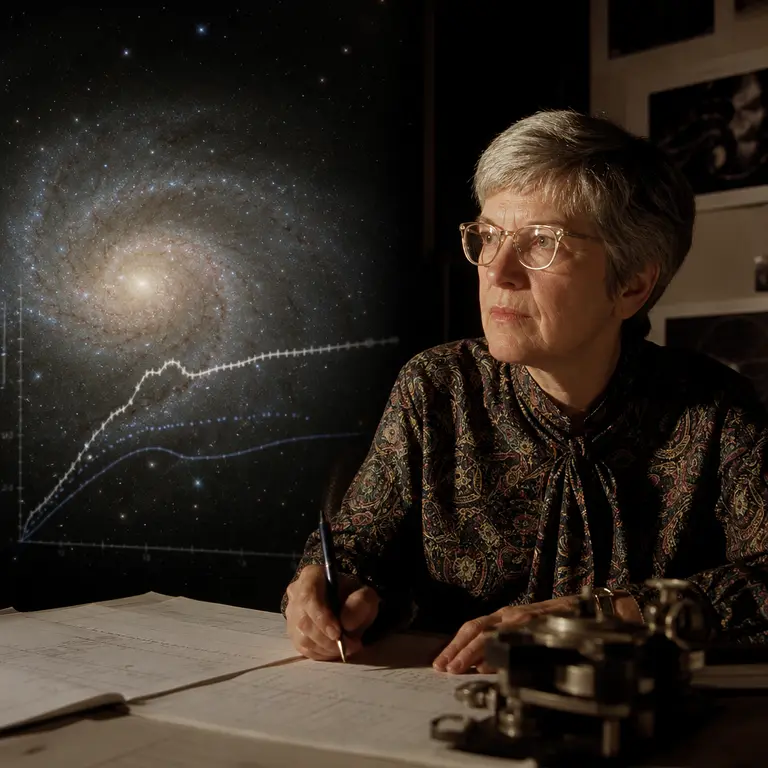
In the late 1960s and through the 1970s, astronomer Vera Rubin and her collaborator Kent Ford were producing data that flatly contradicted the prevailing model of galaxy behavior. By measuring the rotational velocities of stars at varying distances from the centers of spiral galaxies, they expected to find what Newtonian mechanics and Keplerian orbital dynamics predicted: stars near the outer edges of a galaxy should orbit more slowly than those near the center, just as outer planets in the solar system move more slowly than inner ones. Instead, the rotation curves were nearly flat. Stars at the periphery of galaxies were moving just as fast as stars close to the core.
The only coherent explanation was that galaxies contained vastly more mass than could be accounted for by visible stars, gas, and dust — mass that emitted no light and interacted with ordinary matter only gravitationally. What Rubin and Ford had measured, without initially framing it that way, was the gravitational signature of dark matter. It was one of the most consequential empirical discoveries in the history of modern physics, and it arrived not with fanfare but with sustained skepticism, institutional indifference, and a decades-long delay before the broader scientific community fully absorbed its implications.
The resistance Rubin encountered was not purely about the science. When she applied to the California Institute of Technology as a graduate student in 1948, she received no response — the institution did not admit women to its graduate program at the time, a fact that was not always stated plainly when rejections were delivered. When she presented early results at the American Astronomical Society, her findings were dismissed or ignored by colleagues who assumed the anomalies would resolve themselves once the data were refined. She eventually completed her Ph.D. at Georgetown University in 1954 under physicist George Gamow, whose own cosmological ideas were frequently controversial and whose willingness to supervise her work was itself something of an exception. Her dissertation, which argued that galaxies were not uniformly distributed in space but instead clustered in large-scale structures, was largely ignored for nearly two decades — until surveys in the 1980s confirmed exactly what she had described. The pattern of Rubin being correct and ignored would recur more than once.
The Instrument That Made It Possible
The technical achievement behind Rubin’s dark matter work depended heavily on Kent Ford’s image tube spectrograph, a device Ford had spent years developing at the Carnegie Institution of Washington’s Department of Terrestrial Magnetism. The instrument was sensitive enough to detect the Doppler shifts of individual stars in distant galaxies — shifts so slight that earlier equipment could not reliably resolve them. Without this level of precision, the rotational anomalies Rubin was documenting would have remained buried in measurement noise, indistinguishable from instrumental error. The science was only possible because the engineering had advanced far enough to make it so.
By the mid-1970s, Rubin and Ford had mapped the rotation curves of dozens of spiral galaxies. Every single one showed the same anomaly: flat rotation curves extending far beyond where visible matter could account for the gravitational forces at work. The consistency across galaxies, distances, and morphological types was crucial. A single anomalous result can be explained away as an error or a local peculiarity. A pattern repeated across an entire class of objects is something else entirely.
The pair published their landmark paper in 1970, focused on the Andromeda Galaxy, and followed it with a systematic study of 21 spiral galaxies published in 1978. That 1978 paper is now considered one of the most important observational papers in twentieth-century astrophysics. It was not the first suggestion of missing mass in the universe — Swiss astronomer Fritz Zwicky had proposed in 1933 that galaxy clusters contained far more mass than their visible content implied, based on the velocities of galaxies within the Coma Cluster — but Zwicky’s work had been largely set aside for decades, partly because the evidence was indirect and partly because the claim seemed too radical to take seriously without corroboration. Rubin’s systematic, reproducible, galaxy-by-galaxy evidence was harder to dismiss, and it arrived at a moment when the theoretical infrastructure for thinking about non-luminous matter had matured enough to receive it.
It is worth pausing on what it means, scientifically, to produce data that no existing theory can explain. In most cases, anomalous data are absorbed gradually: they accumulate in footnotes, generate competing interpretations, and eventually force a reckoning. Rubin and Ford’s rotation curves followed something like this trajectory, but compressed. Within a decade of the 1978 paper, flat rotation curves had become a foundational constraint on any serious cosmological model. The anomaly had become the standard.
What Dark Matter Actually Means — and Does Not Mean
Dark matter, as the term is used today, refers to a hypothetical form of matter that accounts for approximately 27 percent of the universe’s total mass-energy content, compared to roughly 5 percent for ordinary baryonic matter — the protons, neutrons, and electrons that make up everything visible in the universe, from stars to planets to the readers of this article. It does not emit, absorb, or reflect electromagnetic radiation, which is why it remains invisible to every telescope ever built, regardless of the wavelength those telescopes are designed to detect. Its existence is inferred entirely from gravitational effects: galaxy rotation curves, gravitational lensing, the large-scale structure of the cosmic web, and the behavior of the cosmic microwave background radiation.
What dark matter is made of remains one of the most pressing open questions in physics. Leading candidates include weakly interacting massive particles (WIMPs), axions, and sterile neutrinos. Each of these hypothetical particles has properties that would, in principle, account for the observed gravitational effects without producing detectable electromagnetic signals. But as of 2024, no particle detector has produced confirmed, reproducible evidence for any of them. The Large Underground Xenon experiment, the XENON1T detector at Gran Sasso in Italy, and the PandaX-4T detector in China have all placed increasingly tight constraints on WIMP properties without detecting a signal. The parameter space in which WIMPs can plausibly exist has narrowed considerably, though it has not yet closed.
Some physicists have proposed alternative frameworks that would explain flat rotation curves without invoking unseen matter at all. The most notable of these is Modified Newtonian Dynamics, or MOND, first proposed by Mordehai Milgrom in 1983, which suggests that the laws of gravity behave differently at very low accelerations — precisely the regime relevant to the outer edges of galaxies. MOND reproduces galaxy rotation curves with remarkable accuracy in many cases. However, it struggles to explain observations at cosmological scales, including the distribution of matter in galaxy clusters and the detailed structure of the cosmic microwave background, which dark matter models handle naturally. The 2006 observation of the Bullet Cluster — two galaxy clusters that had passed through each other, with their gas clouds slowed by electromagnetic interaction while a separate mass component appeared to pass through unimpeded — is widely regarded as the most direct observational evidence that dark matter exists as a physical substance rather than a modification of gravitational law.
Rubin herself was careful about the language she used throughout her career. She consistently described the rotation curves as evidence that something was missing from the standard model of galactic mass, not as proof of a specific particle or field. Her scientific conservatism was a notable feature of her public statements, reflecting a genuine epistemic discipline: she knew what the data showed and was equally clear about what it did not.
A Legacy Complicated by Recognition
Vera Rubin died on December 25, 2016, at the age of 88, without receiving the Nobel Prize in Physics — an omission that generated significant commentary in the scientific community and continues to be cited in discussions about how the prize is awarded and to whom. The Nobel committee does not award prizes posthumously, and no more than three individuals are awarded per category per year. By the time the observational case for dark matter had solidified enough to be considered Nobel-worthy, Rubin was elderly, and the committee had not acted. Fritz Zwicky, who made the first systematic argument for missing mass in galaxy clusters more than three decades before Rubin’s landmark papers, also never received the prize.
The question of why the committee did not act sooner is not easily answered. The evidence had been compelling since the late 1970s. The 1978 paper had been cited thousands of times. The cosmological consensus had shifted decisively in favor of dark matter as a physical reality. Whether the delay reflected the committee’s traditional conservatism about awarding prizes for discoveries that lack a confirmed mechanistic explanation — dark matter’s composition remains unknown — or whether other factors were at work is a matter of ongoing discussion in the history of science.
In 2020, the Large Synoptic Survey Telescope, a facility under construction at Cerro Pachon in Chile, was officially renamed the Vera C. Rubin Observatory by an act of the United States Congress — a rare honor that placed her name on one of the most powerful astronomical instruments ever built. The observatory, which began science operations in 2024, is designed to image the entire southern sky every few nights using a 3.2-gigapixel camera, producing a ten-year time-lapse of the universe that will map gravitational lensing by dark matter across cosmic scales. The instrument designed to probe the phenomenon she discovered now bears her name, which is a form of recognition that carries its own particular weight.
Less widely noted is Rubin’s sustained advocacy for women in science throughout her career. She mentored dozens of students, pushed for gender-neutral restroom facilities at observatories that had previously lacked them entirely, and was among the first women permitted to observe at the Palomar Observatory in 1965. She reportedly made the point about restroom access quietly and practically, by drawing a skirt on the figure on the men’s restroom door sign. The gesture was characteristic of her broader approach: understated, effective, and directed at the structural rather than the symbolic. She was not interested in making a statement so much as solving a problem, which is perhaps the most accurate description of how she approached her science as well.
Conclusion
The story of Vera Rubin and dark matter is, at one level, a story about a measurement: a set of spectroscopic observations that revealed the rotation curves of spiral galaxies to be inconsistent with any model that accounted only for visible mass. At another level, it is a story about how scientific knowledge actually advances — not through the smooth accumulation of confirming evidence, but through the slow, contested process by which anomalies become accepted facts. Rubin’s data were not welcomed. They were tolerated, then replicated, then incorporated, and finally recognized as foundational.
What remains unresolved is the deeper question her work raised. The rotation curves tell us that most of the matter in the universe is invisible. They do not tell us what that matter is. Decades of increasingly sophisticated experiments have constrained the possibilities without identifying the answer. The Vera C. Rubin Observatory will spend the next decade mapping dark matter’s gravitational influence across billions of light-years of cosmic structure, producing a dataset that will either confirm current models or force another round of revision. The measurement that nobody wanted to believe has become the mystery that nobody can yet explain, and the search for an answer is, in a meaningful sense, the central project of contemporary cosmology.
Sources & Further Reading
- Rubin, Vera C., and W. Kent Ford Jr. Rotation of the Andromeda Nebula from a Spectroscopic Survey of Emission Regions. The Astrophysical Journal, 1970. https://ui.adsabs.harvard.edu/abs/1970ApJ...159..379R
- Rubin, V., Ford, W. K., and Thonnard, N. Rotational Properties of 21 Sc Galaxies with a Large Range of Luminosities and Radii. The Astrophysical Journal, 1978. https://ui.adsabs.harvard.edu/abs/1978ApJ...225L.107R
- Overbye, Dennis. Vera Rubin, 88, Dies; Opened Doors in Astronomy, and for Women. The New York Times, December 27, 2016. https://www.nytimes.com/2016/12/27/science/vera-rubin-astronomist-who-made-the-case-for-dark-matter-dies-at-88.html
- Vera C. Rubin Observatory. About the Observatory. NOIRLab / SLAC, 2024. https://www.lsst.org/about