
Exploring Neutrinos: Icecube's Quest at the South Pole
Deep beneath the South Pole, a cubic kilometer of ice has been instrumented to catch the rarest particles in the universe — and what it has found is rewriting astrophysics.
 Watch on YouTube
 Watch on Rumble
Introduction: The Most Elusive Particle in the Universe
Neutrinos are among the most abundant particles in the universe, yet they interact so weakly with matter that trillions of them pass through your body every second without leaving a trace. They carry no electric charge, possess almost no mass, and respond to only two of the four fundamental forces — gravity and the weak nuclear force. This near-total indifference to ordinary matter is precisely what makes them scientifically extraordinary. Because they are not deflected by magnetic fields and are not absorbed by intervening gas, dust, or entire galaxies, they carry unaltered information from the most energetic and distant events in the cosmos. The challenge, of course, is catching them at all.
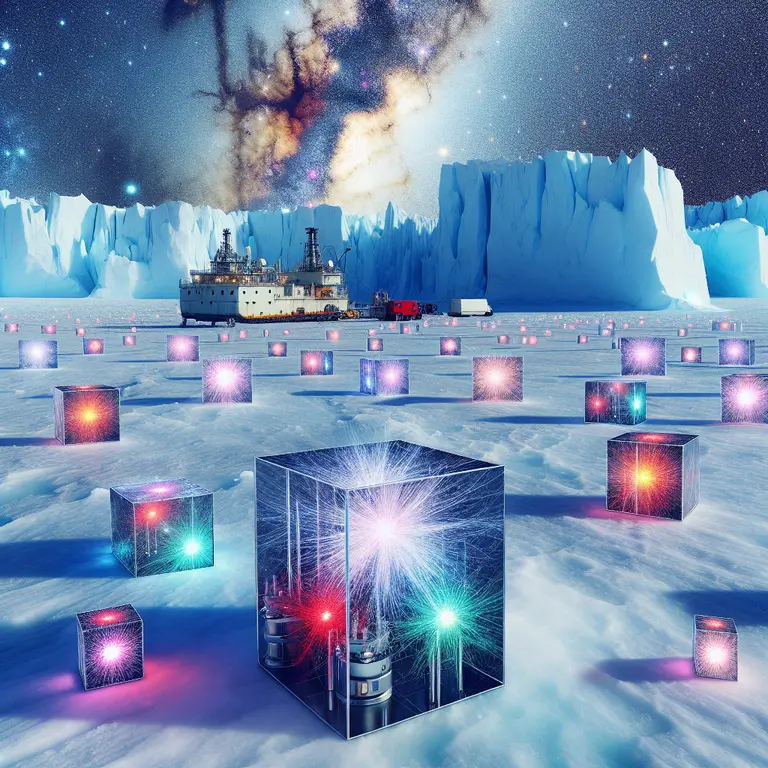
Detecting neutrinos requires extraordinary measures. The IceCube Neutrino Observatory, completed in December 2010 at the Amundsen-Scott South Pole Station in Antarctica, solved this problem by converting a full cubic kilometer of ancient glacial ice into the largest particle detector ever constructed. Eighty-six strings of sensors, each carrying 60 digital optical modules, were drilled 2.5 kilometers into ice that formed over hundreds of thousands of years, instrumenting a volume that dwarfs any laboratory on Earth’s surface. The result is an instrument that sits at the intersection of particle physics, astrophysics, glaciology, and extreme engineering — and one that has already rewritten parts of what we know about the high-energy universe.
How You Detect Something That Refuses to Be Detected
The logic behind IceCube is elegant, even if the physics is counterintuitive. When a neutrino does, on rare occasion, collide with an atom in the ice, it produces a secondary charged particle that travels faster than light moves through that medium. This is not a violation of relativity. The speed of light in a vacuum remains an absolute limit, but inside a dense material like ice, light itself slows down. A sufficiently energetic charged particle can outpace this reduced local speed limit, and when it does, it emits a cone of blue light called Cherenkov radiation — the optical equivalent of a sonic boom produced by an aircraft exceeding the speed of sound. The surrounding sensors capture this faint flash, and from the precise timing and intensity of the signal across dozens of modules, physicists can reconstruct the neutrino’s energy and direction of origin with surprising precision.
What makes this detection strategy particularly powerful is its directionality. Most particles that reach Earth from space are deflected, absorbed, or scattered during their journey. Neutrinos are not. A neutrino detected at IceCube points, in principle, like an arrow straight back to whatever catastrophic event produced it, whether that is a collapsing stellar core, a supermassive black hole consuming surrounding matter, or some still-unidentified class of extreme astrophysical accelerator. This directional fidelity, combined with the sheer scale of the detector, is what transforms a cubic kilometer of ice into a genuine telescope — one that sees not light, but the ghost particles that light cannot replace.
The Astrophysical Signals That Changed Everything
For most of IceCube’s early operational history, the observatory detected neutrinos consistent with production in Earth’s own atmosphere, a useful but unremarkable background generated when cosmic rays strike air molecules overhead. Then, in 2013, the collaboration announced the detection of two extremely high-energy neutrinos nicknamed Bert and Ernie, each carrying energies exceeding a petaelectronvolt — roughly a million times the energy of protons accelerated at CERN’s Large Hadron Collider. These could not have been produced in the atmosphere. They were astrophysical in origin, arriving from somewhere far beyond our solar system and carrying energies that no known terrestrial or atmospheric process could explain.
The accumulation of such events over subsequent years pointed increasingly toward specific classes of cosmic objects. By 2022, IceCube had assembled compelling evidence linking high-energy neutrinos to a specific source: the galaxy NGC 1068, also known as Messier 77, a Seyfert galaxy approximately 47 million light-years away with an active supermassive black hole at its center. This identification was scientifically significant in a way that extended well beyond the detection itself. NGC 1068 had long been suspected of producing high-energy cosmic rays, but direct proof was elusive because cosmic rays carry electric charge and are deflected by magnetic fields during their journey across intergalactic space, arriving at Earth pointing nowhere near their actual origin. Neutrinos, carrying no charge, travel in straight lines and point directly back to their source.
The IceCube result, published in Science in November 2022, marked the first time a specific galaxy had been identified as a neutrino factory with statistical significance exceeding 5 sigma, the gold standard threshold in particle physics that corresponds to a probability of less than 1 in 3.5 million that the result is a statistical fluke. It was a landmark moment, confirming that active galactic nuclei — galaxies powered by accreting supermassive black holes — are among the universe’s most powerful particle accelerators, capable of driving particles to energies that dwarf anything achievable on Earth.
Ice as an Instrument: The Material Science of Detection
The choice of Antarctic glacial ice as a detection medium was not arbitrary, and understanding why it works illuminates just how carefully the entire experiment had to be designed. The ice at depth beneath the South Pole is extraordinarily transparent, with a scattering length for blue light reaching tens of meters, comparable to the clearest ocean water but far more stable and accessible over kilometer-scale volumes. Unlike water-based neutrino detectors, which must contend with ocean currents, biological activity, and the technical difficulties of deploying and maintaining instruments in a dynamic marine environment, the Antarctic ice sheet is geologically inert and mechanically stable over the timescales relevant to scientific operation.
However, the ice is not uniform, which has posed its own scientific puzzles. Layers corresponding to ancient dust deposits from volcanic eruptions and major climate shifts create subtle but measurable variations in optical properties throughout the detector volume. These layers are, in a sense, a stratigraphic record of Earth’s atmospheric history preserved in ice — the same archive that climate scientists mine for information about past temperatures and greenhouse gas concentrations. For IceCube physicists, this layered structure complicates detector calibration, requiring sophisticated optical models that account for how light scatters differently at different depths. Years of dedicated effort have gone into mapping these variations precisely enough to extract reliable physics from the data.
The drilling process itself was a feat of engineering conducted under some of the most hostile conditions on Earth. Hot-water drills bored holes 60 centimeters in diameter through ice that had not been touched since it fell as snow during the last ice age. Each hole had to be completed and instrumented within roughly 40 hours before refreezing made further deployment impossible. Surface temperatures at the South Pole average minus 28 degrees Celsius, and the logistical constraints of operating at the geographic pole — where aircraft can only land during a narrow summer window, and every supply must be flown in — meant that the entire construction required seven Antarctic summer seasons between 2005 and 2010. The human effort embedded in the detector is as remarkable as the physics it enables.
What Comes Next: IceCube-Gen2 and the Multimessenger Era
The success of IceCube has catalyzed plans for a successor facility that would dramatically extend its reach. IceCube-Gen2, currently in the design and early planning phase, would expand the instrumented volume to approximately eight cubic kilometers by adding new strings of sensors around the existing array and incorporating a surface component sensitive to different particle signatures. At this scale, the observatory would detect roughly ten times as many high-energy astrophysical neutrinos per year, enabling the construction of statistically robust source catalogs rather than isolated, hard-won individual detections. The difference between identifying one neutrino source and cataloging dozens is the difference between a curiosity and a new branch of astronomy.
The broader scientific context for this ambition is the emerging field of multimessenger astronomy, in which gravitational waves, electromagnetic radiation across all wavelengths, cosmic rays, and neutrinos are analyzed together to build complete pictures of violent cosmic events. In 2017, IceCube played a supporting role in identifying a blazar called TXS 0506+056 as a probable neutrino source following a detection that coincided with a gamma-ray flare observed by the Fermi Space Telescope — the first compelling multimessenger association involving a neutrino source. As gravitational wave detectors like LIGO and Virgo continue to improve their sensitivity, the possibility of catching a core-collapse supernova simultaneously in gravitational waves, optical light, and the burst of neutrinos that precedes the visible explosion by hours becomes increasingly realistic. IceCube would detect thousands of neutrinos from a supernova in our own galaxy, providing a real-time window into stellar death that no other instrument can offer.
The last time such a galactic supernova occurred close enough to be detected was in 1987, when a star exploded in the Large Magellanic Cloud, and a handful of detectors around the world caught a brief pulse of neutrinos — a signal so fleeting it lasted less than thirteen seconds, yet it confirmed decades of theoretical predictions about how massive stars die. With IceCube and its planned successor in operation, the next nearby supernova would yield not a handful of events but thousands, resolved in time and direction with a precision that would transform our understanding of the physics occurring inside a collapsing stellar core. The ice at the bottom of the world, ancient and cold and seemingly inert, turns out to be one of humanity’s sharpest eyes on the universe's most violent processes.