
Icecube's Neutrino Odyssey: Unlocking the Cosmic Ghosts
How a cubic kilometer of Antarctic ice became humanity's most powerful telescope — not for light, but for ghostly subatomic particles that pass through entire planets unimpeded.
The Particle That Defies Everything
In 1930, Wolfgang Pauli proposed the existence of a particle so shy, so reluctant to interact with ordinary matter, that he famously wrote in a letter to colleagues that he had done a terrible thing by postulating something that could never be detected. He called it the neutrino, Italian for little neutral one. He was almost right about the impossibility. Neutrinos are so weakly interacting that roughly 100 trillion of them pass through your body every second, arriving from the Sun, and not one of them notices you exist. A neutrino fired at a light-year of solid lead has a roughly even chance of passing straight through without touching a single atom.
And yet, buried more than a mile beneath the Antarctic ice sheet, a collaboration of over 300 scientists from 12 countries has built a detector capable of catching them. They accomplished this not by making the target denser, but by making it incomprehensibly larger. The result is one of the most audacious scientific instruments ever constructed, and it is quietly rewriting what we know about the universe.
To understand why this matters, it helps to appreciate just how strange neutrinos really are. They are produced in enormous quantities by nuclear reactions inside stars, by supernovae, by the decay of radioactive elements within the Earth, and by cosmic rays colliding with the upper atmosphere. They have mass, but so little of it that physicists spent decades debating whether they were massless entirely. They come in three varieties, called flavors, and they oscillate among those flavors as they travel, a quantum-mechanical behavior so counterintuitive that its experimental confirmation earned a Nobel Prize in 2015. They are, in almost every measurable sense, ghosts. And ghosts, it turns out, carry extraordinary messages from the most violent corners of the cosmos.
IceCube: A Telescope That Looks Down
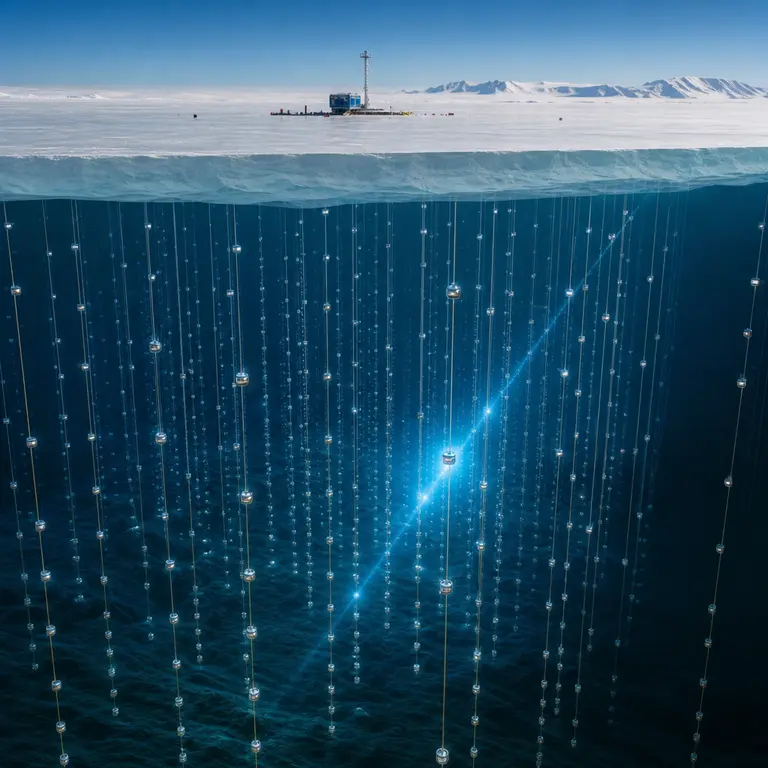
The IceCube Neutrino Observatory, completed in December 2010 after nearly a decade of construction, is not a telescope in any conventional sense. It consists of 5,160 basketball-sized digital optical modules suspended along 86 vertical strings, drilled into the ice at depths between 1,450 and 2,450 meters. Together, these sensors instrument a full cubic kilometer of ancient Antarctic ice, ice that fell as snow up to 100,000 years ago and has been compressed by millennia of accumulation into one of the most optically transparent materials on Earth.
The construction process alone was a remarkable feat of engineering. A specialized hot-water drill bored each of the 86 holes through ice that had never been touched since long before human civilization existed. The holes had to be drilled and the strings deployed within roughly 48 hours each, before the ice refroze around them. Working at the South Pole, in some of the harshest conditions on the planet, the teams managed to complete the array on schedule and within budget, which for a particle physics project of this scale is itself something close to miraculous.
When a neutrino, against all statistical odds, collides with a water molecule in that ice, it produces a secondary charged particle that travels faster than light moves through ice. This is not a violation of Einstein’s relativity. Light in ice travels at roughly 75 percent of its vacuum speed, and charged particles can exceed that local limit. When they do, they emit a cone of faint blue light called Cherenkov radiation, the optical equivalent of a sonic boom. IceCube’s sensors detect this fleeting blue flash, and from the timing and geometry of which sensors lit up and when, physicists reconstruct the neutrino’s energy and the direction from which it arrived, often to within a fraction of a degree.
The telescope looks downward because Earth itself serves as a filter. By detecting neutrinos that have traveled through the entire planet from the northern hemisphere, IceCube screens out the background noise of cosmic rays hitting the atmosphere above Antarctica, which would otherwise drown out the signal. The planet, in other words, becomes part of the instrument. There is something deeply satisfying about that idea: a detector that uses the entire Earth as its shield.
The Blazar That Changed Neutrino Astronomy
For years after its completion, IceCube detected high-energy neutrinos, some carrying energies millions of times greater than anything achievable in particle accelerators, but could not pinpoint their cosmic origins with certainty. The detections were tantalizing but frustratingly anonymous. The particles had clearly traveled from somewhere extraordinary, but the universe offered no obvious return address. Then, on September 22, 2017, everything changed.
IceCube detected a single neutrino carrying 290 teraelectronvolts of energy, roughly 45 times the energy of protons in the Large Hadron Collider. Within 43 seconds, an automated alert was sent to astronomers worldwide. This speed matters enormously. Cosmic events are often brief, and the window in which a follow-up observation can catch an active flare or transient event can close within hours or days. The alert system IceCube had developed, which had been tested and refined over years of operation, performed exactly as intended.
Telescopes swung to the coordinates IceCube provided. What they found was TXS 0506+056, a blazar, an extraordinarily powerful galaxy with a supermassive black hole whose relativistic jet happens to point almost directly at Earth, undergoing a period of heightened gamma-ray activity. The spatial and temporal coincidence was statistically compelling enough to represent the first credible identification of a high-energy cosmic neutrino source. It was published simultaneously in two papers in Science in July 2018, marking the birth of what researchers call multimessenger astronomy: reading the universe not in a single type of signal, but in gravitational waves, light, and now neutrinos simultaneously.
Subsequent archival analysis of IceCube data revealed that TXS 0506+056 had also produced a neutrino flare between 2014 and 2015, before the automated alert system existed, suggesting that the 2017 detection was not a lucky coincidence but rather a confirmation of a persistent source. Blazars, it now appears, may be a primary factory for the high-energy cosmic neutrinos IceCube detects on a regular basis. The jets of these systems, powered by matter falling into supermassive black holes and accelerated to near the speed of light, seem to be among the most powerful particle accelerators the universe has ever produced.
What IceCube Is Teaching Us About the Invisible Universe
Beyond source identification, IceCube has become a laboratory for physics that cannot be replicated anywhere on Earth. In 2020, the collaboration published results measuring the cross-section of neutrino-nucleon interactions at energies far beyond any accelerator’s reach, confirming predictions of the Standard Model with remarkable precision. This matters because the Standard Model, for all its success, is known to be incomplete. Every measurement that confirms its predictions at a new energy scale is also a test of where it might eventually break down, and IceCube is probing territory no human-built machine can reach.
In 2023, IceCube announced one of its most significant results to date: the first detection of high-energy neutrinos from the Milky Way’s galactic plane itself. This was not a detection from a single dramatic source, but a diffuse glow of neutrino emission spread across the galaxy’s dense interstellar medium, likely produced by cosmic rays interacting with gas clouds over millions of years. For the first time in history, our own galaxy had been imaged in neutrinos. It was, in a quiet but profound sense, a new way of seeing home.
The observatory has also placed the tightest constraints yet on the existence of sterile neutrinos, hypothetical fourth-flavor neutrinos that interact even more weakly than the three known types and are among the candidates for dark matter. So far, IceCube’s data disfavors the most popular sterile neutrino mass ranges, quietly narrowing the parameter space where dark matter might hide. This is the less glamorous but equally important work of physics: not just discovering new things, but ruling out possibilities that seemed plausible and thereby forcing theorists to look elsewhere.
A successor project, IceCube-Gen2, is currently in the planning and early approval stages. It would expand the instrumented volume to roughly eight cubic kilometers, incorporating radio antennas capable of detecting neutrinos at energies a thousand times higher still, energies associated with the most violent events in the observable universe. If built, it would transform an already remarkable instrument into something that might finally resolve one of astrophysics’ oldest and most stubborn mysteries: where the universe’s highest-energy particles come from, and what engines are powerful enough to produce them.
The Ghost Particle Grows Up
Pauli’s despair at having proposed something undetectable turned out to be premature. The neutrino was first directly detected in 1956 by Clyde Cowan and Frederick Reines, using a nuclear reactor as a source and large tanks of water as a target, and Reines received the Nobel Prize for it in 1995, nearly four decades later. The history of neutrino physics has always moved on this timescale: ideas proposed in one generation, confirmed in the next, and understood only in the generation after that.
IceCube sits at the beginning of a new chapter in that story. It has demonstrated that neutrinos are not merely curiosities of particle physics but genuine astronomical messengers, carrying information about events and environments that no other signal can penetrate. Light can be absorbed, scattered, or deflected. Gravitational waves require extraordinarily sensitive instruments and carry limited directional information at current sensitivities. Neutrinos travel in straight lines across billions of light-years, pass through anything in their path, and arrive carrying a precise record of the energy and direction of whatever produced them.
The universe, it turns out, has been sending us messages in neutrinos since long before we had the technology to read them. Now, for the first time, we are beginning to listen.
Sources & Further Reading
- IceCube Collaboration. 'Multimessenger observations of a flaring blazar coincident with high-energy neutrino IceCube-170922A.' Science, Vol. 361, Issue 6398, 2018. https://www.science.org/doi/10.1126/science.aat1378
- IceCube Collaboration. 'Evidence for high-energy extraterrestrial neutrinos at the IceCube detector.' Science, Vol. 342, Issue 6161, 2013. https://www.science.org/doi/10.1126/science.1242856
- IceCube Collaboration. 'Observation of high-energy neutrinos from the Galactic plane.' Science, Vol. 380, Issue 6652, 2023. https://www.science.org/doi/10.1126/science.adc9818
- Francis Halzen and Spencer R. Klein. 'IceCube: An instrument for neutrino astronomy.' Review of Scientific Instruments, Vol. 81, 2010. https://doi.org/10.1063/1.3480478