
The Scent That Predicts Thunderstorms Before They Arrive
The sharp, electric smell before a thunderstorm has a precise chemical origin — and scientists are now using it to build atmospheric sensors that could save lives.
 Watch on YouTube
 Watch on Rumble
The Smell of Electricity Has a Name
Most people have experienced it: a sharp, almost metallic tang in the air minutes before a storm breaks. For centuries, it was attributed to the storm itself, to lightning, to something ineffable in the atmosphere. The smell even inspired a word — petrichor, coined in 1964 by Australian mineralogists Isabel Joy Bear and R.G. Thomas to describe the earthy scent released when rain hits dry soil. But that electric pre-storm smell is something else entirely. It is ozone, a molecule composed of three oxygen atoms rather than the usual two, and its presence in the lower atmosphere is a direct signature of electrical activity happening miles overhead.
The word ozone derives from the Greek ozein, meaning to smell. It was identified as a distinct chemical compound in 1840 by Swiss chemist Christian Friedrich Schönbein, who noticed the smell while conducting electrolysis experiments in Basel. He correctly suspected it was produced by electrical discharges. What he could not have known was that the same molecule blankets the stratosphere at altitudes between 15 and 35 kilometers, absorbing ultraviolet radiation and shielding every living thing on Earth — and that the same chemistry responsible for that planetary shield was announcing itself quietly in his laboratory, rising from a tray of salt water and metal electrodes. Schönbein had stumbled onto one of the atmosphere’s most consequential molecules without any awareness of its larger role. The history of ozone is, in this sense, a story about how the grandest chemical processes on Earth can introduce themselves through the smallest and most intimate of human experiences: a smell.
How Lightning Manufactures Ozone at Ground Level
Lightning bolts carry temperatures exceeding 30,000 Kelvin — roughly five times hotter than the surface of the sun. At those temperatures, nitrogen and oxygen molecules in the surrounding air are violently split apart and recombine to form nitrogen oxides, which then react with other atmospheric compounds to produce ozone. A single thunderstorm can generate hundreds of kilograms of ozone, some of which descends toward ground level ahead of the storm on downdrafts. This explains why the smell often arrives before the rain and before the thunder becomes audible. The storm announces itself chemically before it does so acoustically or visually, at least to those paying close enough attention.
The mechanism is worth appreciating in some detail. The lightning channel itself is not the only source. The intense ultraviolet radiation emitted during a discharge also breaks apart oxygen molecules in the surrounding air, producing free oxygen atoms that bond with intact oxygen molecules to form ozone. This photochemical pathway operates in parallel with the thermal and electrical pathways, which is why a single storm can produce ozone across a broad atmospheric column rather than only in the immediate vicinity of a strike. The ozone then mixes downward through the storm’s own circulation, carried on the cold downdrafts that precede rainfall at the surface.
The human nose is extraordinarily sensitive to ozone. Detection thresholds vary between individuals, but most people can smell concentrations as low as 10 parts per billion. For context, the U.S. Environmental Protection Agency’s safety standard for outdoor ozone is 70 parts per billion averaged over eight hours. The nose, in this case, is detecting a genuine atmospheric signal — not an illusion, not folklore — with instrumentation more refined than many early scientific devices. It is a reminder that biological sensory systems, shaped by millions of years of evolutionary pressure, often outperform their engineered counterparts in specific, narrow domains.
Researchers at the National Oceanic and Atmospheric Administration have documented that ground-level ozone concentrations measurably spike in the minutes preceding convective storm events. In a 2018 study published in the Journal of Geophysical Research: Atmospheres, scientists tracked ozone pulses ahead of storm systems across the central United States and found consistent elevation of concentrations 10 to 20 minutes before precipitation arrived at surface weather stations. The data confirmed what human intuition had long suggested: that ozone is a reliable leading indicator of electrical storm activity, and that the nose had been reading this signal correctly all along.
Biomimetic Sensors Inspired by the Human Nose
This convergence of atmospheric chemistry and human sensory biology has attracted attention from an unexpected direction: engineers designing early-warning systems for severe weather in regions with poor radar infrastructure. Rural communities across sub-Saharan Africa, parts of South Asia, and Pacific island nations lack access to Doppler radar networks that provide minute-by-minute storm tracking in wealthier countries. Lightning strikes kill approximately 2,000 people per year globally, with the vast majority of deaths occurring in low-income countries where warning systems are absent or unreliable.
The disparity is stark. A farmer in Kansas has access to real-time radar imagery on a smartphone, updated every few minutes, showing the precise location and intensity of any approaching storm. A farmer in rural Uganda or eastern Bangladesh may have no warning at all beyond the darkening sky and the rising wind. The consequences of this infrastructure gap are measured in lives, and the problem has motivated researchers to think creatively about low-cost radar alternatives that can be deployed at scale without requiring significant power infrastructure or technical maintenance.
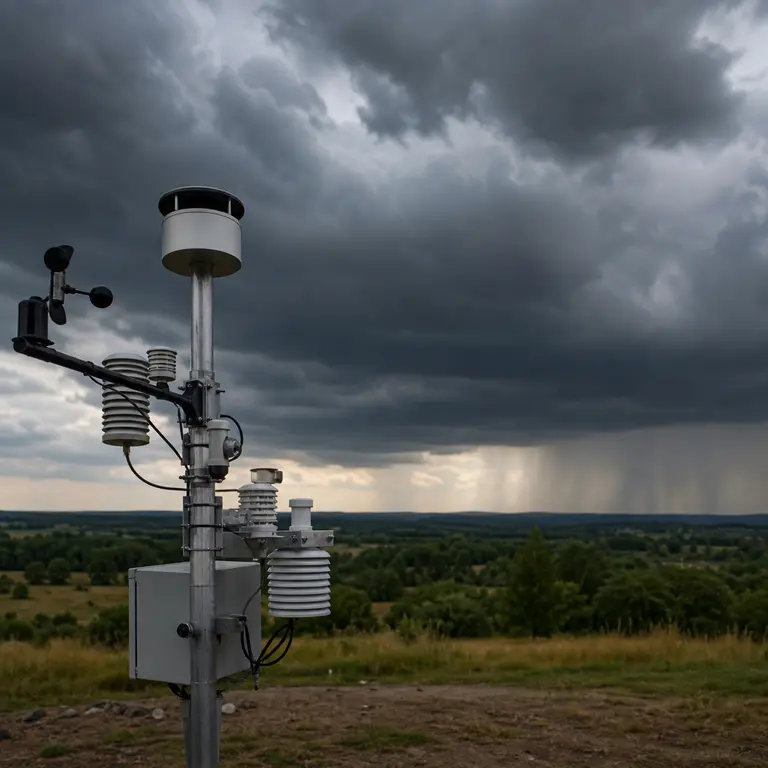
Several research groups, including teams at the University of Reading in the United Kingdom and the Indian Institute of Tropical Meteorology, have been developing low-cost electrochemical ozone sensors that can be deployed in dense networks to triangulate approaching electrical storms. Unlike radar, which requires substantial infrastructure and power, these sensors can operate on solar-charged batteries and transmit data via mobile networks. The principle is straightforward: if ozone concentration rises above a threshold and continues climbing, a storm generating lightning is approaching. The sensor is, in essence, doing what the human nose does — reading the chemical signature of an electrical storm before it arrives — but doing so continuously, quantitatively, and with the ability to transmit that information to anyone with a mobile phone.
The challenge lies in distinguishing lightning-generated ozone from anthropogenic sources. Urban environments produce ozone through photochemical reactions involving vehicle exhaust and industrial emissions — the same chemistry responsible for smog. Calibrating sensors to filter out this background noise while remaining sensitive to the sharp, transient spikes associated with convective storms requires machine learning algorithms trained on thousands of hours of atmospheric data. The temporal signature of lightning-derived ozone is distinctive: it rises steeply over a short window and is often accompanied by correlated changes in humidity, barometric pressure, and particulate matter. Algorithms trained to recognize this multivariate fingerprint can distinguish a storm signal from pollution with high accuracy. As of 2024, prototype networks are undergoing field testing in Kenya and Bangladesh, with preliminary results suggesting detection windows of 15 to 25 minutes before storm arrival — enough time to seek shelter or move livestock, and potentially enough time to save lives.
The Paradox of a Molecule That Both Protects and Poisons
Ozone occupies one of the more paradoxical positions in atmospheric chemistry. In the stratosphere, it is essential to life, absorbing ultraviolet radiation that would otherwise devastate DNA in surface organisms. Without the stratospheric ozone layer, the Earth's surface would be exposed to levels of UV-B radiation incompatible with most complex life. In the troposphere — the lowest layer of the atmosphere where weather occurs, and humans breathe — it is a pollutant. Ground-level ozone irritates lung tissue, exacerbates asthma, reduces crop yields, and contributes to an estimated 1 million premature deaths per year, according to the World Health Organization. The same molecule, separated by altitude, is the difference between a planetary life-support system and a public health hazard.
This vertical duality is sometimes summarized by atmospheric scientists as good up high, bad nearby. It is a phrase that captures the chemistry accurately but perhaps understates how strange this duality is. The ozone in the stratosphere and the ozone at ground level are chemically identical. What differs is context: at altitude, ozone intercepts radiation before it reaches biological tissue; at the surface, it is the biological tissue itself that encounters the molecule directly, and ozone’s oxidizing chemistry damages cellular structures in the lung in much the same way it damages other organic compounds.
The Montreal Protocol of 1987, which phased out chlorofluorocarbon emissions responsible for stratospheric ozone depletion, is widely considered the most successful international environmental treaty ever implemented. The Antarctic ozone hole, which reached its maximum recorded size of approximately 29.9 million square kilometers in September 2000, has since been slowly recovering and is projected to return to pre-1980 levels by mid-century. The recovery is not linear and has been complicated by the introduction of new industrial chemicals, but the overall trajectory is positive — a rare example of the international community identifying an atmospheric threat and responding effectively before the damage became irreversible.
The story of the ozone hole is also, in a quieter way, a story about the fragility of invisible systems. Nobody could smell the loss of stratospheric ozone. There was no sensory signal, no atmospheric messenger descending on storm downdrafts to announce the depletion. The damage was discovered through patient measurement and inference: scientists tracking the absorption spectra of ultraviolet radiation over Antarctica noticed that something had changed. The contrast with ground-level ozone is instructive: the molecule that protects us from above is silent in its protection and silent in its loss, while the molecule that harms us at ground level announces itself to every functioning human nose.
Conclusion
Meanwhile, the very ozone that signals an approaching storm — the same molecule Schönbein smelled in his Basel laboratory, the same chemical that carries the electric perfume of summer storms — continues to serve as an atmospheric messenger that human biology evolved to detect long before chemistry gave it a name. That the nose can sense it at concentrations far below regulatory concern suggests our ancestors may have used it as a reliable cue to seek shelter, encoding storm-survival behavior into olfactory sensitivity across hundreds of thousands of years of evolution. The sharpness of that smell, so distinctive that it earned its own word derived from the Greek for odor, is not incidental. It is the residue of a long conversation between atmospheric physics and biological adaptation, written in the language of molecular chemistry and read through the oldest sensory system we possess.
The story of ozone is ultimately a story about scale and connection. A molecule produced by lightning miles above the ground descends to announce itself to a farmer, a chemist, a child standing in a backyard watching the sky darken. The same molecule, in a different layer of the atmosphere, makes the existence of that farmer, that chemist, that child possible in the first place. Engineers are now teaching machines to read the signal that biology learned to read long ago, in the hope of extending the warning to people who have never had it. In this sense, the smell of electricity is not just a curiosity of atmospheric chemistry. It is a thread connecting the deep past of human evolution to the immediate present of climate adaptation, running through one of the simplest and most ancient of human experiences: catching a scent on the wind and knowing, without being told, that something is coming.
Sources & Further Reading
- Bear, I.J. and Thomas, R.G. Nature of Argillaceous Odour. Nature, 1964. https://www.nature.com/articles/201993a0
- National Oceanic and Atmospheric Administration. Ground-Level Ozone Basics. NOAA, 2022. https://www.noaa.gov
- Schönbein, C.F. On the Odour Accompanying Electricity and the Probability of Its Dependence on the Presence of a New Substance. Philosophical Magazine, 1840.
- World Health Organization. Ambient Air Pollution: Health Impacts. WHO, 2023. https://www.who.int/news-room/fact-sheets/detail/ambient-(outdoor)-air-quality-and-health