
The Gravity Waves That Reshape Planetary Atmospheres
Not to be confused with gravitational waves from colliding black holes, atmospheric gravity waves are invisible ripples driven by buoyancy forces that profoundly shape weather, climate, and even the upper atmospheres of other planets — yet they remain one of the most underrepresented forces in global climate models.
 Watch on YouTube
 Watch on Rumble
The Other Gravity Waves Nobody Talks About
When the LIGO collaboration announced the detection of gravitational waves in 2016, the world briefly became fascinated with ripples in spacetime. Physicists and science enthusiasts alike marveled at the idea that colliding black holes a billion light-years away could send tremors through the fabric of the universe detectable by instruments on Earth. The announcement dominated headlines for weeks and eventually earned its architects the Nobel Prize in Physics. But there is another class of wave carrying the word gravity in its name that has been reshaping planetary atmospheres for billions of years, largely without public notice. Atmospheric gravity waves, sometimes called buoyancy waves, are oscillations that arise when a parcel of air is displaced vertically in a stably stratified atmosphere. Gravity, acting as the restoring force, pulls the parcel back, causing it to oscillate up and down like a weight on a spring. The result is a wave that propagates both horizontally and vertically through the air column, transporting energy and momentum across vast distances.
These waves are not exotic phenomena confined to the edges of the atmosphere or the extremes of weather. They are generated constantly by thunderstorms, mountain ranges, ocean swells, jet streams, and even the wake of large wildfires. A single severe thunderstorm can launch gravity waves that travel upward into the mesosphere, more than 80 kilometers above Earth’s surface, carrying momentum that alters wind patterns thousands of kilometers away. Despite their ubiquity, they operate at spatial scales too small for most global climate models to resolve directly, a problem that climate scientists call the gravity wave parameterization problem, and one that introduces measurable uncertainty into century-scale climate projections. Understanding these invisible oscillations is not merely an academic exercise. It is increasingly clear that the accuracy of our best predictions about future climate depends on getting them right.
Mountains as Wave Generators
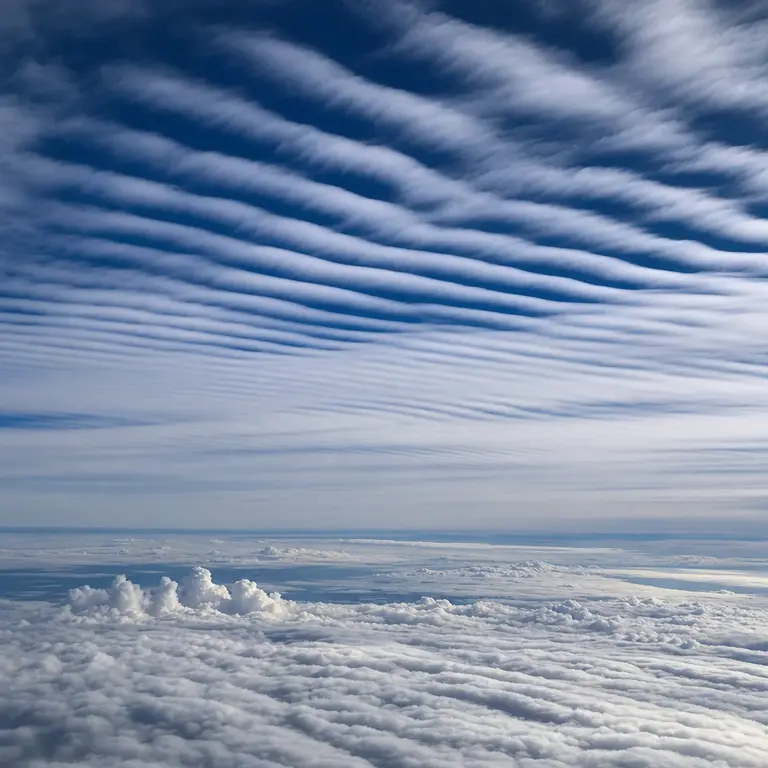
The most studied variety of atmospheric gravity wave is the orographic gravity wave, produced when horizontal wind flows over a mountain range and is forced upward. The displaced air oscillates as it crosses the terrain, producing a series of wave crests and troughs that can extend hundreds of kilometers downwind in what are called mountain waves or lee waves. These structures are not hypothetical constructs drawn on a whiteboard. They are physical enough to be exploited by pilots and visible enough to be photographed from orbit when the right conditions cause clouds to trace their outlines across the sky.
Glider pilots have exploited these structures for decades, riding the rising portions of mountain waves to altitudes unreachable by thermal soaring alone. The world record for unpowered glider altitude, set over the Andes in 2018 by Jim Payne and Tim Gardner, reached 23,202 meters, nearly the cruising altitude of a U-2 spy plane, using orographic gravity waves as an invisible elevator. That a human being could ascend to the lower boundary of the stratosphere without an engine, powered entirely by an atmospheric wave generated by wind crossing a mountain range, speaks to the extraordinary energy these structures carry.
At the atmospheric level, orographic waves generated by the Rockies, Andes, Himalayas, and Antarctic Peninsula play a measurable role in driving the quasi-biennial oscillation, a remarkably regular cycle in which equatorial stratospheric winds reverse direction approximately every 28 months. This oscillation, first described in detail by Richard Reed and colleagues in 1961, influences monsoon strength, hurricane frequency, and the timing of the Arctic polar vortex. The connection between a mountain range and a monsoon half a world away, mediated by waves propagating through the stratosphere, is exactly the kind of nonobvious coupling that makes atmospheric science both humbling and endlessly surprising. Recent work published in the Journal of the Atmospheric Sciences has demonstrated that orographic gravity wave drag accounts for a significant fraction of the momentum budget of the middle atmosphere, meaning that getting the waves wrong in a climate model means getting the stratosphere wrong, which in turn means getting surface climate wrong.
Gravity Waves Beyond Earth
One of the more striking aspects of atmospheric gravity waves is that they are not confined to Earth. Wherever a planetary body has an atmosphere with stable vertical stratification and some mechanism for displacing air parcels, gravity waves will form. The solar system turns out to be full of them, and the study of gravity waves on other worlds has become a productive branch of planetary science in its own right.
The Cassini spacecraft, during its 13-year mission to Saturn, detected gravity wave signatures in Saturn’s rings, an unexpected discovery that revealed the planet’s internal oscillation modes were exciting waves in the ring material itself, a phenomenon that researchers have taken to calling ring seismology. The rings of Saturn, it turned out, were acting as a vast and extraordinarily sensitive seismograph, recording the internal vibrations of a gas giant. On Venus, ESA’s Venus Express mission identified gravity wave patterns in the cloud tops at roughly 65 kilometers altitude, propagating away from the highland regions of Aphrodite Terra and Ishtar Terra. Because Venus rotates so slowly, completing one rotation every 243 Earth days, the interaction between its surface topography and its dense, fast-moving atmosphere, which completes a full circuit in just four Earth days, produces gravity waves of extraordinary amplitude. The mismatch between the surface and atmospheric paces creates a kind of permanent meteorological turbulence that gravity waves help mediate.
Mars presents a particularly striking case. NASA’s Mars Reconnaissance Orbiter has captured gravity wave patterns in Martian water-ice clouds with wavelengths of 30 to 50 kilometers, strikingly similar in appearance to the billow clouds seen over Earth’s mountain ranges. The thin Martian atmosphere, only about one percent the density of Earth’s, might seem an unlikely medium for wave propagation, but the steep thermal gradients near the Martian surface create strong buoyancy forces that support robust wave activity. Understanding Martian gravity waves has direct engineering implications that go well beyond scientific curiosity. The waves create turbulence that complicates the entry, descent, and landing profiles of spacecraft, and future crewed missions will need to account for them in landing site selection and in the design of habitats that must withstand repeated atmospheric stress.
The Climate Model Crisis and the Path Forward
The core problem with atmospheric gravity waves from the perspective of climate science is one of scale. Global climate models typically operate on horizontal grid spacings of 25 to 100 kilometers. Atmospheric gravity waves relevant to the momentum budget of the middle atmosphere often have horizontal wavelengths of 10 to 50 kilometers, placing them below the resolution threshold of most operational models. Modelers compensate by using parameterization schemes, mathematical approximations that represent the statistical effect of unresolved waves rather than simulating them directly. These schemes were largely developed in the 1990s and carry assumptions that observational campaigns have since shown to be systematically wrong in certain regions, particularly over the Southern Ocean and the Antarctic continent, where wave sources are sparse and difficult to characterize from the ground.
The consequences are not trivial and do not remain confined to the stratosphere. A 2022 study in Geophysical Research Letters found that errors in gravity-wave parameterization contribute to a persistent cold bias in the Southern Hemisphere stratosphere across virtually every major climate model currently in use. That bias cascades downward, affecting surface wind patterns and sea ice extent, thereby propagating errors throughout the entire simulated climate system. When a climate model incorrectly represents the winds over the Southern Ocean, it also misrepresents the ocean circulation beneath it, the deep-ocean heat uptake, and, ultimately, the rate at which the planet warms in response to rising greenhouse gas concentrations. A wave too small to see on a weather map turns out to be consequential enough to skew projections of global temperature decades into the future.
The emerging solution is a combination of approaches that would have seemed implausible even a decade ago. Ultra-high-resolution global storm-resolving models, which operate at grid spacings of one to five kilometers and can explicitly simulate gravity waves rather than parameterizing them, are now being run on the most powerful supercomputers available. Satellite observations from instruments like the Atmospheric Infrared Sounder aboard NASA’s Aqua satellite are providing global maps of gravity wave activity, allowing modelers to test and correct their parameterization schemes against real data. Perhaps most intriguingly, a new generation of superpressure balloons, balloons that maintain a constant density level rather than a constant altitude and can drift through the stratosphere for weeks at a time, are logging wave activity in regions where no other observing platform can reach. The Strateole-2 campaign, a joint French-American project that deployed 20 such balloons over the tropical Pacific between 2019 and 2021, has already produced datasets that are forcing a fundamental revision of how gravity wave sources are distributed globally.
Conclusion
The story of atmospheric gravity waves is, in miniature, the story of how science tends to work. A phenomenon too common to seem remarkable, too small to fit conveniently into the dominant models, and too widespread to study exhaustively turns out to be load-bearing in ways that only become apparent when the models built without it begin to fail. The invisible oscillations threading through every planetary atmosphere are not background noise or atmospheric decoration. They are structural elements in the architecture of climate itself, connecting mountain ranges to monsoons, thunderstorms to the stratosphere, and the internal vibrations of Saturn to the geometry of its rings.
What makes this field particularly interesting at this moment is the convergence of tools that are finally capable of meeting the problem on its own scale. Kilometer-resolution models, stratospheric balloon networks, and a new generation of satellite instruments are collectively producing a picture of gravity wave activity that no single approach could have assembled on its own. The science of understanding these waves is only now catching up to their importance, and the revisions it is forcing on climate projections are a useful reminder that the atmosphere, like most complex systems, keeps secrets in the places we were too confident we already understood.
Sources & Further Reading
- Alexander, M. Joan, et al. 'Recent developments in gravity-wave effects in climate models and the global distribution of gravity-wave momentum flux from observations and models.' Quarterly Journal of the Royal Meteorological Society, 2010. https://doi.org/10.1002/qj.637
- Fritts, David C., and M. Joan Alexander. 'Gravity wave dynamics and effects in the middle atmosphere.' Reviews of Geophysics, 2003. https://doi.org/10.1029/2001RG000106
- NASA Jet Propulsion Laboratory. 'Aqua Mission: Atmospheric Infrared Sounder.' NASA, ongoing. https://airs.jpl.nasa.gov
- Holt, Larissa A., et al. 'Strateole-2 superpressure balloon observations of gravity waves in the tropics.' Journal of Geophysical Research: Atmospheres, 2023. https://doi.org/10.1029/2022JD038041