
Adipocere: The Waxy Mystery Preserving the Dead's Secrets
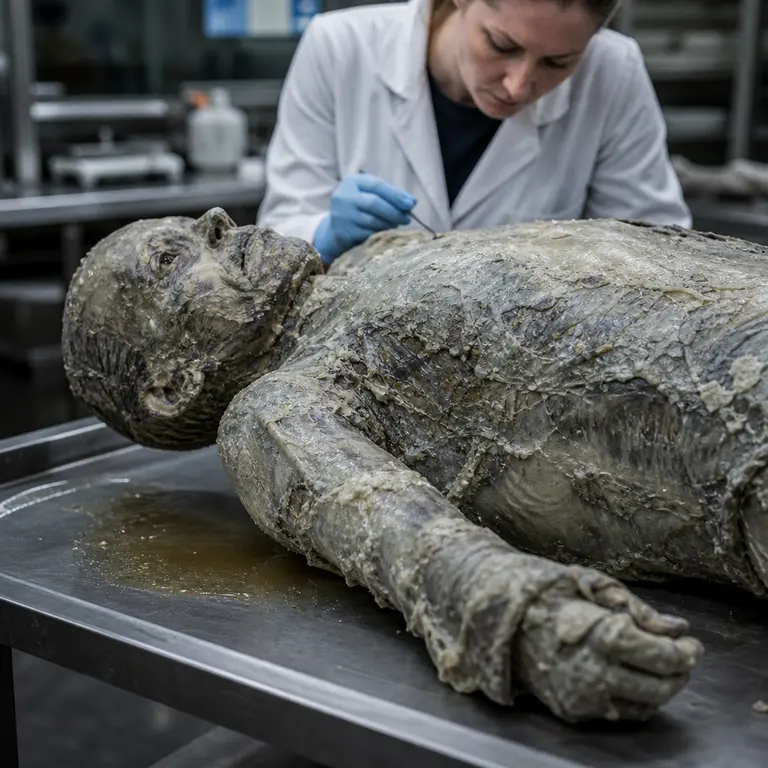
Saponification — the chemical transformation of human fat into a soap-like substance called adipocere — has preserved entire bodies for centuries, and forensic scientists are now using it to rewrite cold cases and ancient burial histories.
 Watch on YouTube
 Watch on Rumble
When the Dead Refuse to Decay
In 1786, workers draining a Parisian cemetery made a discovery that would unsettle anatomists for generations. Beneath the soil lay bodies not rotted, not skeletonized, but transformed — their flesh converted into a pale, waxy, faintly soapy substance that held the shape of living tissue with uncanny fidelity. The material was named adipocere, from the Latin adeps (fat) and cera (wax), and it would become one of forensic science’s most consequential and least understood phenomena.
The discovery was made at the Saints-Innocents cemetery, one of the oldest and most overcrowded burial grounds in Paris, which had been in continuous use since the tenth century. By the time workers began draining it in preparation for its closure, the cemetery had absorbed the remains of an estimated two million people. The sheer density of burials, combined with the anaerobic, moisture-saturated soil, had created conditions ideal for a transformation that science at the time lacked a framework to explain. The French chemist Antoine Fourcroy was among the first to study the material systematically, describing it as a kind of grave wax and noting its structural resemblance to soap. What Fourcroy could not have known was that he was observing a process that had been quietly occurring in graves, bogs, shipwrecks, and sealed tombs across the world for as long as humans had been burying their dead.
Adipocere is not decomposition in the conventional sense. It is, in chemical terms, saponification — the alkaline hydrolysis of body fat into long-chain fatty acids and their salts. The result is a substance resembling hard soap or tallow, capable of preserving soft tissue, internal organs, and even facial features for decades, centuries, or in exceptional cases, millennia. The conditions that trigger it are specific: anaerobic environments, moisture, and warmth. Waterlogged graves, submerged bodies, and sealed coffins are ideal incubators. What makes the phenomenon so scientifically significant is not merely that it preserves the dead, but that it does so in a way that retains biological information — the kind of information that can answer questions about identity, cause of death, and the circumstances of burial long after conventional decomposition would have erased every trace.
The Chemistry Beneath the Skin
The process begins within weeks of death. Anaerobic bacteria — particularly Clostridium species — begin hydrolyzing triglycerides in adipose tissue, releasing glycerol and free fatty acids. In the presence of alkaline soil minerals or body fluids, these fatty acids undergo saponification, binding with calcium, magnesium, or sodium ions to form insoluble soaps. The resulting adipocere is chemically dominated by hydroxystearic acid, palmitic acid, and oleic acid derivatives.
What makes this transformation remarkable is its self-perpetuating quality. Once a sufficient layer of adipocere forms on the body’s exterior, it creates a physical barrier that slows further microbial intrusion, effectively mummifying the interior. Researchers at the University of Tennessee’s Anthropological Research Facility — the famous Body Farm — have documented cases in which adipocere formation began as early as 5 weeks post-mortem in warm, wet conditions and persisted with structural integrity for over a century in controlled burial simulations. The Body Farm, established by forensic anthropologist William Bass in 1981, has provided much of the foundational empirical data on adipocere formation rates, and its long-term burial studies remain the most comprehensive source of information on how environmental variables influence the process.
The substance is not uniform. Depending on the body’s fat distribution, age, and burial chemistry, adipocere can range from soft and greasy to hard and chalk-like. Infants and obese individuals form it more readily due to higher fat content. In rare mass burial events — shipwrecks, flooded crypts, collapsed mineshafts — entire groups have been found in various stages of adipocere formation, creating what forensic anthropologists call saponification clusters. One of the most striking documented examples occurred during the excavation of a 19th-century burial vault in Philadelphia, where the sealed, moisture-rich environment had driven adipocere formation across multiple interments simultaneously, preserving bodies buried decades apart in comparable states of waxy transformation. The uniformity of the process across different individuals in the same environment underscored how powerfully ambient conditions can override individual biological variation in determining the trajectory of post-mortem change.
Cold Cases and the Forensic Renaissance
For much of history, adipocere was regarded as a curiosity rather than a tool. That changed in the late 20th century as forensic anthropology matured into a rigorous discipline. Adipocere-preserved remains now offer investigators a remarkable window into the cause of death, identity, and post-mortem interval — the time elapsed since death.
In 2004, forensic scientists analyzing remains from a 19th-century New York burial ground found that adipocere preservation had maintained enough soft tissue to recover histological evidence of tuberculosis lesions — something skeletonized remains could never provide. Similarly, a 2011 study published in the Journal of Forensic Sciences demonstrated that DNA extraction from adipocere-preserved tissue yielded significantly higher-quality genetic material than from comparably aged dry remains, opening new avenues for identifying victims of historical crimes and disasters. This finding has particular relevance for mass casualty events involving water — floods, ferry sinkings, and maritime disasters — where bodies may spend extended periods submerged before recovery and where conventional decomposition would otherwise degrade forensic evidence beyond utility.
Perhaps most dramatically, adipocere played a central role in the forensic investigation of the Cromwell Street murders in Gloucester, England, where the remains of victims buried by Fred and Rosemary West in the 1970s and 1980s had partially saponified. The preservation of soft tissue allowed pathologists to determine wound characteristics and positioning that would have been impossible to recover from skeletonized material alone. The case illustrated a point that forensic scientists have come to appreciate with increasing clarity: adipocere is not simply an obstacle to standard decomposition analysis but an alternative preservation pathway that, when properly understood, can yield evidence of exceptional quality.
The substance also confounds time-of-death estimates. Because adipocere slows conventional decomposition, investigators who encounter it without recognizing its presence may dramatically miscalculate how long a body has been buried. A body in an advanced state of saponification may superficially resemble remains that are far older or far younger than they actually are, depending on the local chemistry and hydrology of the burial environment. Forensic training programs now include dedicated modules on identifying and interpreting saponification stages, and the development of standardized scoring systems for adipocere extent and consistency has helped investigators communicate more precisely about what they are observing when they encounter it in the field.
Ancient Adipocere and the Archaeology of Preservation
Beyond criminology, adipocere has reshaped archaeological interpretation of burial sites across Europe, Asia, and the Americas. The Bog Bodies of northern Europe — preserved in acidic, anaerobic peat — represent the most famous examples of exceptional soft-tissue preservation, but many owe their survival not to the bog’s acidity alone but to partial saponification working in concert with the tannin-rich environment.
The Haraldskær Woman, discovered in a Danish bog in 1835 and initially believed to be a medieval queen, has been reanalyzed multiple times. Modern studies suggest her soft-tissue preservation involved both the classic bog-mummification mechanism and adipocere formation in her subcutaneous fat layers, a combination that gave her skin its distinctive leathery quality while preserving deeper structures. The interplay between these two preservation pathways is now recognized as more common than previously assumed, and archaeologists working with waterlogged organic remains have begun incorporating adipocere analysis into their standard examination protocols.
In China, the Han dynasty tomb of Lady Dai at Mawangdui — opened in 1972 — revealed a 2,100-year-old body in a state of preservation so complete that her joints still bent, her skin remained elastic, and her internal organs were intact enough for autopsy. While much of this preservation is attributed to the tomb’s sealed, oxygen-poor environment and a mysterious acidic liquid surrounding the coffin, Chinese forensic researchers have identified adipocere formation in her abdominal fat layers as a contributing factor. The case of Lady Dai remains one of the most studied examples of ancient soft-tissue preservation in the world, and ongoing analysis of her remains continues to yield new insights into the biochemistry of long-term preservation. Her body, in a very real sense, is still being read, still yielding information about a life lived more than two millennia ago — a testament to the extraordinary archival capacity of a substance that forms not by design but by the blind operation of chemistry in the dark.
The Living Chemistry of the Dead
Recent research has added a microbial dimension to adipocere science that earlier investigators could not have anticipated. A 2019 study from the University of Liège in Belgium found that the bacterial communities responsible for initiating saponification are not random opportunists but a predictable, successional consortium — a structured ecological community that assembles in a reproducible sequence after death. This discovery has implications for post-mortem interval estimation, suggesting that the microbial fingerprint of an adipocere-bearing body could serve as a biological clock independent of chemical analysis. The field of thanatomicrobiome research — the study of microbial communities associated with decomposition — is still in its early stages, but the Liège findings represent a significant step toward a more complete model of how the body’s internal ecology shapes its post-mortem fate.
Moreover, emerging research in taphonomy — the study of how organisms decay after death — has identified adipocere as a potential carbon sink. In waterlogged environments, saponified bodies resist full microbial breakdown, which would release carbon dioxide and methane, effectively sequestering organic carbon in stable fatty acid salts for extended periods. The ecological significance of this finding remains under investigation, but it suggests that mass burial events in anaerobic environments may have had measurable, if minor, effects on local carbon cycling. This is a counterintuitive implication: that the manner in which a society disposed of its dead could have left a faint but detectable mark on the environment's chemistry.
There is something philosophically arresting about adipocere when considered in full. It is a substance that forms in the absence of intention, through the convergence of moisture, bacteria, and soil chemistry, yet accomplishes something that the most deliberate acts of preservation — embalming, mummification, freezing — often fail to achieve over comparable timescales. It preserves not just structure but biological information: DNA, histological architecture, the microscopic signatures of disease and injury. The dead, under the right conditions, become their own archivists.
Adipocere sits at the intersection of chemistry, microbiology, forensics, and archaeology — a substance born from death that paradoxically preserves the evidence of life with extraordinary fidelity. As analytical techniques grow more sophisticated, the waxy residue of the Parisian cemetery workers’ 1786 discovery continues to yield secrets that the living could not have anticipated the dead would keep. From cold case investigations to ancient burial grounds to emerging questions in environmental science, the chemistry of saponification has proven to be one of the most consequential and underappreciated processes in the natural history of the human body. The dead, it turns out, have much more to say than we once imagined — and the medium through which they speak is a pale, waxy soap that forms in the dark, over years, in silence.
Sources & Further Reading
- Dent, B.B., Forbes, S.L., and Stuart, B.H. Review of Human Decomposition Processes in Soil. Environmental Geology, 2004.
- Vass, A.A. Beyond the Grave: Understanding Human Decomposition. Microbiology Today, 2001. https://www.microbiologyresearch.org
- De Boer, H.H., et al. Adipocere Formation in Forensic Contexts: A Review. Journal of Forensic Sciences, 2011.
- Brier, B. The Encyclopedia of Mummies. Checkmark Books, 1998.