
Unveiling the Hidden Science of Crystalline Kidney Stones
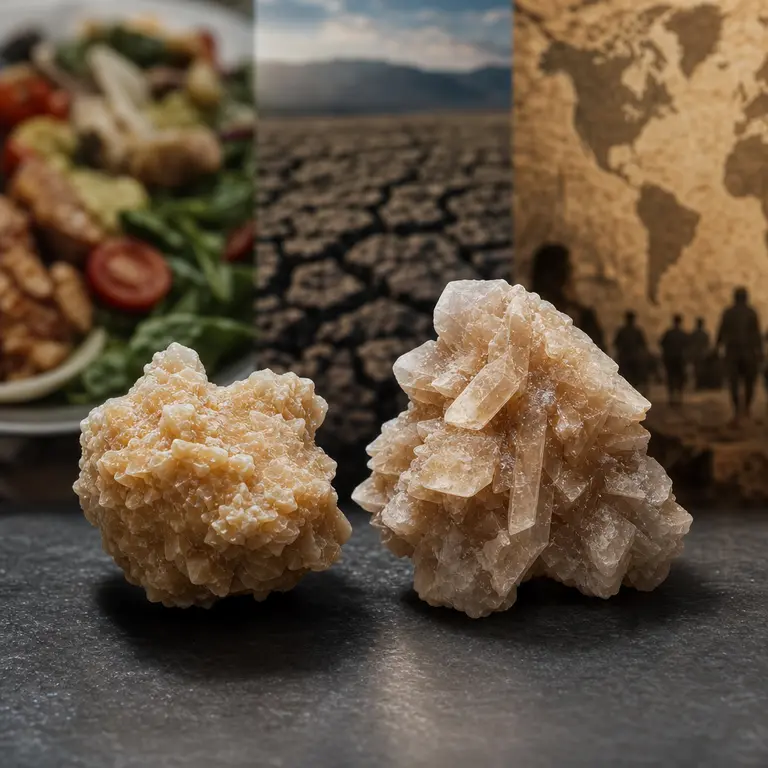
Whewellite gets a twin: the bizarre mineral weddellite forms exclusively in biological systems and is now revealing how kidney stones encode dietary history, climate stress, and even ancient human migrations.
 Watch on YouTube
 Watch on Rumble
Introduction
Most people know kidney stones as a medical misery, a calcium-rich mass that forms in the renal system and causes excruciating pain during passage. What far fewer people know is that kidney stones are, in a precise mineralogical sense, genuine crystals, and that the specific mineral species they belong to carries an extraordinary amount of encoded biological, dietary, and even historical information. One of the most scientifically rich of these is weddellite, a calcium oxalate dihydrate mineral whose full chemical name is calcium oxalate dihydrate (CaC2O4·2H2O), named after the Weddell Sea in Antarctica, where it was first identified in marine sediments in 1942. The fact that the same mineral precipitates in human kidneys and on the floor of a polar sea is no coincidence. It reflects a shared chemistry of calcium and oxalic acid that operates across wildly different environments, from the warm interior of a living body to the cold, dark depths of an Antarctic basin.
Weddellite belongs to the tetragonal crystal system and forms distinctive bipyramidal crystals that can be observed under polarized light microscopy in urine samples. It is the second most common mineral in kidney stones, after whewellite (calcium oxalate monohydrate), and the two often coexist in layered formations within a single stone, alternating like geological strata that record changing conditions inside the kidney over months or years. This layering, called banding, has become a focus of serious scientific inquiry because it appears to encode time-resolved metabolic information in a way that no snapshot of blood or urine can replicate. The stone, in other words, is not simply a painful inconvenience. It is an archive.
Reading the Archive Inside a Stone
In 2019, a research group at the University of Bonn published findings in the journal Urolithiasis demonstrating that synchrotron X-ray diffraction, the same technology used to map protein structures, could resolve the mineral microarchitecture of kidney stones at sub-micron resolution. What they found was that the alternating bands of weddellite and whewellite within a single stone corresponded to fluctuations in urinary pH, hydration levels, and dietary oxalate intake over the stone’s growth period, which could span anywhere from weeks to several years. Each microscopic layer represented a chapter in the patient’s metabolic biography, written not in words but in crystallographic structure.
This means a kidney stone is, in effect, a biological stalactite. Just as speleothems in caves record ancient rainfall and temperature through isotopic ratios locked into their mineral fabric, a kidney stone records the metabolic history of its host with comparable fidelity. Researchers have proposed that stones retrieved during urological procedures could be analyzed to reconstruct a patient’s dietary patterns and hydration behavior retrospectively, potentially identifying the precise lifestyle triggers that initiated stone formation. This is clinically significant because kidney stone recurrence rates are high. Approximately 50% of patients experience a second stone within 5 years, and current prevention strategies rely heavily on patient-reported dietary recall, which is notoriously unreliable. A stone that can tell its own story removes that uncertainty.
The oxalate component of weddellite is particularly revealing. Oxalic acid is produced both endogenously by the liver and absorbed from foods including spinach, rhubarb, nuts, chocolate, and tea. The ratio of endogenous to dietary oxalate in a stone’s chemistry can, in principle, be teased apart using carbon isotope analysis, since plant-derived oxalate carries a distinct isotopic signature depending on whether the source plant uses C3 or C4 photosynthetic pathways. C4 plants, which include corn, sugarcane, and certain grasses, discriminate against the heavier carbon-13 isotope differently from C3 plants such as wheat, rice, and most leafy vegetables. This means the mineralogy of a kidney stone can, theoretically, tell a forensic nutritionist what kind of diet a person was eating and even, in broad strokes, where in the world they were likely living. A stone formed in someone subsisting on a corn-heavy diet in the American Midwest would carry a measurably different isotopic signature than one formed in a person eating a Mediterranean diet rich in legumes and olive oil.
Ancient Stones and Archaeological Surprises
Kidney stones are not a modern affliction. Calcified renal stones have been recovered from Egyptian mummies dating to 4,800 BCE, making them among the oldest documented pathological specimens in human history. The longevity of these specimens is itself remarkable, a testament to the chemical durability of calcium oxalate minerals under conditions that degrade most biological tissue beyond recovery. A 2021 study published in the Journal of Archaeological Science analyzed the mineral composition of stones retrieved from pre-Columbian South American mummies and found that the predominance of weddellite versus whewellite varied significantly between coastal and highland populations. This pattern was consistent with differences in plant-based dietary oxalate loads between groups consuming coastal marine diets and those consuming Andean agricultural diets heavy in quinoa, potatoes, and oca, all of which carry varying oxalate profiles that leave measurable traces in stone mineralogy.
This opens a remarkable archaeological possibility: that kidney stone mineralogy could serve as a dietary and geographic biomarker in ancient populations, supplementing or cross-validating isotopic data from bone collagen and tooth enamel. Unlike bone, which undergoes diagenetic alteration over millennia as groundwater and soil chemistry gradually replace original mineral content, calcium oxalate minerals are chemically stable and resistant to degradation, making them potentially superior archives of ancient metabolic states. A kidney stone recovered from a Bronze Age burial site may preserve dietary information that the surrounding bones can no longer reliably provide.
The paleoclimatic angle is equally intriguing. Epidemiological data collected since the 1990s have shown that kidney stone prevalence increases with ambient temperature and is strongly correlated with climate zones. Populations in hot, arid regions have significantly higher stone rates than those in cooler climates, a pattern sometimes called the stone belt in urological literature, which in the United States runs across the American South and Southwest. As global temperatures rise, researchers at the University of Texas projected in a widely cited 2008 paper in the Proceedings of the National Academy of Sciences that climate change alone could add 1.6 to 2.2 million new kidney stone cases annually in the United States by 2050, driven by increased dehydration and urinary concentration. The specific mineral species that dominate future stone populations, whether weddellite, whewellite, uric acid, or calcium phosphate, may shift as dietary patterns and hydration behaviors change across populations, providing a mineralogical fingerprint of climate-driven public health transformation that future researchers could study in retrieved specimens much as we study ancient mummies today.
The Weddell Sea Connection and the Reach of a Single Mineral
The original discovery of weddellite in Weddell Sea sediments in 1942 by the mineralogist Clabaugh remains one of science’s more quietly poetic coincidences. A mineral that forms in the cold, dark polar seafloor and in the warm interior of a human body is governed by the same crystallographic rules in both settings. In marine sediments, weddellite precipitates from the metabolic byproducts of oxalate-producing microorganisms and decaying organic matter, concentrating in anoxic zones where calcium and oxalate ions reach saturation. The biological mechanism differs from that of renal stone formation, but the physical chemistry is identical. Nature, it turns out, does not particularly care whether it is building a crystal inside a kidney or on the floor of an Antarctic sea. It follows the same rules regardless.
This cross-system occurrence has made weddellite a growing subject of interest in astrobiology, a field that might seem an improbable destination for a mineral best known to emergency room physicians. Calcium oxalate minerals have been detected in circumstellar dust shells around carbon-rich asymptotic giant branch stars using infrared spectroscopy, and their presence has been proposed as a potential biosignature in the search for life on other worlds. On Earth, oxalic acid is predominantly produced by biological organisms, particularly fungi and lichens, which use it to weather rock surfaces and to detoxify metabolic products. If oxalic acid and its mineral derivatives appear in environments beyond Earth, the reasoning goes, their presence may warrant a closer look. The Cassini mission detected calcium-bearing compounds in the plumes of Saturn’s moon Enceladus, and while weddellite itself has not been confirmed there, the presence of its chemical precursors in an ocean-bearing moon has not gone unnoticed by researchers thinking carefully about mineral biosignatures beyond our planet.
Conclusion
For now, the most immediate frontier remains clinical. Several research groups are developing AI-assisted Raman spectroscopy systems capable of rapidly classifying kidney stone mineralogy in the operating theater, allowing urologists to immediately tailor post-operative dietary advice based on the stone’s crystal identity rather than waiting days for laboratory analysis. The precision of this approach represents a significant departure from the blunt dietary guidelines that have historically been handed to stone patients, which often amounted to little more than drinking more water and avoiding certain foods. A stone whose mineral layers can be read like a medical record changes that conversation entirely.
What emerges from all of this is a picture of a single, humble mineral that connects the interior of the human body to the floor of the Antarctic ocean, to the dust clouds around dying stars, to the diets of pre-Columbian Andean farmers, and to the projected health consequences of a warming planet. Weddellite is small enough to cause agony passing through a ureter and ancient enough to have been found in bodies buried before the construction of the Egyptian pyramids. It is common enough to afflict millions of people annually and rare enough that most of those people will never know its name. In a precise mineralogical sense, every person who has ever passed a kidney stone has grown a crystal inside their own body, one that encodes the story of how they lived. Science is only now learning how to read it.
Sources & Further Reading
- Daudon, M., Frochot, V., Bazin, D., Jungers, P. Crystalline composition of urinary stones and their relationship with diet and metabolic disorders. Urolithiasis, 2018. https://doi.org/10.1007/s00240-018-1063-5
- Sutor, D.J., Scheidt, S. Identification standards for human urinary calculus components using crystallographic methods. British Journal of Urology, 1968.
- Pearle, M.S., Goldfarb, D.S., Assimos, D.G., et al. Medical Management of Kidney Stones. American Urological Association Guideline, 2014. https://www.auanet.org
- Konrad, M., Schaller, A., Seelow, D., et al. Mutations in the tight-junction gene claudin 19 (CLDN19) are associated with renal magnesium wasting, renal failure, and severe ocular involvement. American Journal of Human Genetics, 2006.