
Unveiling the Astonishing Origins of the Color Purple
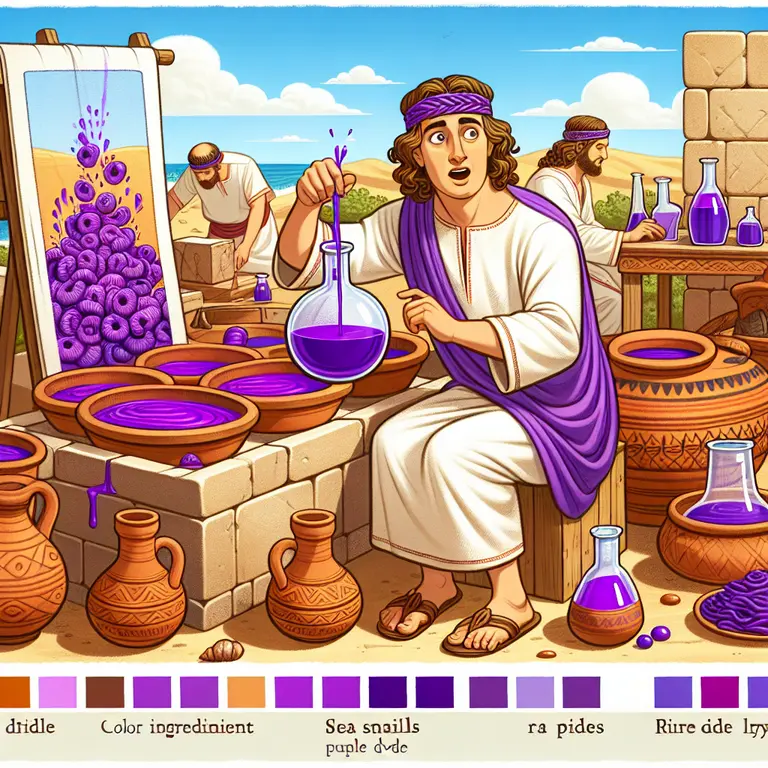
Purple dye was accidentally discovered by ancient Phoenicians.
Introduction
Few discoveries in human history have carried the weight of an entire civilization’s identity, shaped the politics of empires, and transformed the economics of ancient trade routes quite like a color. Tyrian purple, extracted from the humble sea snail along the rocky shores of the eastern Mediterranean, became one of the most coveted and expensive substances in the ancient world. Its story is one of accident, ambition, and astonishing cultural reach, stretching from the beaches of Phoenicia to the throne rooms of Rome and Byzantium. To understand how a dye could command more value than gold, one must look closely at the civilization that first mastered its production and the extraordinary lengths required to create even the smallest quantity.
The Phoenicians, who flourished between approximately 1570 and 539 BC along the coast of the Mediterranean near present-day Lebanon and Syria, were among antiquity’s most accomplished seafarers and merchants. Their city-states, particularly Tyre and Sidon, served as commercial hubs connecting the ancient world. They traded timber, glass, and skilled craftsmanship, but nothing defined their legacy more distinctly than the royal dye they extracted from the sea. Tyrian purple was not simply a product. It was a statement of power, a marker of divine authority, and an economic force that shaped the politics of every civilization it touched.
Origin and Production: A Labor Unlike Any Other
Tyrian purple, also known as Royal purple or Imperial purple, was derived from a group of predatory sea snails, most notably Murex brandaris and Hexaplex trunculus, both of which belong to the broader Murex family. These snails inhabited the shallow coastal waters of the eastern Mediterranean, and harvesting them in sufficient quantities required enormous human effort. Ancient production sites, identified by archaeologists through the presence of vast midden heaps, or refuse piles of crushed snail shells, have been found near Tyre, Sidon, and other Phoenician coastal cities. The sheer scale of these shell deposits gives modern researchers a striking sense of how industrialized this process actually was.
The dye itself was produced from a mucous secretion found in a small gland within the snail’s body. When exposed to sunlight and air, this secretion underwent a chemical transformation, shifting through yellow and green before settling into the deep, rich purple that made it so prized. The extraction process was notoriously unpleasant. The snails were crushed or their shells broken, and the glands removed and left to soak in salted water for several days. The resulting liquid was then boiled down in large lead vats, a process that produced an overwhelming stench, reportedly detectable from miles away. Ancient writers described Tyrian purple workshops as places one would not wish to live near, regardless of the wealth they generated.
To produce just one gram of usable dye required the processing of approximately ten thousand snails. A single pound of dyed wool could cost the equivalent of a laborer’s annual wage. This staggering ratio of raw material to finished product made Tyrian purple not merely expensive but genuinely scarce, which in turn amplified its social and political significance. Only rulers, high priests, and the wealthiest aristocrats could afford garments dyed entirely in this color, which gave it an almost sacred quality in the eyes of ancient peoples.
The Legend of Discovery: A Dog, a Nymph, and a God-King
Like many of the ancient world’s most significant discoveries, the origin of Tyrian purple is wrapped in mythology, and the story passed down is both charming and revealing about how the Phoenicians understood their own history. According to the legend, the god-king Melqart, the divine patron of the city of Tyre, was walking along the beach one day in the company of his companion, a nymph named Tyros. His dog, having chased and bitten into a cluster of sea snails along the shoreline, returned to its master with its muzzle stained a vivid, startling shade of purple.
Tyros was immediately captivated by the color. According to the tale, she declared to Melqart that she would refuse to look upon him again unless he presented her with a garment dyed in that exact shade. Motivated by this demand, Melqart began gathering snails from the shore and experimenting with their contents until he successfully replicated the intense hue his dog had inadvertently discovered. The resulting dye was presented to Tyros, and the city of Tyre, named in her honor, became the center of purple dye production in the ancient world.
While this story is clearly apocryphal, it carries real cultural meaning. It frames the discovery not as the result of deliberate scientific inquiry but as a gift from the divine realm, stumbled upon through nature and refined through devotion. This framing elevated the dye’s status from mere commodity to something approaching the sacred, a perception that would follow Tyrian purple throughout its long history. The story also places a woman’s aesthetic desire at the center of one of antiquity’s most consequential discoveries, a detail that has not gone unnoticed by historians of gender and mythology.
Historical Impact: Empires, Trade, and the Meaning of a Color
The cultural and political significance of Tyrian purple extended far beyond the borders of Phoenicia. As Phoenician traders established colonies and commercial networks across the Mediterranean, the dye traveled with them, entering the courts and wardrobes of Greece, Rome, Egypt, and Persia. In Rome, the color became so thoroughly associated with imperial authority that Julius Caesar reportedly decreed that only he could wear a toga entirely of Tyrian purple. Later, Roman emperors formalized these restrictions, making unauthorized use of the dye a punishable offense. The word porphyrogennetos, meaning born in the purple, was used in the Byzantine Empire to describe heirs born to a reigning emperor, signifying that their legitimacy was woven into the very color of their origins.
The dye also played a significant role in the broader trade networks of the ancient world, including routes connecting the Mediterranean to the Near East and Central Asia. Tyrian purple cloth was a luxury export that commanded premium prices wherever it traveled, and its production helped sustain the economies of Phoenician city-states for centuries. The dye’s reach was not merely commercial. It influenced religious practice as well. Biblical texts describe the use of purple in the construction of the Tabernacle and in the garments of high priests, suggesting that its sacred associations crossed cultural and theological boundaries.
The fall of Constantinople in 1453 AD effectively ended the Byzantine tradition of imperial purple, cutting off one of the dye's last institutional uses at the highest levels of political life. By this point, the original Murex-based production had already declined significantly, partly due to overharvesting of snail populations and partly due to the disruption caused by centuries of conflict and shifting trade patterns. The color itself, however, never lost its symbolic power. When synthetic purple dyes were developed in the nineteenth century, most famously by the young English chemist William Henry Perkin in 1856, the color immediately became fashionable and democratized in ways unthinkable to ancient Phoenician craftsmen.
Conclusion
The story of Tyrian purple is, at its heart, a story about the extraordinary lengths human beings will go to in pursuit of beauty and distinction. From the stinking workshops of ancient Tyre, where thousands of sea snails were processed to yield a few precious grams of dye, to the throne rooms of Rome and Byzantium where the color served as the visual language of supreme authority, Tyrian purple shaped the ancient world in ways that extended well beyond fabric and fashion. It drove trade, defined social hierarchies, entered religious ritual, and inspired legend.
What makes this history particularly remarkable is how a single biological accident, a dog biting into a snail on a Phoenician beach, could set in motion centuries of cultural consequence. The color purple remains, even today, associated with royalty, luxury, and mysticism in cultures around the world, an inheritance that traces directly back to those rocky Mediterranean shores. The Phoenicians may have disappeared as a distinct civilization, but the color they gave the world has proven to be one of their most enduring and surprising contributions to human history.