
Decoding Solar Mysteries: Neutrinos and the Cno Cycle
Deep beneath Italy's Gran Sasso massif, the Borexino experiment spent decades capturing solar neutrinos with unprecedented precision, revealing secrets about the Sun's core that no telescope could ever see.
 Watch on YouTube
 Watch on Rumble
Seeing the Sun from the Inside Out
Most people understand the Sun through its light — the photons that leave the solar surface and reach Earth in roughly eight minutes. But those photons tell a deceptively shallow story. A photon generated by nuclear fusion in the Sun’s core takes anywhere from 10,000 to 170,000 years to random-walk its way through the dense plasma before it ever escapes into space. The process is not a straight-line journey but an endless series of absorptions and re-emissions, each step redirected by the crushing pressure and opacity of solar material. By the time sunlight reaches your eyes, it carries almost no direct information about what is happening at the center of the star right now. In a very real sense, the light you see on a summer afternoon was born in the solar core before our ancestors had developed agriculture.
Neutrinos are different. They interact so weakly with matter that they travel from the Sun’s core to Earth in just over eight minutes, passing through the entire solar mass as though it barely exists. Every second, approximately 65 billion solar neutrinos pass through every square centimeter of your body — through your skin, your bones, and the chair beneath you — without depositing so much as a single measurable effect. They are, in the most literal sense, messengers from the present moment inside the Sun, carrying information about nuclear reactions happening right now rather than light echoing from processes that concluded tens of thousands of years ago.
Capturing even a handful of them requires extraordinary engineering and extraordinary patience. The Borexino detector, housed 1,400 meters beneath the Gran Sasso mountains in central Italy, was built to do exactly that. After more than two decades of operation, it produced results that fundamentally confirmed and extended our understanding of stellar physics, including the first direct detection of neutrinos produced by the carbon-nitrogen-oxygen (CNO) fusion cycle — a process theorized since 1938 but never before directly observed in the Sun. The announcement, published in the journal Nature in 2020, represented one of the most significant confirmations in the history of nuclear astrophysics.
A Cathedral of Liquid Scintillator
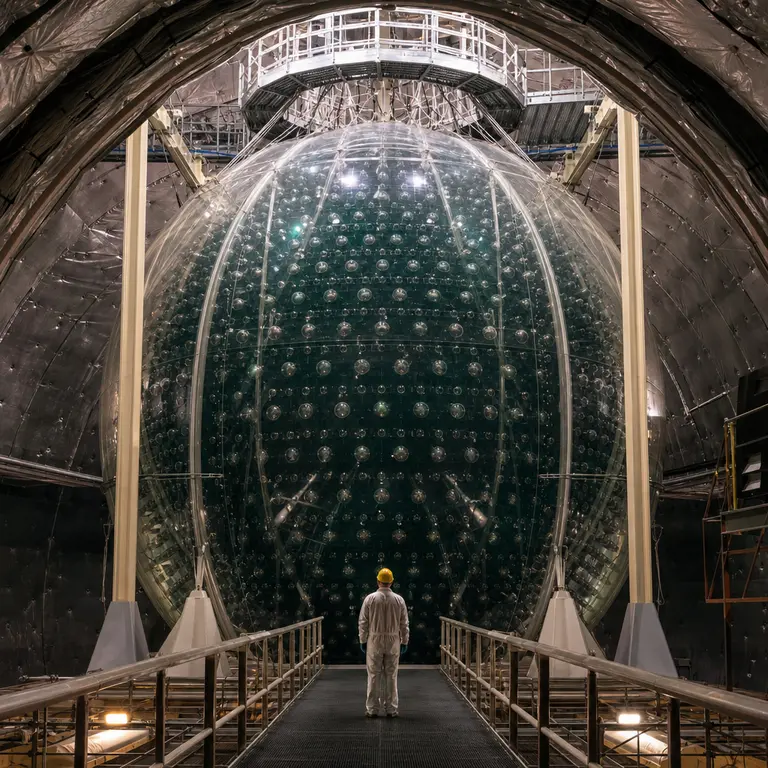
Borexino’s design is a feat of almost obsessive purity. At its center sits 278 tonnes of liquid pseudocumene — a hydrocarbon scintillator — contained within a thin nylon sphere 8.5 meters in diameter. When a neutrino very occasionally interacts with an electron in this liquid, it produces a faint flash of light. That flash is detected by 2,212 photomultiplier tubes arranged in a surrounding stainless-steel sphere, each tube sensitive enough to register the arrival of individual photons. The entire assembly is then submerged in a tank of ultrapure water, which serves as an additional shielding layer against radiation originating from the surrounding rock.
The central challenge was not building the detector. It was making it clean enough to work. Neutrino interactions produce signals so faint that the natural radioactive decay of ordinary materials — the uranium and thorium present at trace levels in almost everything on Earth — would completely overwhelm them. The pseudocumene used in Borexino was purified to a level of radioactive contamination roughly a billion times lower than that of typical laboratory-grade chemicals. The nylon membranes were manufactured in a dedicated clean room under conditions more stringent than those used to produce semiconductor chips. Workers handling internal components wore multiple layers of protective garments and followed protocols designed to prevent even the oils from human skin from contaminating the detector’s interior surfaces.
The rock overburden of the Gran Sasso blocks cosmic-ray muons, reducing the background by a factor of one million compared to the surface. This geological shielding was not incidental — it was the primary reason the site was chosen. The mountain itself became part of the instrument. The result was, at the time of its construction, the most radiopure large-scale detector ever built. Physicists sometimes describe it as requiring the cleanest material ever assembled by human hands, a claim that is less poetic hyperbole than straightforward technical assessment. No other object of comparable size has ever been assembled with such meticulous attention to the elimination of natural radioactivity.
The CNO Cycle and a 1938 Prediction Confirmed
In 1938, physicists Hans Bethe and Carl Friedrich von Weizsäcker independently proposed that stars more massive than the Sun primarily generate energy not through the proton-proton chain that dominates our Sun, but through a catalytic cycle involving carbon, nitrogen, and oxygen nuclei. In this CNO cycle, these heavier elements act as intermediaries, facilitating the fusion of hydrogen into helium while themselves being regenerated at the end of each cycle. Carbon, nitrogen, and oxygen are neither consumed nor permanently altered—they function as biological catalysts in living cells, enabling reactions without being used up. Bethe would later receive the Nobel Prize in Physics in 1967, partly for this work, but the CNO cycle itself remained a theoretical construct for the Sun specifically, never directly observed in the star where it was predicted to operate in a minor but measurable capacity.
For the Sun, which is a relatively modest star, the CNO cycle was predicted to contribute only about one percent of total energy output. That tiny contribution made detecting its neutrino signature extraordinarily difficult. The neutrinos produced by the CNO cycle fall within an energy range that overlaps with those from other processes, and the expected count rate was so low that even a detector as sensitive as Borexino initially struggled to separate the signal from background contamination. In 2020, the Borexino collaboration announced in the journal Nature that they had succeeded in detecting, for the first time, the neutrinos produced specifically by the CNO cycle operating inside the Sun.
The detection required not only the extreme radiopurity already achieved but also an additional years-long campaign to stabilize the detector's thermal environment, because temperature gradients caused convective mixing that moved trace bismuth-210 contamination into the fiducial volume. Bismuth-210 is a naturally occurring radioactive isotope whose decay products produce signals in the same energy range as CNO neutrinos, making it a particularly insidious source of interference. Engineers insulated the detector and monitored its temperature to within fractions of a degree across the entire structure. The final CNO neutrino signal was extracted from data collected between 2016 and 2020 and represented a flux of approximately seven counts per day per 100 tonnes of scintillator — an almost incomprehensibly faint signal pulled from an ocean of background noise accumulated over four years of continuous operation.
What the Sun’s Core Chemistry Reveals
The CNO neutrino detection did more than confirm a theory. It provided the first direct measurement of the metallicity of the Sun’s core — the abundance of elements heavier than hydrogen and helium at the very center of the star. In astrophysics, the term metallicity refers to all elements beyond the two lightest, so oxygen, carbon, nitrogen, iron, and everything else in the periodic table beyond helium are collectively referred to as metals, regardless of their physical properties. The composition of the solar core has been surprisingly difficult to determine because no light escapes it directly, and the Sun's surface composition may not accurately reflect what lies beneath billions of tonnes of overlying plasma.
This matters because helioseismology, which studies sound waves propagating through the Sun in a manner analogous to how seismologists study earthquakes propagating through Earth, and spectroscopic measurements of the solar surface have been in disagreement for roughly two decades. Modern three-dimensional models of the solar atmosphere suggest a lower abundance of heavy elements than older models, but this lower metallicity produces a solar interior model that conflicts with helioseismic data. The predicted sound-speed profile of the solar interior under the low-metallicity assumption does not match what helioseismologists actually measure, and the discrepancy is large enough to be troubling. The tension, known as the solar abundance problem or solar modeling problem, has been one of the most persistent puzzles in astrophysics, resisting resolution despite significant advances in computational modeling and observational technique.
Borexino’s CNO neutrino flux measurement offered the first independent, direct probe of the core’s composition. The result, while not yet precise enough to fully resolve the debate, is consistent with the higher-metallicity models and has given theorists important constraints to work with. A follow-up generation of experiments, including SNO+ in Canada and the massive JUNO detector in China, aims to improve the measurement precision enough to settle the question definitively. JUNO in particular, with its 20,000 tonnes of liquid scintillator, will represent roughly a 70-fold increase in detector mass over Borexino, potentially enabling the statistical precision needed to distinguish between competing solar models with a level of confidence that would end the debate.
Beyond the Sun, the CNO cycle confirmation has implications for understanding stellar evolution across the galaxy. Stars above roughly 1.3 solar masses are thought to be CNO-dominated, meaning the cycle drives the energy output of the majority of bright, massive stars visible to the naked eye. Direct observational confirmation of its operation — even in a star where it plays a minor role — validates the theoretical framework used to model stellar lifetimes, supernova rates, and the chemical enrichment of galaxies over cosmic time. The heavy elements seeded into the interstellar medium by massive stars, which eventually find their way into planets and living organisms, are produced and expelled on timescales set by the CNO cycle. Confirming that the cycle operates as predicted is therefore not merely a triumph of detector engineering but a foundational verification of the chain of reasoning that connects nuclear physics to the existence of the chemical elements themselves.
Conclusion
What Borexino achieved over its decades of operation is a reminder that some of the most consequential scientific results emerge not from dramatic discoveries but from the slow, painstaking elimination of everything that might obscure a faint truth. The CNO neutrino signal was always there, streaming through the detector at seven counts per day, waiting to be distinguished from the noise. The work was not to generate the signal but to quiet the world around it enough to hear it clearly.
The Sun will continue fusing hydrogen in its core for another five billion years, producing neutrinos by both the proton-proton chain and the CNO cycle in proportions that have remained essentially constant across geological time. Those neutrinos have been passing through every living thing on Earth since life first appeared, carrying real-time dispatches from the stellar interior that nothing else can deliver. For most of human history, we had no way to read them. Borexino showed that with enough ingenuity, enough patience, and enough commitment to cleanliness, we can listen to the Sun from the inside out — and what we hear confirms, in remarkable detail, that our theories of how stars work are not merely plausible but demonstrably correct.
Sources & Further Reading
- Borexino Collaboration. Experimental evidence of neutrinos produced in the CNO fusion cycle in the Sun. Nature, 2020. https://www.nature.com/articles/s41586-020-2934-0
- Bethe, Hans A. Energy Production in Stars. Physical Review, 1939. https://journals.aps.org/pr/abstract/10.1103/PhysRev.55.434
- Alimonti, G. et al. The Borexino detector at the Laboratori Nazionali del Gran Sasso. Nuclear Instruments and Methods in Physics Research, 2009. https://doi.org/10.1016/j.nima.2008.11.076
- Serenelli, Aldo. Alive and well: a short review about standard solar models. European Physical Journal A, 2016. https://link.springer.com/article/10.1140/epja/i2016-16078-1