
Icecube: Unveiling the Universe's Most Elusive Particles
How a buried Antarctic detector is revealing the hidden architecture of the universe through particles that pass through entire planets without stopping.
 Watch on YouTube
 Watch on Rumble
The Particle That Refuses to Interact
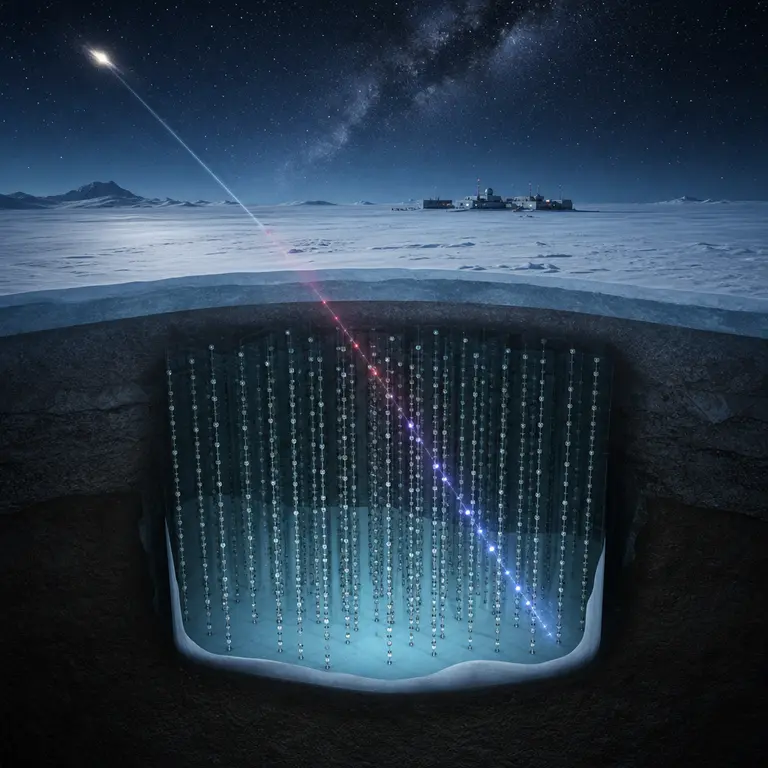
Somewhere beneath the Antarctic ice sheet, at depths between 1.5 and 2.5 kilometers, sits one of the strangest observatories ever built. It has no lens, no mirror, and no conventional detector array. Instead, it uses a cubic kilometer of ancient glacial ice as its sensing medium, watching for faint flashes of blue light produced by particles that can travel through the entire Earth without being deflected once. These particles are neutrinos, among the most elusive objects in the known universe. To understand why physicists have gone to such extraordinary lengths to detect them — drilling into one of the most inhospitable places on the planet, deploying thousands of sensors into boreholes that will never be reopened — you first have to understand just how aggressively neutrinos avoid being known.
The history of the neutrino begins not with a discovery but with a crisis. In the late 1920s, physicists studying beta decay — a process in which a neutron transforms into a proton and emits an electron — noticed that energy and momentum were not being conserved. The electron carried away less energy than the decay should have released. Wolfgang Pauli, unwilling to abandon conservation laws but equally reluctant to announce a new particle, wrote in a 1930 letter to colleagues that he had done a terrible thing: he had postulated a particle that could not be detected. He called it the neutron at the time, though the name was later changed to neutrino after Enrico Fermi formalized the theory. It took until 1956 for Clyde Cowan and Frederick Reines to actually detect one, using a nuclear reactor as a source. Pauli, upon receiving the telegram confirming the discovery, reportedly replied, "Everything comes to those who know how to wait."
Why Neutrinos Matter
Neutrinos are produced in enormous quantities by nuclear reactions inside stars, supernovae, black hole accretion disks, and the Big Bang itself. They carry no electric charge, have almost no mass, and interact with ordinary matter only through the weak nuclear force — one of the four fundamental forces of nature, and one that operates at extraordinarily short ranges. This means a neutrino can pass through a light-year of solid lead with only a 50 percent chance of being stopped. For practical purposes, they are ghosts. Billions of them pass through your thumbnail every second without consequence.
This near-total imperviousness to matter is precisely what makes neutrinos scientifically valuable. Unlike photons, which are absorbed and scattered by dense material, neutrinos escape from the cores of stars and the inner regions of black hole accretion disks without being deflected or absorbed. They carry information from environments that are completely opaque to light. When a massive star collapses into a neutron star or black hole, the event releases an almost incomprehensible amount of energy — roughly 10 to the power of 44 joules — and approximately 99 percent of that energy is carried away not by light, not by gravitational waves, but by neutrinos. They are the dominant messengers of the universe's most violent events, and for most of human history, we had no way to read what they were saying.
There are three known types, or flavors, of neutrinos: electron neutrinos, muon neutrinos, and tau neutrinos, each associated with a corresponding charged lepton. One of the more disorienting facts about them is that they do not maintain a fixed identity as they travel. A neutrino produced as a muon neutrino will, after some distance, have a measurable probability of being detected as an electron neutrino or a tau neutrino. This phenomenon, called neutrino oscillation, was confirmed experimentally in 1998 by the Super-Kamiokande experiment in Japan and earned Takaaki Kajita and Arthur McDonald the 2015 Nobel Prize in Physics. Oscillation also proved that neutrinos have mass — a fact not predicted by the original Standard Model of particle physics and still not fully incorporated into it.
Building a Telescope Inside a Glacier
The IceCube project, managed by a collaboration of over 300 scientists from 58 institutions across 14 countries, was completed in 2010 after a decade of construction. Building it required drilling 86 boreholes into the Antarctic ice using a specialized hot-water drill that could bore a 60-centimeter-wide hole to a depth of 2.5 kilometers in under 40 hours. Into each borehole, engineers lowered a string of 60 digital optical modules — spherical glass pressure vessels each containing a photomultiplier tube capable of detecting a single photon. In total, 5,160 sensors were deployed across the cubic kilometer volume.
The choice of Antarctic ice was not arbitrary. Ice formed over hundreds of thousands of years at the South Pole is extraordinarily clear, with blue-light scattering lengths reaching up to 100 meters in the clearest layers. It is also geologically stable and located at one of the most remote points on Earth, far from radio-frequency noise and vibration that would contaminate more accessible sites. The ice itself becomes the detector, and its ancient clarity enables precision measurements.
When a high-energy neutrino collides with a water molecule inside the Antarctic ice, it produces a secondary particle called a muon, which travels faster than light moves through ice — not faster than light in a vacuum, but faster than light in that particular medium. This produces a cone of blue radiation called Cherenkov radiation, the optical equivalent of a sonic boom. It is this faint blue flash that IceCube is designed to detect, and the cone's geometry reveals the direction from which the original neutrino arrived, allowing researchers to trace it back across billions of light-years to its source.
One of the most significant technical challenges was calibrating the detector against the varying optical properties of different ice layers. Dust layers deposited during ancient volcanic eruptions and climate events show up as scattering anomalies that must be mapped and corrected for. IceCube researchers have produced some of the most detailed maps of deep Antarctic ice stratigraphy ever assembled, a byproduct of building a particle physics instrument that has proven independently useful to glaciologists and climate scientists studying past atmospheric conditions.
What IceCube Has Actually Found
In 2013, IceCube announced the detection of two neutrinos with energies exceeding one petaelectronvolt — roughly one quadrillion electron volts, or about 570 times the energy achievable by the Large Hadron Collider. These were named Bert and Ernie after the Sesame Street characters, a naming convention the collaboration has since maintained for exceptionally high-energy events. These detections confirmed for the first time that astrophysical neutrinos, produced outside our solar system, were reaching Earth. The energies involved are staggering: a single subatomic particle carrying as much kinetic energy as a tennis ball moving at 100 kilometers per hour, compressed into something with a mass roughly one millionth that of an electron.
In 2022, a landmark result identified NGC 1068, also known as the Squid Galaxy, located 47 million light-years away, as a significant source of high-energy neutrinos. This was particularly surprising because NGC 1068 is a Seyfert galaxy with an active galactic nucleus — a supermassive black hole actively consuming material from its surroundings. The detection suggests that the regions immediately surrounding actively feeding black holes are powerful particle accelerators, producing neutrinos through hadronic processes that gamma-ray telescopes had not fully captured. The neutrino signal from NGC 1068 was actually stronger than models based on gamma-ray observations predicted, suggesting that some of the most energetic processes near black holes occur in regions too dense for gamma rays to escape, but transparent enough for neutrinos to pass through freely.
Perhaps most dramatically, in 2023, IceCube published results linking a diffuse background of high-energy neutrinos to the Milky Way galaxy itself. This was the first time neutrino emission had been detected from our own galaxy as a whole, suggesting that the plane of the Milky Way — rich in cosmic ray interactions with gas and dust — glows in neutrinos in a way that had been theorized but never confirmed. The result required over a decade of accumulated data and advanced machine learning techniques to extract a signal from background noise. The image produced, a map of the Milky Way rendered in neutrinos rather than light, is one of the more quietly astonishing scientific visualizations of recent years: a familiar shape seen through an entirely unfamiliar sense.
The Future Beneath the Ice
IceCube-Gen2, the planned upgrade to the existing facility, would expand the instrumented volume to approximately 8 cubic kilometers by adding an outer ring of new strings, a surface array, and a densely packed inner core for detecting lower-energy neutrinos. The expanded detector would increase sensitivity by roughly an order of magnitude, potentially allowing researchers to identify dozens of individual neutrino point sources rather than statistical excesses above background. Where the current instrument can say that a general region of the sky is producing neutrinos, Gen2 may be able to identify specific objects, compare them to observations from X-ray, gamma-ray, and gravitational wave observatories, and begin assembling a genuinely multi-messenger picture of the high-energy universe.
Beyond astrophysics, IceCube has contributed to fundamental particle physics. In 2020, the collaboration published constraints on sterile neutrinos — hypothetical fourth-flavor neutrinos that interact even more weakly than the three known types and have been proposed as dark matter candidates. The results significantly narrowed the parameter space in which sterile neutrinos could exist, ruling out large portions of the theoretically allowed range. This is a reminder that IceCube is not only a telescope but also a particle physics experiment, using cosmic accelerators far more powerful than anything humans can build to probe questions that laboratory instruments cannot yet reach.
The observatory also monitors for neutrino bursts from galactic supernovae in real time. Because neutrinos escape a collapsing stellar core seconds before the light does, IceCube could provide advance warning of a visible supernova before it becomes optically detectable. This early warning system is integrated into a global network called SNEWS (SuperNova Early Warning System), which coordinates multiple detectors worldwide. The last confirmed detection of supernova neutrinos came from SN 1987A in the Large Magellanic Cloud, captured by three smaller instruments before IceCube existed. The next galactic supernova, whenever it arrives, will be seen in extraordinary detail by a detector that was not yet imagined when the last one occurred.
What makes IceCube philosophically remarkable is that it turns the planet itself into an instrument. The Earth acts as a filter, blocking cosmic-ray muons that would otherwise overwhelm the signal, while the ice serves as a medium that converts otherwise invisible particles into measurable light. It is an observatory built not to look outward through a clear sky, but to look through an entire planet, using its mass as a shield and its ancient ice as a lens. In doing so, it has opened a new sensory channel onto the universe — one that bypasses everything we previously used to observe the cosmos and listens instead for the particles that have been passing through us, unnoticed, since before the Earth existed.
Sources & Further Reading
- IceCube Collaboration. Evidence for High-Energy Extraterrestrial Neutrinos at the IceCube Detector. Science, 2013. https://www.science.org/doi/10.1126/science.1242856
- IceCube Collaboration. Observation of High-Energy Neutrinos from the Galactic Plane. Science, 2023. https://www.science.org/doi/10.1126/science.adc9818
- IceCube Collaboration. Evidence for Neutrino Emission from the Nearby Active Galaxy NGC 1068. Science, 2022. https://www.science.org/doi/10.1126/science.abg3395
- Francis Halzen and Spencer R. Klein. IceCube: An Instrument for Neutrino Astronomy. Reviews of Modern Physics, 2010. https://journals.aps.org/rmp/abstract/10.1103/RevModPhys.82.2365