
The Radio Signals Leaking from Earth's Polar Cusps
Earth itself broadcasts natural radio emissions powerful enough to be detected across interstellar distances — a fact with profound implications for the search for extraterrestrial life.
 Watch on YouTube
 Watch on Rumble
Earth Is Shouting Into the Cosmos
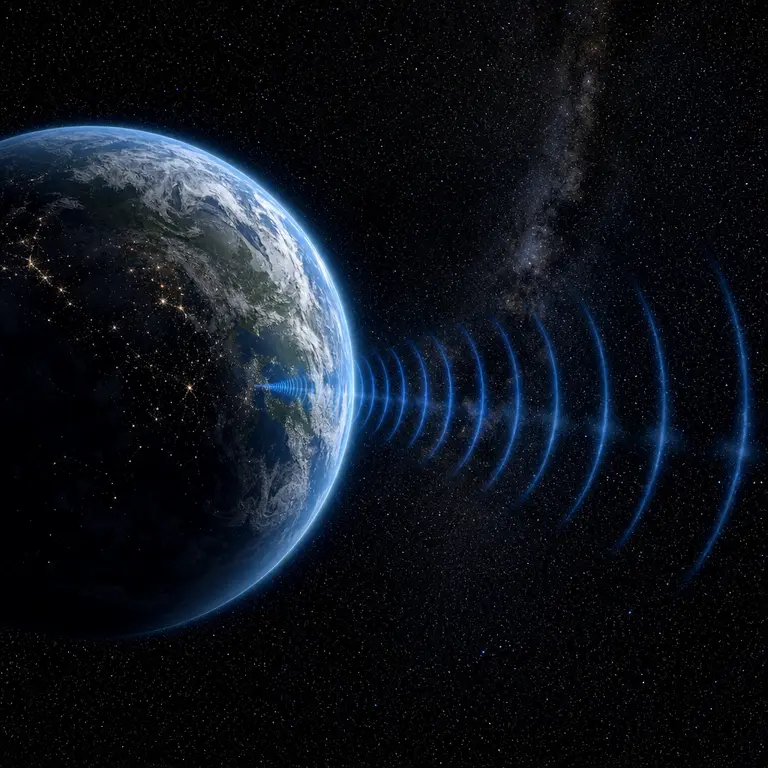
Most discussions about detecting alien civilizations focus on artificial transmissions — deliberate beacons, radar leakage, or television signals drifting outward from distant worlds. What rarely enters the conversation is that Earth itself produces powerful, naturally occurring radio emissions that could, in principle, be detected by a sufficiently sensitive telescope orbiting another star. These emissions, known as Auroral Kilometric Radiation, or AKR, were first definitively characterized by NASA’s IMP-6 satellite in 1972 and have since been studied extensively as one of the most energetically intense radio phenomena generated by any planet in the solar system. The story of AKR is, in a sense, the story of Earth announcing itself to the universe without ever meaning to — a planetary voice that has been broadcasting continuously for as long as our magnetic field has existed, indifferent to whether anyone is listening.
AKR originates in the polar cusp regions of Earth’s magnetosphere, where solar wind particles funnel along magnetic field lines and crash into the upper atmosphere. The mechanism driving it is called the Electron Cyclotron Maser Instability, a process in which electrons spiraling along magnetic field lines coherently amplify radio waves, much like a laser amplifies light. The result is a burst of radiation in the frequency range of 100 to 600 kilohertz, with peak power outputs that can reach one billion watts — comparable to a modest nuclear power station’s electrical output, but radiated entirely as radio energy. Unlike the aurora borealis, which is the visible manifestation of the same magnetospheric process, AKR is invisible to the human eye and passes entirely unnoticed by the billions of people living beneath it. It is a conversation Earth is having with the cosmos that none of its inhabitants can hear.
Why This Matters for the Search for Life
The significance of AKR for astrobiology is both elegant and underappreciated. For decades, the search for extraterrestrial intelligence, commonly known as SETI, has focused on the microwave window, particularly the 1.42 gigahertz hydrogen line, as the most logical frequency for deliberate interstellar communication. The hydrogen line was identified as a candidate frequency in the landmark 1959 paper by Giuseppe Cocconi and Philip Morrison in Nature, and it has since anchored radio SETI efforts. But in 2004, a team led by Jean-Mathias Grießmeier published modeling work in the journal Astronomy and Astrophysics demonstrating that magnetized exoplanets — including potentially habitable ones — should generate their own versions of AKR at radio frequencies detectable by modern and near-future telescopes.
The key insight is that AKR is not a sign of technology. It is a sign of a magnetic field interacting with stellar wind plasma, and magnetic fields are intimately linked to planetary habitability. A robust magnetosphere shields a planet’s atmosphere from erosion by stellar wind, a process that is believed to have stripped Mars of much of its early atmosphere over billions of years once its core cooled and its magnetic dynamo weakened. A planetary magnetic field also protects surface life from harmful ionizing radiation that would otherwise bombard the surface with energies capable of breaking apart organic molecules and disrupting cellular repair mechanisms. Detecting AKR-like emissions from an exoplanet would therefore simultaneously confirm the presence of a substantial magnetic field and suggest conditions potentially favorable to life — without requiring that life be intelligent, communicative, or even aware of our existence.
This reframing is significant because it shifts the search from a narrow focus on technological civilizations to a broader survey of planetary environments. The question shifts from whether someone is trying to contact us to whether a planet has the physical properties associated with habitability. In this sense, AKR detection is less like intercepting a message and more like reading a geological core sample from across the light-years.
Jupiter’s Louder Version and What It Teaches Us
Earth is not the loudest radio emitter in our solar system. Jupiter produces a version of the same electron cyclotron maser emission that is roughly one million times more powerful than Earth’s AKR, detectable from Earth’s surface with relatively modest radio equipment. Amateur astronomers using simple dipole antennas have recorded Jovian decametric radio bursts for decades, making Jupiter one of the few astronomical objects that can be meaningfully studied from a backyard. This intensity arises from Jupiter’s vastly stronger magnetic field — roughly 20,000 times more powerful than Earth’s at the cloud tops — and from the additional energy injected by its moon Io, whose intense volcanic activity seeds the magnetosphere with ionized sulfur and oxygen at a rate of approximately one ton per second.
The Jupiter-Io system has become a template for understanding what astronomers call star-planet magnetic interactions in exoplanetary systems. The relationship between a moon’s volcanic output and a planet’s radio emissions is a reminder that habitability-related signals can arise from unexpected sources. A distant observer detecting Jupiter’s radio emissions would be picking up a signal shaped not just by the planet but by the gravitational and geological dynamics of its moon system — an indirect fingerprint of an entire planetary architecture compressed into a radio waveform.
Hot Jupiters — gas giants orbiting extremely close to their host stars — are expected to produce AKR-equivalent emissions orders of magnitude more powerful than anything in our solar system, because they are bathed in far denser stellar winds. Several candidate detections have been reported using the Low Frequency Array, or LOFAR, a pan-European radio telescope network headquartered in the Netherlands and consisting of thousands of simple antennas spread across multiple countries. In 2020, a team led by Joseph Callingham at Leiden Observatory reported in Nature Astronomy a statistical analysis of 19 stellar systems that showed excess circularly polarized radio emission consistent with star-planet magnetic interactions. Circular polarization is a key diagnostic signature because it is characteristic of coherent emission processes, such as the electron cyclotron maser mechanism, distinguishing planetary signals from the incoherent thermal radio noise produced by stars themselves. Confirming individual exoplanetary sources remains technically challenging, but the statistical pattern is compelling enough to have energized the field considerably.
The Technical Barrier and How It Is Being Overcome
Detecting Earth-like AKR from another star system is beyond the capability of any existing instrument. At a distance of even four light-years — the distance to the nearest stellar system, Alpha Centauri — Earth’s AKR would arrive at a flux density of roughly 10 to the minus 40 watts per square meter per hertz, a number so small it defies intuitive comparison. The most sensitive existing radio telescopes fall many orders of magnitude short of this threshold. However, the field is advancing rapidly, and the targets most likely to be detected first are not Earth analogs but Jupiter-class emitters, which are far louder.
The Square Kilometer Array, or SKA, currently under construction across sites in South Africa and Australia, with a planned operational start in the late 2020s, will achieve sensitivity at low radio frequencies several orders of magnitude beyond LOFAR. Its name reflects its collecting area: when complete, the SKA will aggregate roughly one square kilometer of radio-collecting surface distributed across thousands of individual antenna elements, achieving angular resolution and sensitivity that will transform low-frequency radio astronomy. Modeling by Philippe Zarka at the Paris Observatory suggests that the SKA may be able to detect Jupiter-class emissions from exoplanets within approximately 50 to 150 light-years, a volume of space containing thousands of known planetary systems identified by missions such as the Kepler Space Telescope and the Transiting Exoplanet Survey Satellite.
More speculatively, researchers have proposed that a future space-based low-frequency array, operating below 30 megahertz where Earth’s ionosphere becomes opaque and blocks ground-based observation, could extend this reach dramatically and potentially detect emissions from Earth-analog planets around the nearest stars. Concepts for such an observatory have been discussed in the context of lunar far-side radio astronomy, where the Moon itself would shield the instrument from terrestrial radio frequency interference — a fitting irony, since Earth’s own radio noise would otherwise drown out the faint signals scientists are trying to hear.
What makes this avenue of research philosophically striking is its inversion of the usual SETI paradigm. Rather than waiting for another civilization to decide to talk to us, it proposes listening for the involuntary electromagnetic noise that any sufficiently magnetized, inhabited world would produce simply by existing inside a stellar system. It is a cosmic fingerprint left not by intention, but by physics — the unavoidable consequence of a planet having a molten iron core, a magnetic dynamo, and a star close enough to drive a wind across its magnetosphere.
Conclusion
The story of Auroral Kilometric Radiation is ultimately a story about what planets cannot help but reveal. Earth has been broadcasting into the galaxy for billions of years, long before any creature on its surface had the capacity to wonder whether anyone else was out there. The emissions are not a message. They carry no information about our biology, our culture, or our intentions. But they carry something arguably more fundamental: evidence that a planet has the physical architecture that makes complex chemistry, stable atmospheres, and surface life possible in the first place.
As the SKA comes online and low-frequency radio astronomy matures into a precision science, the prospect of detecting these natural planetary signals from nearby stellar systems shifts from theoretical curiosity to a genuine observational program. If such a detection were made, it would not confirm the existence of intelligent life. It would do something in some ways more profound: it would confirm that another world has the conditions to host life of any kind, that somewhere within a few dozen light-years, a planet is sitting inside its star’s wind, its magnetic field pushing back, its polar skies almost certainly lit by auroras that no eye may ever see. That would be a discovery worth shouting about.
Sources & Further Reading
- Zarka, Philippe. Magnetospheric radio emissions from extrasolar planets: The role of the host stars. Planetary and Space Science, 2007. https://doi.org/10.1016/j.pss.2006.05.045
- Callingham, J. R. et al. The population of M dwarfs observed at low radio frequencies. Nature Astronomy, 2021. https://doi.org/10.1038/s41550-021-01483-0
- Grießmeier, Jean-Mathias et al. Cosmic rays and the magnetic field of the early Sun. Astronomy and Astrophysics, 2004. https://doi.org/10.1051/0004-6361:20041171
- Gurnett, D. A. The Earth as a radio source: Terrestrial kilometric radiation. Journal of Geophysical Research, 1974. https://doi.org/10.1029/JA079i031p04227