
The Underground Ocean Hidden Inside Europa's Ice Shell
New findings from NASA's Europa Clipper mission are reshaping our understanding of Jupiter's moon Europa, where a vast saltwater ocean beneath miles of ice may harbor conditions suitable for life — and the chemistry involved is stranger than most people realize.
 Watch on YouTube
 Watch on Rumble
A Moon That Shouldn’t Be Wet
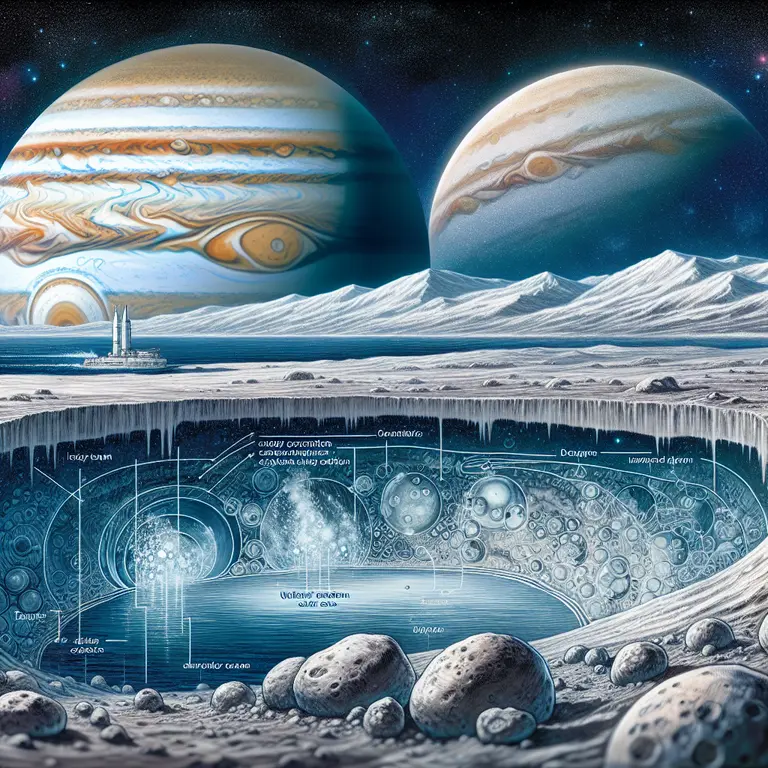
Europa, one of Jupiter’s 95 known moons, orbits a gas giant so far from the Sun that its surface temperature hovers around negative 160 degrees Celsius. By any conventional logic, it should be a frozen, geologically dead rock. Instead, it is one of the most scientifically electrifying objects in the solar system. Beneath a shell of ice estimated to be between 15 and 25 kilometers thick, Europa harbors a global liquid water ocean that contains roughly twice the volume of all Earth’s oceans combined. This is not a hypothesis — it is supported by decades of magnetometer readings, surface geology analysis, and gravitational measurements, most recently reinforced by data from NASA’s Europa Clipper spacecraft, which launched in October 2024 and is currently en route to the Jovian system.
What makes this ocean possible is not solar heat but tidal flexing. Jupiter’s immense gravitational field, combined with the orbital resonance Europa shares with neighboring moons Io and Ganymede, continuously squeezes and stretches Europa’s interior. This mechanical friction generates enough heat to keep water liquid at depths where no sunlight has ever penetrated. The same process drives violent volcanism on Io, Europa’s inner neighbor, but on Europa, the energy is gentler and more evenly distributed, producing a warm, chemically active seafloor rather than a catastrophically erupting surface. The elegance of this mechanism is worth pausing on. Europa does not need a star to be warm. It needs neighbors. The gravitational conversation between three moons, locked into a precise mathematical rhythm called the Laplace resonance, has quietly maintained a liquid ocean for billions of years without any input from the Sun. It is a reminder that the conditions for habitability may be far more varied and widespread across the cosmos than our Sun-centric intuitions have led us to assume.
Europa’s surface offers visible evidence of the churning activity below. Unlike the Moon or Mars, which are covered in ancient craters that record billions of years of impact history, Europa’s face is strikingly smooth and relatively unmarked. It is crisscrossed instead by a vast network of reddish-brown ridges, fractures, and chaotic terrain called lenticulae — dome-shaped features that some researchers believe form when pockets of warm ice or liquid water push upward from below and deform the surface from within. The scarcity of large craters is not because Europa has been spared impacts, but because its surface is geologically young and continuously reshaped. Something active is happening beneath the surface, and it has been going on for a very long time.
The Chemistry Beneath the Ice
One of the most underreported aspects of Europa’s ocean is its likely chemical composition. Scientists analyzing spectroscopic data from the Hubble Space Telescope and the Galileo spacecraft identified sodium chloride — ordinary table salt — on Europa’s surface in 2019, suggesting the ocean below is saline in ways that parallel Earth’s own seas. But the salt is only part of the story. Europa’s surface is also streaked with reddish-brown compounds that researchers believe are sulfur-bearing salts, magnesium sulfate, and possibly organic molecules that have been cycled upward from the ocean through cracks in the ice. The color of those streaks, so vivid against the white ice in close-range photography, is itself a clue. On Earth, similar reddish discolorations in geological formations often indicate the presence of iron compounds or biological pigments. On Europa, the source remains debated, but the chemical complexity implied by that coloration is significant in itself.
The ice shell itself is not a passive barrier. Europa’s surface is geologically young — estimated at only 40 to 90 million years old based on crater counts — which means material is being continuously recycled between the ocean and the surface. This process, sometimes called double-diffusive convection within the ice, could allow oxidants produced on the surface by Jupiter’s intense radiation to be transported downward into the ocean. On Earth, the combination of liquid water, chemical energy gradients, and mineral-rich interfaces at hydrothermal vents is precisely where life first emerged, or at least where it thrives most vigorously today. Europa’s seafloor may offer analogous conditions, with hydrothermal vents pumping heat and minerals into an ocean that has existed for billions of years.
This chemical cycling matters enormously for the question of habitability. Life as we know it does not require liquid water alone. It requires energy gradients — differences in chemical potential that organisms can exploit to drive metabolism. On Earth, hydrothermal vents create exactly these gradients by releasing hydrogen, methane, and sulfur compounds into cold, oxidant-rich seawater. If Europa’s ocean floor is similarly active, and if oxidants from the irradiated surface can be delivered downward through the ice over geological timescales, then Europa may possess a self-sustaining chemical engine capable of powering biology indefinitely. The ocean would not merely be wet. It would be energetically alive in the thermodynamic sense, primed for the emergence of living chemistry, whether or not any life has actually arisen there.
What Europa Clipper Is Actually Measuring
NASA’s Europa Clipper is not designed to land on Europa or drill through the ice. Instead, it will conduct 49 close flybys of the moon between 2030 and 2034, skimming as low as 25 kilometers above the surface. The spacecraft carries nine scientific instruments, including a magnetometer to map the ocean’s depth and salinity, a mass spectrometer to analyze particles ejected into space, an ice-penetrating radar called REASON that can probe up to 30 kilometers beneath the surface, and a thermal imaging system to detect regions of anomalous heat that might indicate active water plumes. The flyby architecture, rather than an orbital insertion around Europa itself, was chosen partly to minimize the spacecraft’s exposure to Jupiter’s brutal radiation belts, which are intense enough to damage electronics over time and would shorten the mission’s operational life if the spacecraft remained in close orbit indefinitely.
The plume question is particularly significant. In 2012 and again in 2016, the Hubble Space Telescope detected what appeared to be water vapor erupting from Europa’s southern hemisphere to heights of 200 kilometers. If confirmed, these plumes would mean Europa is actively venting ocean material into space — material that Europa Clipper could fly through and sample directly without ever touching the surface. This would represent an unprecedented opportunity to analyze the chemistry of an alien ocean using instruments already in orbit. The Cassini mission at Saturn accomplished something similar at the moon Enceladus in 2015, detecting hydrogen gas in that moon’s plumes, a chemical signature consistent with active hydrothermal reactions on the seafloor. That discovery at Enceladus fundamentally changed how scientists think about ocean worlds and set a precedent for what a well-equipped flyby mission can reveal.
What Europa Clipper cannot do is directly resolve the question of life. Its instruments are designed to characterize habitability, not to detect biosignatures with certainty. Even the mass spectrometer, which could in principle detect complex organic molecules in plume material, would face significant interpretive challenges in distinguishing biological chemistry from abiotic organic synthesis. This limitation is deliberate and scientifically honest. Before sending a lander or a drill, humanity needs to know where to look and what it is looking at. Europa Clipper is, in essence, a reconnaissance mission — the most sophisticated one ever sent to an ocean world — and its findings will determine the shape of everything that comes after it.
The Deeper Philosophical Weight
The search for life on Europa carries implications that extend well beyond planetary science. If microbial life were discovered in Europa’s ocean, it would almost certainly represent an independent origin of life from Earth’s — a second genesis. This single finding would statistically transform the probability of life existing elsewhere in the universe from a philosophical curiosity into a near-certainty. The universe contains an estimated two trillion galaxies, and if life can arise independently in two locations within a single solar system, the mathematics becomes overwhelming. The Fermi paradox, which asks why we have not detected signs of intelligent civilizations elsewhere, given the universe’s size and age, would take on a different and more urgent character. The silence of the cosmos would no longer suggest that life is rare. It would suggest instead that something else — something more troubling — prevents complex life from persisting or communicating.
There is also a lesser-known ethical dimension to Europa exploration. Some astrobiologists have raised concerns about forward contamination — the risk that Earth microbes hitchhiking on spacecraft could colonize Europa’s ocean and compromise any future detection of native life. NASA’s Office of Planetary Protection applies strict sterilization protocols to the Europa Clipper for exactly this reason, treating the moon as a Category III celestial body that requires rigorous controls. The irony is that the very caution required to protect scientific integrity slows the pace of discovery. A lander capable of penetrating the ice and sampling the ocean directly would be subject to even more stringent sterilization requirements, potentially adding years and hundreds of millions of dollars to mission development before a single measurement could be taken.
This tension between urgency and caution reflects a deeper aspect of the human relationship with the unknown. We are a species that has spent its entire existence on one world, shaped by one evolutionary history, embedded in one biosphere. The possibility that another biosphere exists a few hundred million kilometers away, sealed beneath kilometers of ice and sustained by the gravitational pull of a gas giant, is almost too large a thought to hold. Yet the evidence points stubbornly in that direction. Europa has been waiting in silence beneath its ice for perhaps four billion years. It may wait a little longer while humanity figures out how to listen without disturbing what it finds. But the listening has already begun, and the spacecraft carrying our instruments is already moving through the dark, closing the distance year by year toward one of the most consequential destinations in the history of exploration.