
The Cosmic Origins and Vital Role of Iron in Human Life
Every atom of iron in human blood was forged inside a dying star. This article explores the extraordinary astrophysical and biochemical chain linking stellar death to the hemoglobin molecule keeping you alive today.
 Watch on YouTube
 Watch on Rumble
Introduction: The Most Important Atom You Never Think About
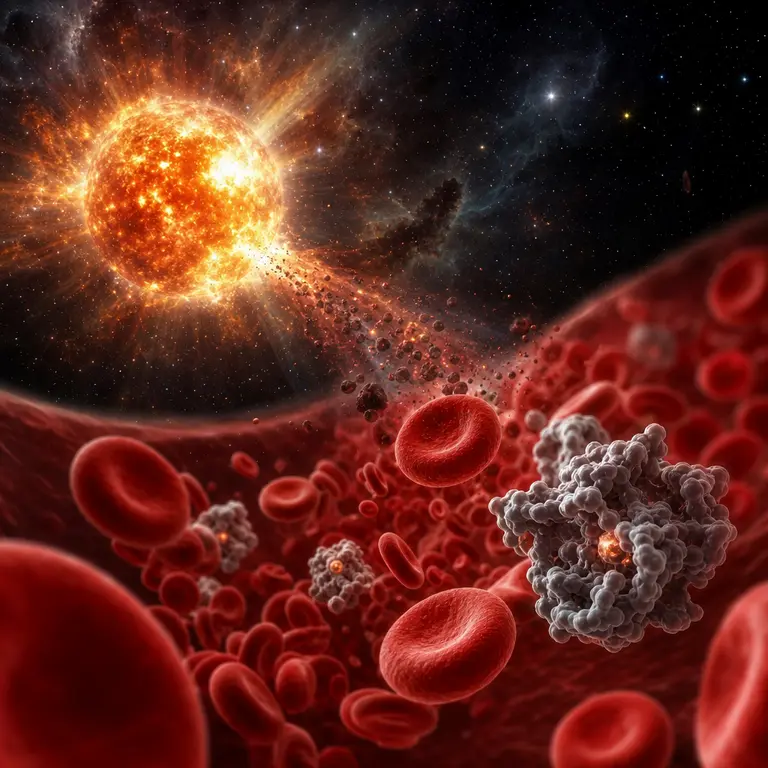
When a massive star exhausts its nuclear fuel and collapses in a supernova explosion, it releases more energy in a few seconds than the sun will emit across its entire ten-billion-year lifetime. Among the debris scattered across light-years of space is iron — the final product of stellar nucleosynthesis, the heaviest element a star can manufacture through fusion before the process becomes energetically futile. Iron is where stars go to die. It is also remarkable where human life begins.
Every red blood cell in your body contains roughly 270 million molecules of hemoglobin, and at the center of each hemoglobin molecule sits a single iron atom cradled within a structure called a heme group. That iron atom binds oxygen in your lungs and releases it in your tissues, sustaining cellular respiration across your entire body. Without it, your cells would suffocate within minutes. The iron doing this work was not produced on Earth. It was synthesized in the nuclear cores of stars that exploded billions of years before the solar system formed, and it drifted through interstellar space for millions of years before being swept into the collapsing cloud of gas and dust that eventually became the sun, the planets, and you.
This is not a metaphor. The iron in your blood is, in the most literal and measurable sense, the ash of dead stars. Tracing the journey of that iron — from the heart of a stellar furnace to the center of your circulatory system — reveals one of the most remarkable chains of causation in all of science, connecting astrophysics, geology, evolutionary biology, and modern medicine into a single unbroken story.
How Stars Build Iron — and Why They Stop
Stellar nucleosynthesis proceeds through a hierarchy of fusion reactions that can be thought of as a ladder, each rung harder to climb than the last. Hydrogen fuses into helium, helium into carbon and oxygen, and successive stages produce neon, magnesium, silicon, and sulfur. Each step releases energy, which is what keeps a star from collapsing under its own gravity. The star is, in a real sense, burning its way up the periodic table, and for most of its life, this process is self-sustaining and self-regulating.
But iron-56, the most common isotope of iron, occupies a singular position on the nuclear binding energy curve: it is the most tightly bound nucleus in nature. This means that fusing lighter elements into iron releases energy, as all previous fusion steps have done, but fusing iron into anything heavier requires energy input rather than output. Iron is the point at which the ladder ends. A star that has built an iron core has nothing left to burn. It has reached a thermodynamic dead end of its own making.
When a massive star — typically more than eight times the mass of the sun — builds up an iron core, fusion simply stops generating the outward pressure needed to counteract gravity. The core collapses in under a second, triggering a core-collapse supernova of almost incomprehensible violence. The implosion rebounds as a shockwave that tears the star apart, dispersing the iron core and the surrounding layers of lighter elements into interstellar space. In the extreme neutron-rich environment of the explosion itself, a process called rapid neutron capture — the r-process — synthesizes elements heavier than iron, including gold, platinum, and uranium, in fractions of a second. But iron itself is the quiet endpoint of the orderly fusion chain that preceded the explosion, and it is produced in extraordinary quantities. A single supernova can synthesize roughly 0.07 solar masses of iron-56, equivalent to approximately 70,000 times the mass of the Earth.
Astronomers have been able to observe this process directly. The supernova SN 1987A, which exploded in the Large Magellanic Cloud and was visible to the naked eye from the Southern Hemisphere, produced a light curve whose decay matched almost perfectly the radioactive decay of nickel-56 into cobalt-56, which then decays into iron-56. Watching that distant stellar death, scientists were watching iron being born in real time.
From Nebula to Bloodstream: The Billion-Year Journey
The solar system formed approximately 4.6 billion years ago from a molecular cloud enriched by multiple generations of stellar death. Isotopic analysis of primitive meteorites — particularly the Allende meteorite, which fell in Mexico in 1969 — has revealed presolar grains containing anomalous isotopic signatures that trace directly to specific types of supernovae that predated the sun. These microscopic grains are, in a very real sense, physical samples of other stars, preserved inside a rock that fell from the sky. The iron now locked into Earth’s crust, mantle, and core carries no such exotic signatures, having been thoroughly mixed into the solar nebula over millions of years, but its ultimate origin is the same: stellar explosions that preceded the sun by hundreds of millions to billions of years.
When life emerged on early Earth, iron was already abundant in the environment, dissolved in the ancient oceans in its soluble ferrous form. The first photosynthetic organisms — cyanobacteria, which appeared roughly 2.7 billion years ago — began producing oxygen as a metabolic byproduct, gradually transforming the atmosphere in what geologists call the Great Oxidation Event. This transformation, which peaked around 2.4 billion years ago, had a dramatic and largely underappreciated secondary effect: it oxidized soluble ferrous iron dissolved in the oceans into insoluble ferric iron, causing it to precipitate out of the water in enormous quantities. The banded iron formations visible today in ancient rock strata across Australia, Canada, and South Africa — those striking red-and-grey-striped cliffs — are the geological record of this planetary-scale chemical reaction. They are, in a sense, rust laid down by the first breath of oxygen in Earth’s history.
The consequence for life was profound. Iron, which had previously been freely available, became scarce almost overnight in geological terms. Life had to evolve sophisticated biochemical machinery to recapture and manage this newly scarce resource. The proteins that handle iron in living organisms today — hemoglobin, myoglobin, ferritin, transferrin — are all, in part, evolutionary responses to the crisis caused by the Great Oxidation Event. The oxygen that made complex animal life possible also made the iron necessary to sustain that life far harder to obtain.
Hemoglobin itself is an ancient molecule whose evolutionary history stretches back further than most people realize. Its precursors, the globin proteins, appear across nearly all domains of life, including bacteria and plants, where they serve functions related to oxygen sensing and nitric oxide metabolism. The specific tetrameric structure of human hemoglobin — four protein chains each wrapping around a heme-iron center — evolved in vertebrates and has been refined over hundreds of millions of years of natural selection. The iron atom at its center, however, is older than any biology. It is older than Earth itself.
The Cosmic Debt Hidden in Modern Medicine and Ocean Science
The astrophysical origin of iron has practical implications that extend far into modern medicine, oceanography, and climate science, connecting the most intimate details of human health to processes operating at planetary and cosmic scales.
Iron deficiency anemia affects an estimated 1.2 billion people globally, making it the most prevalent nutritional disorder on Earth. Understanding iron metabolism — how the body absorbs it through the gut lining, transports it through the bloodstream, stores it within cells, and recycles it from aging red blood cells — has become a major focus of hematology and gastroenterology. The protein transferrin ferries iron through the bloodstream, while ferritin stores it in a form that is accessible but chemically contained. The hormone hepcidin, discovered in 2000 by researchers at the Salk Institute, acts as the master regulator of iron homeostasis, adjusting intestinal iron absorption based on the body’s current stores and signals from inflammation and infection. Disruptions to this system underlie not only classic iron deficiency anemia but also the anemia of chronic disease, hereditary hemochromatosis, and certain forms of anemia associated with kidney disease and cancer.
Iron’s scarcity in the modern biosphere also has implications that extend far beyond human bodies. Oceanographer John Martin proposed in 1990, in a hypothesis that became known informally as the iron hypothesis, and which he summarized with the memorable quip “give me half a tanker of iron, and I’ll give you an ice age” — that iron limitation constrains phytoplankton growth across vast stretches of the Southern Ocean and equatorial Pacific. These regions receive abundant sunlight and nutrients such as nitrogen and phosphorus, yet phytoplankton populations remain surprisingly sparse. Martin argued that iron, present only in trace quantities in these remote waters far from continental dust sources, was the missing ingredient. Deliberate iron fertilization experiments conducted in the 1990s and 2000s, including the SOIREE experiment in 1999 and the LOHAFEX experiment in 2009, confirmed that adding dissolved iron to iron-limited ocean regions triggers dramatic phytoplankton blooms visible from satellites. The implications for carbon sequestration, ocean productivity, and potential climate intervention remain actively debated, and sometimes contentiously, among oceanographers and climate scientists.
Conclusion: The Vertigo of Deep Time
There is something quietly vertiginous about the full picture that emerges when you follow iron from its origins to its present locations. The same element whose scarcity in remote ocean waters limits the productivity of marine ecosystems, whose regulation inside the human body requires an elaborate hormonal system, whose deficiency affects more than a billion people worldwide, and whose presence in ancient rock strata records one of the most transformative events in Earth’s biological history, arrived on this planet as the ash of dead stars.
The iron in your hemoglobin was last inside a stellar core perhaps six or seven billion years ago, in a star that no longer exists. Before that stellar explosion, iron did not exist in the universe at all. It was created in the final moments of a dying star’s life, scattered across space, swept up into a new solar system, incorporated into a planet, dissolved into ancient oceans, pulled into the bodies of early life forms, and refined over billions of years of evolution into the molecule that is, right now, carrying oxygen from your lungs to your brain.
We are accustomed to thinking of the universe as something that exists out there, separate from us and observable at a distance. The story of iron suggests a different picture. The universe is not merely the context in which life occurs. It is the substance from which life is made, and the processes that govern the largest structures in the cosmos — the life cycles of stars, the chemistry of interstellar space, the formation of planetary systems — are the same processes that ultimately govern whether the cells in your body have enough oxygen to survive another second. The furnace that made you went dark billions of years ago, but its work is still running in your veins.
Sources & Further Reading
- Burbidge, E.M., Burbidge, G.R., Fowler, W.A., and Hoyle, F. Synthesis of the Elements in Stars. Reviews of Modern Physics, 1957. https://journals.aps.org/rmp/abstract/10.1103/RevModPhys.29.547
- Andrews, N.C. Disorders of Iron Metabolism. New England Journal of Medicine, 1999. https://www.nejm.org/doi/full/10.1056/NEJM199912023412307
- Martin, J.H. Glacial-interglacial CO2 change: The Iron Hypothesis. Paleoceanography, 1990. https://agupubs.onlinelibrary.wiley.com/doi/abs/10.1029/PA005i001p00001
- Nomoto, K. Nucleosynthesis yields of core-collapse supernovae and hypernovae, and galactic chemical evolution. Nuclear Physics A, 2006. https://www.sciencedirect.com/science/article/pii/S0375947406001801