
The Explosive Chemistry of Ball Lightning Explained
Ball lightning has puzzled scientists for centuries, appearing as glowing orbs that drift through walls and vanish without trace. New electrochemical and plasma theories are finally closing in on an answer.
 Watch on YouTube
 Watch on Rumble
Introduction
In August 1753, the German physicist Georg Wilhelm Richmann was killed by what witnesses described as a pale blue ball of fire that leaped from an experimental rod and struck him in the head, leaving a red spot on his forehead and his shoes blown open at the soles. Richmann had been attempting to replicate Benjamin Franklin’s lightning experiments in Saint Petersburg, following the enormous public excitement Franklin’s work had generated across Europe's scientific community. His death was widely reported across the continent, mourned in the correspondence of leading natural philosophers, and treated as a cautionary tale about the dangers of experimental ambition. But the glowing orb that killed him received comparatively little serious attention. It was almost certainly ball lightning, a phenomenon so strange and so resistant to conventional explanation that for most of the twentieth century, mainstream science quietly debated whether it existed at all.
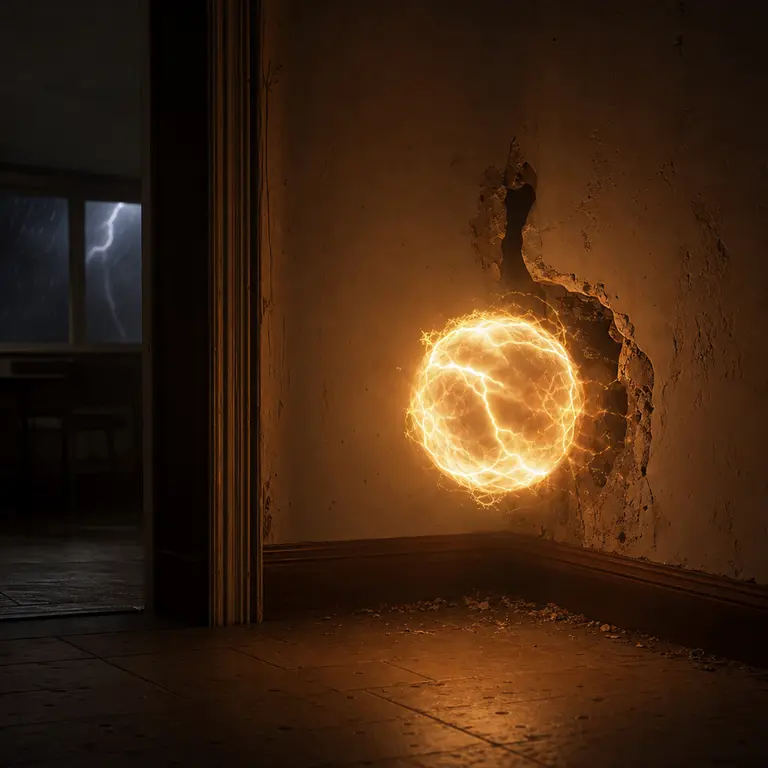
Ball lightning has been reported across every continent and in every era of recorded history. Ancient Chinese texts describe floating fire pearls that drift through rooms and dissolve against walls. Medieval European chronicles mention luminous spheres drifting through cathedral windows during storms, occasionally terrifying congregations who interpreted them as divine or demonic visitations. Modern airline pilots have reported glowing balls passing through cockpit windshields at altitude without causing any structural damage to the aircraft. The objects are typically described as ranging in size from a golf ball to a beach ball, persisting for anywhere from a few seconds to several minutes, and then either fading silently or exploding with a sharp crack. Some witnesses report a sulfurous smell afterward. Some report no smell at all. The consistency of these descriptions across cultures, centuries, and continents is one of the most striking and underappreciated features of the phenomenon.
Why Science Struggled to Take It Seriously
The core problem with ball lightning as a scientific subject is that it leaves almost no physical evidence. Unlike conventional lightning, which scorches trees, fuses sand into fulgurites, and trips electrical meters, ball lightning typically vanishes without a measurable trace. It does not burn the surfaces it passes near, it does not reliably trigger electromagnetic sensors, and it has historically appeared and disappeared too quickly for witnesses to do anything other than describe what they saw after the fact. This made it extraordinarily difficult to study, and for decades it occupied an uncomfortable middle ground between accepted atmospheric physics and anecdote.
A 1972 survey by astronomer James Rand tallied more than 4,000 eyewitness accounts and found a remarkably consistent set of characteristics: spherical or slightly oval shape, luminosity roughly equivalent to a 100-watt bulb, a tendency to move slowly and horizontally rather than falling under gravity as a dense object would, and a lifetime measured in seconds to minutes rather than the microseconds that characterize conventional lightning. The consistency across independent reports from people who had never heard of each other, separated by geography, culture, and centuries, made dismissal increasingly difficult to sustain. A skeptic could explain away one account, or a dozen, but the structural similarity between a medieval monk’s description and a Royal Air Force pilot’s incident report from 1944 demanded a more serious response.
The institutional reluctance to engage with ball lightning also reflected a broader tendency in twentieth-century physics to treat atmospheric phenomena as largely solved. The mechanisms of conventional lightning had been well characterized, and ball lightning seemed to violate several of the principles that made those mechanisms work. Plasma, the ionized gas that carries conventional lightning, disperses almost instantaneously when the driving electrical current stops. Nothing in standard plasma physics predicted a self-sustaining luminous sphere that could drift through a living room for thirty seconds and then vanish without scorching the carpet. The phenomenon did not fit, and what does not fit is often quietly set aside.
The real turning point came in 2012, when Chinese researchers at Lanzhou University accidentally captured ball lightning on video and spectrographic equipment while monitoring a thunderstorm in Qinghai Province. The object glowed for 1.6 seconds, traveled approximately 15 meters across the landscape, and its spectrum showed strong lines from silicon, iron, and calcium, elements found in ordinary soil. This single observation was transformative. It gave physicists not just a recording but a chemical fingerprint, dramatically narrowing the theoretical field and providing something concrete to work with for the first time in the subject's history.
The Competing Theories and the One Gaining Ground
Over the past century, more than 200 distinct theoretical models have been proposed to explain ball lightning. These include plasma vortices, microwave cavities generated inside ionized air columns, combustion of atmospheric methane, and even quantum vacuum fluctuations drawn from the more speculative edges of theoretical physics. Most have been quietly abandoned as they failed to account for the full range of observed behaviors, particularly the phenomenon’s apparent ability to pass through solid materials and its tendency to persist far longer than any conventional energy source could plausibly sustain.
The theory that has attracted the most serious attention since the 2012 observation is the silicon oxide aerosol model, developed independently by several research groups, including scientists at the Max Planck Institute for Plasma Physics in Germany. The model proposes that a conventional lightning strike vaporizes silicates in the soil, producing a cloud of silicon nanoparticles that then oxidize slowly in the surrounding air, releasing energy as visible light and heat. The oxidation process is slow enough that the luminous cloud persists for seconds rather than microseconds, and the energy released maintains the orb’s structure against gravity and air currents long enough to produce the drifting, hovering behavior that witnesses consistently describe. The silicon spectral lines captured in the 2012 footage fit this model almost precisely, lending it a degree of empirical support that most previous theories never achieved.
A separate but complementary hypothesis developed by physicist Antonio Ranada involves topological structures in electromagnetic fields, essentially knotted magnetic field lines that can sustain themselves independently of any material substrate. Ranada’s model, published in Physical Review Letters in 1996, is mathematically elegant and explains one of the most puzzling features of witness accounts: ball lightning’s apparent ability to pass through glass windows without breaking them. A purely electromagnetic structure would interact with glass very differently from a plasma or aerosol would, potentially passing through it without transferring enough mechanical energy to cause fracture. The two models are not mutually exclusive, and some researchers now believe that what witnesses call ball lightning may actually encompass several distinct phenomena that happen to look similar under casual observation, much as several different atmospheric optical effects are all colloquially called mirages.
Laboratory Attempts to Recreate It
Reproducing ball lightning under controlled conditions has proven to be one of the most stubborn challenges in experimental physics, and the history of attempts to do so is itself a fascinating record of creative problem-solving at the boundary of known science. In 2006, Brazilian physicists Antonio Pavao and Gerson Paiva reported creating small luminous orbs by firing a high-current electrical arc at silicon wafers. The orbs lasted up to eight seconds, rolled across the laboratory floor under their own momentum, and left behind a powdery white residue consistent with oxidized silicon compounds. The experiment was reproducible across multiple trials, which gave it genuine scientific standing, though critics noted that the laboratory objects were considerably smaller and shorter-lived than those reported in most field cases, and that the experimental conditions did not closely resemble those under which natural ball lightning appears.
At the Technical University of Munich, researchers have used microwave resonators to create stable plasma balls in low-pressure chambers that share several visual characteristics with reported ball lightning. These objects can be made to hover, drift, and even pass through certain materials under controlled conditions, though they require continuous microwave input to sustain themselves, a constraint that natural ball lightning apparently does not share. The Munich experiments have been valuable in understanding the optical and electromagnetic properties of self-contained plasma structures, even if they fall short of fully replicating the phenomenon.
The most recent and arguably most significant experimental advance came in 2023, when a team at Tsinghua University published results in Physical Review Applied describing the creation of luminous plasmoid structures using high-voltage discharges into water vapor. The resulting objects persisted for up to three seconds after the initial discharge, without any external energy input, a meaningful threshold that earlier laboratory analogs had not crossed. The team measured the objects’ temperature, spectral output, and electromagnetic field profile in detail, providing what may be the most complete physical characterization of an artificial ball lightning analog produced to date. The results were consistent with both the silicon aerosol model and certain predictions of the topological field hypothesis, suggesting that the two frameworks may be describing complementary aspects of the same underlying physics.
What Ball Lightning Might Tell Us About Plasma Physics and Beyond
Beyond satisfying centuries of curiosity, understanding ball lightning has real and practical implications for plasma physics and potentially for the future of fusion energy research. One of the central engineering challenges in magnetic confinement fusion, the approach used in the ITER reactor currently under construction in southern France, is maintaining stable plasma structures against turbulent instabilities that cause the plasma to lose energy and disperse before fusion reactions can be sustained. Ball lightning, if it represents a naturally occurring stable plasma configuration that maintains itself without any external magnetic confinement, may encode physical principles that engineers have not yet fully exploited in their designs.
Some plasma physicists have drawn explicit connections between the topological stability hypothesized in Ranada’s model and the concept of plasmoids, which are self-contained plasma structures observed in both laboratory fusion experiments and the solar corona. The sun’s outer atmosphere is itself full of unexplained luminous structures that persist far longer than conventional plasma dynamics predict, and at least one solar physicist, David Rust of Johns Hopkins University, has argued that the same knotted magnetic field topology that might explain ball lightning also underlies the behavior of solar prominences. If this connection is real, then studying a glowing sphere witnessed by a farmer in rural China could contribute to understanding plasma behavior on a stellar scale.
For now, ball lightning remains one of the few atmospheric phenomena that have been reliably witnessed by millions of people throughout recorded history but have never been fully explained to the satisfaction of the scientific community. The 2012 spectrographic data and the growing body of laboratory analogs suggest that a complete explanation is genuinely within reach, perhaps within the current decade. What makes the subject remarkable is not only the strangeness of the phenomenon itself, but what its long history of neglect reveals about the limits of scientific confidence and the difficulty institutions have in taking seriously what does not fit existing frameworks. Something witnessed by a German physicist in 1753, a Chinese farmer in 1984, and an airline pilot over the North Atlantic in 2019 remained, in the age of particle colliders and quantum computers, a mystery sitting at the edge of physics, waiting for someone to look at it carefully enough and long enough to understand what it actually was.
Sources & Further Reading
- Stephan, K.D. Ball Lightning: A Popular History. Springer, 2018.
- Cen, J., Yuan, P., and Xue, S. Observation of the Optical and Spectral Characteristics of Ball Lightning. Physical Review Letters, 2014. https://journals.aps.org/prl/abstract/10.1103/PhysRevLett.112.035001
- Rañada, A.F. and Trueba, J.L. Ball Lightning an Electromagnetic Knot? Nature, 1996. https://www.nature.com/articles/383032a0
- Pavão, A.C. and Paiva, G.S. Generation of Stable Plasma Balls by Atmospheric Discharge. Physical Review Letters, 2006.