
The Electrifying Mysteries of Volcanic Lightning Unveiled
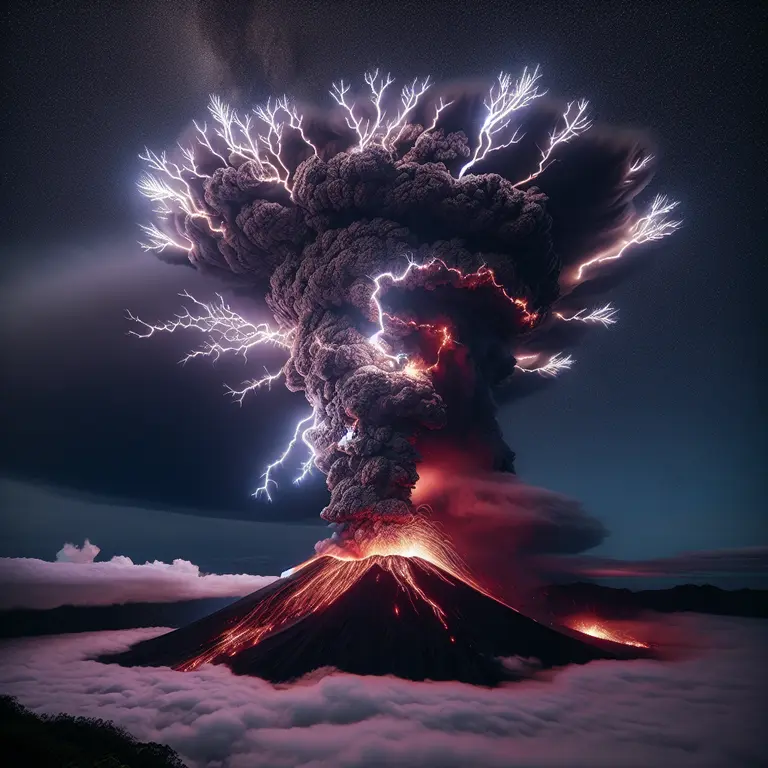
The rare and spectacular phenomenon of volcanic lightning occurs when ash particles in eruption plumes generate massive electrical discharges.
 Watch on YouTube
 Watch on Rumble
The Sky-Splitting Power of Dirty Thunderstorms
When Mount Vesuvius erupted in 79 CE, Pliny the Younger described something that sounded almost mythological: “A fearful black cloud was rent by forked and quivering bursts of flame.” What the Roman administrator witnessed wasn’t poetic exaggeration but a phenomenon so visually dramatic it seems impossible: volcanic lightning.
Volcanic lightning—sometimes called a “dirty thunderstorm”—occurs when massive electrical discharges form within volcanic plumes during eruptions. Unlike regular lightning, which requires water droplets in clouds, volcanic lightning forms through a completely different mechanism that wasn’t fully understood until recently. These spectacular electrical storms represent one of nature’s most awe-inspiring displays, where geology and atmospheric physics collide in a dance of primordial forces.
The Surprising Triboelectric Effect
The key mechanism behind this phenomenon is something that would surprise even many geologists and meteorologists: volcanic plumes generate electricity primarily through friction between ash particles, not through the ice formation process that drives conventional thunderstorms.
When volcanic ash particles violently collide during an eruption, they create static electricity through the triboelectric effect—the same principle that causes a balloon to stick to your hair after rubbing it. But in volcanic plumes, this occurs at catastrophic scales. The ash particles become electrically charged, creating massive potential differences that discharge as lightning bolts extending several kilometers.
What’s particularly counterintuitive is that volcanic lightning can occur in completely dry conditions and even in environments where conventional thunderstorms would be impossible—such as on Jupiter’s moon Io, where scientists have observed electrical discharges in its sulfur dioxide plumes despite the absence of water.
The intensity of these electrical discharges correlates directly with the explosivity of the eruption. During the 2010 eruption of Iceland’s Eyjafjallajökull volcano, researchers recorded up to 300 lightning strikes per hour at the eruption’s peak. More violent eruptions like the 1980 Mount St. Helens event generated lightning bolts that stretched nearly 2 miles in length—far exceeding the average length of typical thunderstorm lightning.
Recent laboratory experiments have revealed another surprising aspect of this phenomenon: the shape of the ash particles matters significantly. Angular, irregular particles generate far more electrical charge than smooth, rounded ones. This explains why some eruptions produce spectacular lightning displays while others with similar explosive force generate relatively little electrical activity.
The Scientific Time Machine
Perhaps most surprising is how volcanic lightning serves as a window into Earth’s primordial past. Atmospheric scientists now believe that before life existed on Earth, when the atmosphere contained no oxygen and was rich in volcanic gases, lightning generated in volcanic plumes may have been crucial in creating the complex organic compounds necessary for life’s emergence.
This connection between geological violence and biological origins represents a profound cross-disciplinary insight: the same destructive forces that obliterated Pompeii might have been instrumental in creating the chemical preconditions for life itself billions of years earlier.
The energy from volcanic lightning on early Earth would have broken apart simple molecules such as water, carbon dioxide, and nitrogen, allowing them to recombine into more complex organic compounds. Laboratory simulations of these conditions have successfully produced amino acids—the building blocks of proteins—suggesting that volcanic lightning could have been a crucial catalyst for prebiotic chemistry.
What makes this particularly fascinating is that volcanic lightning would have been far more common on the young Earth than it is today. With constant volcanic activity and an atmosphere rich in ash and gases, the early planet may have been continuously illuminated by these electrical discharges, providing a persistent energy source for chemical evolution long before photosynthesis evolved.
The Electromagnetic Fingerprint
Each volcanic eruption produces a unique “lightning signature” based on the chemical composition of its magma and ash. Scientists have recently developed methods to analyze these electromagnetic patterns remotely, allowing them to determine the explosivity and ash content of eruptions happening in remote locations where direct observation is impossible.
This unexpected application has transformed volcanic lightning from a mere spectacle into a crucial monitoring tool for predicting ashfall patterns that might affect aviation and public health—a perfect example of how understanding an extreme natural phenomenon can yield practical benefits in seemingly unrelated fields like transportation safety and emergency management.
The electromagnetic signals generated by volcanic lightning propagate through the Earth’s atmosphere in distinctive ways. By analyzing the frequency, amplitude, and polarization of these signals, volcanologists can now determine critical information about eruptions occurring hundreds or even thousands of miles away. This capability has proven invaluable for monitoring volcanoes in remote regions of Alaska, Indonesia, and the South Pacific.
Perhaps most remarkable is how this technology has been miniaturized. Modern volcanic lightning detection systems can fit inside a suitcase and operate autonomously for months on solar power, creating a global network of sensors that continuously monitor the world’s most dangerous volcanoes. These systems can detect electrical activity even in the earliest stages of an eruption, sometimes providing crucial early warnings before traditional seismic monitoring systems register significant activity.
Cultural Significance and Historical Documentation
Throughout human history, volcanic lightning has occupied a special place in mythology and cultural understanding. Ancient cultures frequently interpreted these displays as divine wrath or cosmic battles. The Aztecs believed that Xiuhtecuhtli, their fire deity, manifested through volcanic lightning, while Norse mythology associated similar phenomena with Thor’s battles against the giants.
What’s particularly valuable to historians and archaeologists is how descriptions of volcanic lightning serve as reliable markers in historical texts. When ancient chronicles mention fire in the sky coinciding with earthquakes or darkness at midday, modern scholars can often pinpoint these accounts to specific volcanic events. Pliny the Younger's description of Vesuvius’s eruption is among the earliest scientific documentation of volcanic lightning, providing invaluable insights into both the eruption’s characteristics and Roman observational methods.
Japanese woodblock prints from the 18th and 19th centuries frequently depicted volcanic lightning during eruptions of Mount Fuji and other volcanoes, creating an artistic record that complements scientific understanding. These visual representations, created long before photography, help modern volcanologists reconstruct the behavior of historically significant eruptions.
Conclusion
Volcanic lightning represents one of nature’s most perfect convergences of destructive beauty—where the violent upheaval of Earth’s crust generates atmospheric electricity on a scale that dwarfs conventional thunderstorms. From its role in potentially sparking the chemistry of early life to its modern applications in volcanic monitoring, this phenomenon transcends disciplinary boundaries.
As climate change potentially alters volcanic activity patterns worldwide, understanding dirty thunderstorms becomes increasingly relevant. Some climate models suggest that certain volcanoes may experience more frequent or explosive eruptions as glaciers and ice caps that currently suppress their activity melt away. This could lead to more frequent volcanic lightning events in regions previously unaccustomed to them.
The next time you see footage of lightning crackling through an ash cloud, remember that you’re witnessing more than just a spectacular light show. You’re observing a phenomenon that connects our modern world to Earth’s most ancient processes—a reminder that even in an age of technological sophistication, the planet still harbors primal forces that both threaten and fascinate us, just as they did when Pliny watched Vesuvius transform the Mediterranean sky nearly two thousand years ago.