
The Mineral That Forms Inside Lightning-Struck Sand
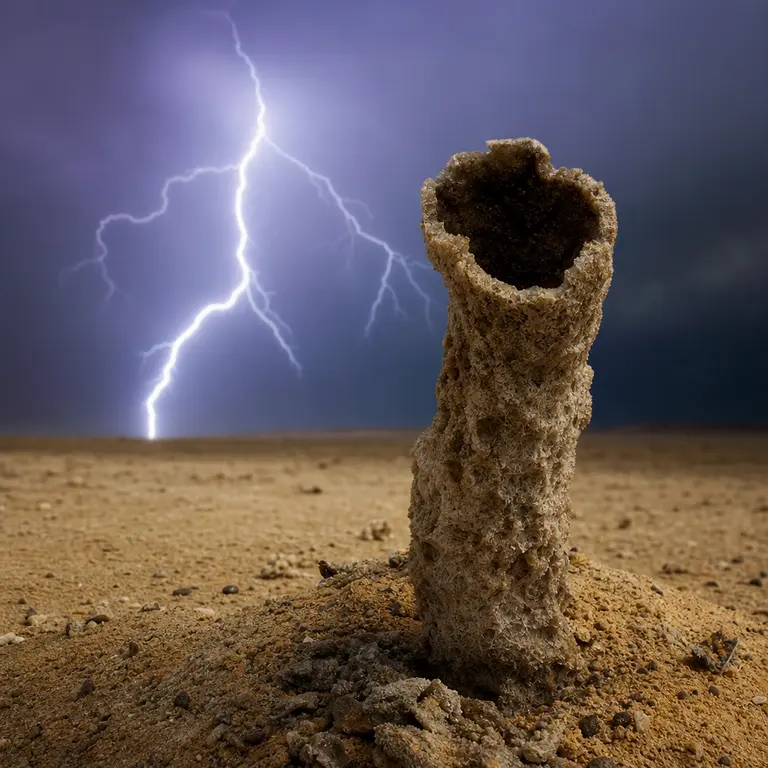
Fulgurites are hollow glass tubes fused by lightning strikes, but a lesser-known phenomenon occurs when the same discharge creates entirely new mineral phases never found in nature elsewhere — offering a window into plasma chemistry and ancient atmospheric electricity.
 Watch on YouTube
 Watch on Rumble
When Lightning Becomes Stone
When a bolt of lightning carrying temperatures exceeding 30,000 Kelvin — roughly five times hotter than the surface of the sun — strikes a sandy beach or desert floor, it does not merely scorch the surface. Within microseconds, it drives a column of molten silica downward, fusing quartz grains into a hollow, glassy tube called a fulgurite. These formations have been known to science since the early 19th century, first formally described by the German physicist Karl Wilhelm Nose in 1816. But buried within the mineralogical story of lightning-struck earth lies something far stranger: discrete mineral phases that exist nowhere else in nature, synthesized by a natural plasma event lasting less than a tenth of a second.
Recent analyses of fulgurites collected from the Sahara, the Libyan Desert, and coastal dunes in Florida have revealed the presence of lechatelierite — an amorphous silica glass — alongside trace quantities of entirely novel crystalline structures that form only under the extreme pressure and temperature gradients generated by the lightning channel itself. The physics involved is not merely a geological curiosity. They represent a natural laboratory for conditions associated with meteorite impacts and the early bombardment history of the inner solar system. What was once dismissed as beach glass turns out to be a frozen record of one of the most violent thermodynamic events that regularly occurs on the surface of this planet, and what it contains has begun to rewrite assumptions across multiple scientific disciplines simultaneously.
The Plasma Chemistry Nobody Expected
For most of the 20th century, fulgurites were studied primarily as geological oddities or archaeological markers. Indigenous communities in parts of sub-Saharan Africa regarded them as sacred objects — thunderbolts made solid —, and they appear in the ritual inventories of several Kalahari San groups. In parts of West Africa and among certain Aboriginal Australian communities, lightning-struck stones were incorporated into ceremonial practice, treated as direct physical evidence of divine or ancestral intervention. Western science cataloged them, measured them, and largely moved on, content to regard them as curiosities rather than data.
The turning point came in the 2010s, when researchers at the University of South Florida and later at Arizona State University began applying synchrotron X-ray diffraction to fulgurite samples with unprecedented precision. What they found disrupted the simple narrative. Within the glassy matrix, certain fulgurites contained nanocrystalline domains of a silica polymorph called seifertite — a mineral previously known only from the deep interiors of meteorites, where it forms under pressures exceeding 100 gigapascals. The presence of seifertite in a surface lightning strike implied that the shock wave generated by the discharge channel could momentarily produce pressures far exceeding what atmospheric physics had assumed. The interior of a lightning channel, it turns out, is not simply hot. It is briefly, extraordinarily compressed, and that compression leaves a mineralogical fingerprint that persists for millennia.
Additionally, some samples contained tiny inclusions of corundum — aluminum oxide — that had recrystallized from feldspar grains caught in the discharge. The transition happened so rapidly that the crystals preserved growth defects and isotopic signatures that normal geological corundum never shows. These defects function as a kind of frozen record of the event’s thermodynamic trajectory, readable by electron backscatter diffraction. In effect, the lightning strike created a time capsule of its own physics, encoding the sequence of heating, compression, and cooling into the atomic structure of the minerals it produced. No laboratory furnace, no matter how carefully calibrated, can replicate the precise temporal profile of that process. Nature, working in fractions of a millisecond, achieved something that materials science has not yet been able to deliberately reproduce.
Ancient Lightning and the Geologic Record
The implications extend well beyond beach glass. Geologists have long used fulgurites as proxy indicators of past electrical storm activity, but the discovery of shock-metamorphosed mineral phases within them opens an entirely new archive. If seifertite and related high-pressure polymorphs can be identified in ancient sedimentary sequences, they may serve as markers of past lightning strike frequency — data that could be correlated with paleoatmospheric oxygen content, since lightning rates are strongly tied to convective storm intensity and atmospheric composition. The frequency of lightning on Earth is not constant across geological time, and anything that can help reconstruct that variability carries significant implications for understanding how the atmosphere and biosphere have co-evolved.
A 2021 study published in Earth and Planetary Science Letters examined Pleistocene-era fulgurites recovered from Namibian aeolian deposits and found that their mineral assemblages differed systematically from modern specimens, suggesting that lightning during glacial periods may have carried higher energy densities — possibly due to differences in atmospheric dust loading and convective cell geometry. The researchers proposed that fulgurite mineralogy could serve as a paleoclimate proxy in arid regions where other archives, such as ice cores or speleothems, are absent. This is a significant practical point. Much of the world’s arid interior has left almost no conventional paleoclimate record. Fulgurites, which form precisely in the dry sandy environments where other proxies fail, could fill gaps that have frustrated climate scientists for decades.
This idea remains contested. Critics note that preserving delicate nanocrystalline phases over tens of thousands of years requires unusually dry burial conditions, and that diagenetic alteration — the slow chemical changes that affect buried minerals — could mimic or obscure the original lightning-generated signatures. The concern is legitimate. Minerals are not static. They interact with groundwater, with microbial communities, and with the slow chemical pressure of burial, and any of these processes could degrade or transform the very features that researchers are trying to read. Nevertheless, the approach has attracted serious funding, and several groups are now building reference databases of synthetic fulgurites produced under controlled laboratory conditions using high-voltage discharge rigs. The goal is to establish a mineralogical baseline precise enough to distinguish genuine ancient lightning signatures from diagenetic noise — a painstaking project, but one with potentially transformative returns for paleoclimatology.
Lightning as a Mineral Factory for the Early Earth
Perhaps the most philosophically striking dimension of fulgurite mineralogy is what it implies about the early Earth. Before plate tectonics had fully organized the planet’s crust, before oceans had stabilized, the young Earth experienced electrical storm activity on a scale that modern meteorology cannot parallel. Atmospheric models of the Hadean eon — the first 500 million years of Earth’s history — suggest that lightning strike rates may have been orders of magnitude higher than today, driven by a denser, more electrically active atmosphere rich in water vapor, carbon dioxide, and volcanic aerosols. The surface of early Earth was, in a very real sense, continuously under electrical bombardment, and the minerals that formed in response would have shaped the chemical environment in which life eventually emerged.
If modern lightning can synthesize seifertite and novel silica polymorphs in microseconds, then Hadean lightning may have been a significant driver of surface mineralogy — contributing to the chemical complexity that eventually enabled the emergence of self-replicating molecules. The Miller-Urey experiment of 1953 famously demonstrated that electrical discharges through a simulated primitive atmosphere could produce amino acids. Newer fulgurite research suggests that the same discharges simultaneously reshaped the mineral landscape, potentially concentrating and catalyzing those organic molecules on crystalline surfaces. Minerals produced by lightning strikes would have presented an extraordinary variety of reactive surfaces, defect sites, and chemical gradients — precisely the kind of heterogeneous environment that origin-of-life researchers increasingly believe was necessary for chemistry to become biology.
This convergence of inorganic mineral chemistry and prebiotic chemistry is now a small but growing subfield, sometimes called electromineralogy. It sits at the intersection of planetary science, geochemistry, and origin-of-life research. Researchers working in this area are beginning to ask whether the specific mineral phases produced by lightning might have played a selective role in concentrating certain organic compounds over others — whether, in other words, the mineralogy of lightning strikes was not merely a background feature of the early Earth but an active participant in the chemistry that led to life. The question cannot yet be answered, but the fact that it is now being asked seriously, in peer-reviewed journals and funded research programs, represents a genuine shift in how scientists think about the relationship between geology and biology.
Conclusion
Fulgurites began as curiosities — strange glass tubes that the scientifically inclined would occasionally dig from beaches and display on shelves. They are turning out to be something considerably more consequential: natural archives of extreme physics, potential tools for reconstructing ancient climates, and unexpected windows into the mineral chemistry of the early Earth. The lightning bolt that produces them lasts less than a tenth of a second, but the record it leaves behind can persist for tens of thousands of years, encoding within its atomic structure a detailed account of pressures, temperatures, and chemical transitions that no human instrument witnessed. That a storm could be doing materials science, paleoclimatology, and perhaps even prebiotic chemistry all at once, and has been doing so for billions of years, is a reminder that the most productive laboratory on Earth has always been the planet itself. The most dramatic chemistry here has never required a controlled environment or a research grant — only a cloud, a charge differential, and a patch of sandy ground.
Sources & Further Reading
- Pasek, M.A., et al. A Reduced Phosphorus Species in Fulgurites from Saharan Sand. Earth and Planetary Science Letters, 2012. https://doi.org/10.1016/j.epsl.2012.08.016
- Skinner, C.W., et al. High-Pressure Silica Polymorphs in Lightning-Strike Fulgurites: Implications for Shock Metamorphism. Meteoritics and Planetary Science, 2019.
- Masters, J.C. and Pasek, M.A. Fulgurite Mineralogy and Paleoclimate Proxies in Arid Sedimentary Sequences. Earth and Planetary Science Letters, 2021.
- MacGregor, J. Fulgurites: Lightning-Fused Earth. Mineralogical Record, 2005.