
Decoding Coffee: The Microbial Art Behind Every Brew
The complex microbial ecology of coffee fermentation, including the overlooked role of wild yeasts and fungi in shaping flavor, and how modern science is engineering better beans through controlled fermentation.
 Watch on YouTube
 Watch on Rumble
The Invisible Workforce Behind Every Cup
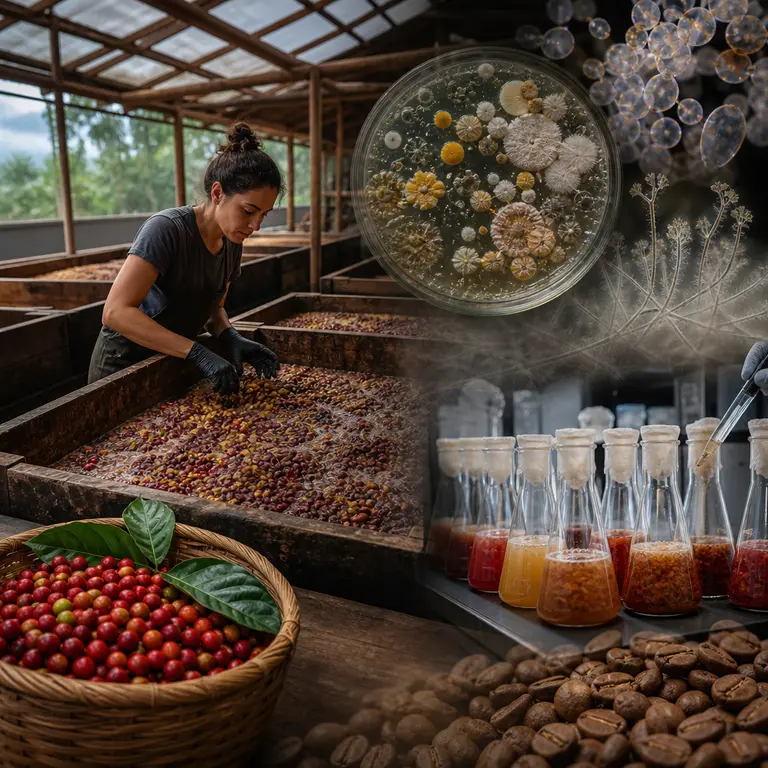
When coffee drinkers debate single-origin beans or roasting profiles, they rarely consider what happens in the hours between harvest and drying. Yet the fermentation stage — a process lasting anywhere from 12 to 72 hours, depending on method and climate — may be the single most consequential step in determining what ends up in the cup. At the center of this transformation is not a skilled roaster or an agronomist, but an invisible community of microorganisms: bacteria, yeasts, and filamentous fungi that collectively dismantle the mucilaginous layer surrounding the coffee seed and, in doing so, generate the volatile compounds that define flavor.
For most of the 20th century, coffee fermentation was treated as a necessary but poorly understood nuisance — a step farmers managed by intuition, smell, and tradition. The science of what was actually happening inside a fermentation tank was largely ignored by the specialty coffee industry until the early 2000s, when microbiologists began applying the tools of food microbiology to coffee processing with surprising results. What they found was not a simple or predictable process, but a dynamic ecological succession involving dozens of competing microbial species, each contributing differently to the chemical landscape of the finished bean. The story of that discovery, and what the industry is beginning to do with it, is one of the more quietly consequential developments in modern food science.
Yeasts, Bacteria, and the Chemistry of Flavor
The dominant organisms in wet-processed coffee fermentation are lactic acid bacteria, particularly species of Lactobacillus and Leuconostoc, alongside wild yeasts from the genera Saccharomyces, Pichia, and Candida. These organisms establish themselves quickly in the oxygen-depleted environment of a sealed or submerged fermentation tank, feeding on the sugars and organic acids in the mucilage that surrounds the coffee seed. Their metabolic activity produces lactic acid, acetic acid, ethanol, and a range of volatile esters and aldehydes — compounds that interact with the bean’s own chemistry and become embedded in the seed’s cellular structure during drying and curing.
But it is the filamentous fungi — molds of the genera Aspergillus, Penicillium, and Fusarium — that complicate the picture considerably. Research published in journals including Food Microbiology and the International Journal of Food Microbiology has documented that the fungal community in coffee fermentation is highly variable depending on altitude, ambient temperature, water source, and the condition of fermentation vessels. A 2015 study by researchers at the Federal University of Lavras in Brazil identified over 50 distinct fungal species across fermentation tanks in a single growing region. Most were transient and contributed little to flavor. But a subset produced enzymes — pectinases, cellulases, and proteases — that broke down the coffee mucilage more efficiently than bacteria alone, accelerating the process and generating distinct aromatic precursors.
Some of these fungal metabolites are beneficial. Certain Pichia species, for instance, produce esters and higher alcohols associated with fruity and floral notes that coffee buyers now actively seek. Others are problematic. Fusarium species can produce mycotoxins under certain conditions, and Aspergillus species related to those that produce ochratoxin A — a nephrotoxic compound — have been detected in improperly dried or stored green coffee. The European Food Safety Authority has monitored ochratoxin A levels in coffee since the early 2000s, and while roasting significantly reduces concentrations, the presence of these organisms underscores the importance of fermentation control. The line between a fermentation that produces a celebrated cup and one that produces a contaminated batch is, in microbial terms, surprisingly narrow.
What makes the chemistry especially complex is the degree to which microbial interactions — rather than individual species acting in isolation — determine final outcomes. Certain yeast strains suppress bacterial growth by producing antimicrobial peptides, thereby reshaping the surrounding community. Lactic acid bacteria, in turn, lower the pH of the fermentation environment in ways that inhibit some fungal species while favoring others. The result is a succession of microbial dominance that unfolds over hours and is sensitive to temperature, oxygen availability, and the initial microbial load on the harvested cherry. Two fermentation tanks sitting side by side on the same farm, filled on the same morning, can produce measurably different cups if their starting microbial communities differ.
The Science of Controlled Inoculation
The recognition that microbial communities shape coffee quality has led to a new wave of research into controlled or starter-culture fermentation — the deliberate inoculation of fermentation tanks with selected microbial strains, a technique borrowed from winemaking and dairy production. The logic is straightforward: if spontaneous fermentation is a lottery whose outcome depends on which organisms happen to be present at the start, then seeding the tank with a known, well-characterized strain should reduce variability and allow producers to target specific flavor outcomes with greater reliability.
A 2019 study led by Luc De Vuyst’s group at the Vrije Universiteit Brussel, in collaboration with coffee producers in Honduras and Ethiopia, demonstrated that inoculating wet fermentation tanks with specific Saccharomyces cerevisiae strains consistently produced cups with higher concentrations of desirable esters and lower acetic acid content compared to spontaneous fermentation controls. The results were reproducible across different farms and harvest years — a significant finding in an industry where vintage variation is typically accepted as inevitable. For producers selling into high-value specialty markets, the ability to guarantee a consistent flavor profile from one season to the next has obvious commercial appeal.
More recently, researchers at the University of California, Davis, have explored the use of non-Saccharomyces yeasts, particularly Torulaspora delbrueckii, which had already gained traction in winemaking for its ability to enhance aromatic complexity without generating excessive ethanol. Early trials with coffee suggest that T. delbrueckii inoculation increases concentrations of 2-phenylethanol — a rose-scented compound — in the finished bean, a result that aligns with growing consumer demand for floral cup profiles. The crossover from enology to coffee processing is not merely methodological; it reflects a broader recognition that the two industries address similar problems and that decades of winemaking research constitute a largely untapped resource for coffee scientists.
The commercial implications are significant. Several specialty coffee companies, including Sasa Sestic’s Project Origin in Australia, have already partnered with microbiologists to develop proprietary fermentation protocols. Sestic, who won the 2015 World Barista Championship partly on the strength of a carbonic maceration technique borrowed from natural winemaking, has since become one of the most visible advocates for scientifically guided fermentation in the specialty sector. His success helped normalize the idea that fermentation is not merely a processing step to be managed and minimized, but a creative tool — one that, in skilled hands, can be used to produce cups with flavor characteristics that no amount of roasting artistry could generate from an otherwise ordinary bean.
Dry Processing, Honey Processing, and the Fungal Frontier
Not all coffee is wet-processed. Natural or dry processing — in which whole coffee cherries are dried in the sun with the fruit intact — creates an entirely different fermentation environment, one dominated by surface-dwelling fungi rather than aquatic bacteria. The dried cherry acts as a kind of bioreactor, and the microbial succession that unfolds over days or weeks of sun-drying produces flavor compounds that wet processing cannot replicate: the characteristic winey, blueberry, and fermented-fruit notes associated with Ethiopian and Brazilian naturals.
Research from the Brazilian Agricultural Research Corporation (Embrapa) has shown that the fungal community during natural processing is substantially more diverse than during wet fermentation, with filamentous molds playing a proportionally larger role. Aspergillus niger, which in other contexts is associated with citric acid production and enzyme manufacturing, has been identified as a significant contributor to the breakdown of cherry pulp sugars during natural drying. The metabolic byproducts of this breakdown — including glycerol, organic acids, and volatile esters — diffuse into the bean and contribute directly to the cup. The process is slower, less controlled, and more dependent on ambient conditions than wet fermentation, which is part of why natural-processed coffees are simultaneously more distinctive and more variable than their washed counterparts.
Honey processing, a hybrid method in which varying amounts of mucilage are left on the bean during drying, occupies a middle ground. The microbial ecology of honey-processed coffees is among the least studied in the literature, though preliminary work from Costa Rican researchers suggests that the ratio of mucilage retained on the bean significantly influences which fungal genera predominate and, consequently, which flavor compounds accumulate. Yellow, red, and black honey designations — which refer to the proportion of mucilage left on the bean — may therefore represent not just different drying protocols but genuinely different fermentation environments, each with its own characteristic microbial community and flavor signature. The taxonomy of honey processing, currently defined almost entirely by visual and tactile criteria, may eventually need to be rewritten in microbial terms.
From Ancient Practice to Precision Agriculture
Coffee fermentation is, in one sense, among the oldest biotechnologies in continuous use. Ethiopian farmers have been processing coffee cherries using variations of natural and wet methods for centuries, long before microbiology was understood. What is changing now is the ability to decode, predict, and replicate outcomes that were once entirely dependent on local knowledge and environmental luck. The accumulated wisdom of traditional producers — their sensitivity to smell, timing, and texture during fermentation — turns out to have tracked real microbial phenomena, even if the language used to describe them was sensory rather than scientific.
The convergence of metagenomics — the sequencing of entire microbial communities from environmental samples — with precision fermentation technology means that the microbial fingerprint of a specific farm’s fermentation tank can now be characterized in detail, compared across seasons, and potentially engineered toward a target flavor profile. Startups in Colombia, Ethiopia, and Indonesia are already offering fermentation consulting services based on on-site microbial analysis, a development that would have seemed implausible to coffee producers a decade ago. The cost of metagenomic sequencing has fallen dramatically since the early 2010s, following the same trajectory as other genomic technologies, and what once required a university laboratory and months of analysis can now be accomplished with portable sequencing devices and cloud-based bioinformatics tools in a matter of days.
The implications extend beyond flavor. As climate change alters growing conditions across the coffee belt, fermentation science may offer one of the more accessible levers for maintaining bean quality under suboptimal conditions. Rising temperatures affect not only the plant itself but also the microbial communities inhabiting its processing environment, potentially disrupting fermentation dynamics that producers have relied on for generations. If the chemistry of the cup can be partially engineered at the fermentation stage, producers in regions experiencing erratic rainfall or temperature stress may be able to compensate for environmental deficits through microbial management — a form of agricultural resilience that requires no genetic modification of the plant itself, only a deeper understanding of the invisible organisms that have always been part of the process.
That understanding is still incomplete. The interaction between microbial metabolites and the bean’s own biochemistry during roasting — a process that transforms hundreds of precursor compounds into the aromatic molecules that define brewed coffee — remains poorly mapped. Researchers do not yet have a reliable model to predict how a specific fermentation-derived compound will behave under different roasting conditions, which means the full potential of fermentation engineering cannot be realized until roasting science catches up. But the direction of travel is clear. The cup of coffee that a consumer lifts to their lips in a specialty cafe is the end product of a biological process that began not with a farmer or a roaster, but with microorganisms too small to see — and the industry is only beginning to understand what they are capable of.
Sources & Further Reading
- De Vuyst, L. et al. Microbial Ecology and Process Technology of Sourdough Fermentation; applied to coffee fermentation studies. International Journal of Food Microbiology, 2019.
- Silva, C.F. et al. Succession of bacterial and fungal communities during natural coffee fermentation. Food Microbiology, 2013. https://doi.org/10.1016/j.fm.2012.09.012
- European Food Safety Authority. Ochratoxin A in Food. EFSA Journal, 2006. https://efsa.onlinelibrary.wiley.com/doi/10.2903/j.efsa.2006.365
- Nascimento Junqueira, A.C. et al. First Description of Bacterial and Fungal Communities in Colombian Coffee Fermentation. Frontiers in Microbiology, 2019. https://doi.org/10.3389/fmicb.2019.01816