
Beryllium-10: Unlocking Earth's Cosmic and Solar History
Beryllium-10, a rare cosmogenic isotope deposited in Antarctic ice cores, acts as a precise recorder of solar activity and geomagnetic reversals stretching back 800,000 years — and is now reshaping how scientists forecast space weather.
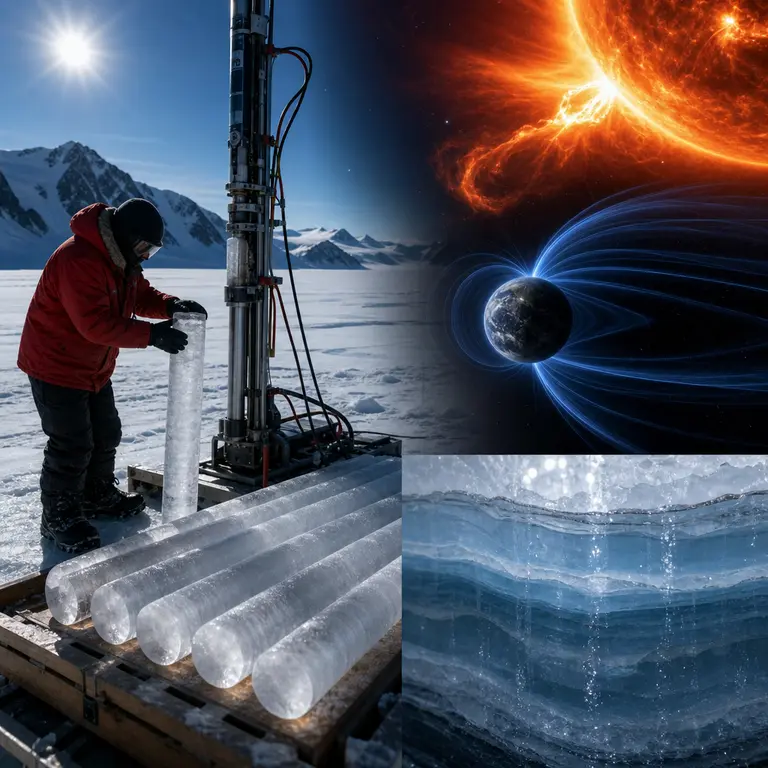
The Isotope That Falls Like Snow
High in the upper atmosphere, roughly 15 to 20 kilometers above the surface, cosmic rays streaming from distant supernovae collide with nitrogen and oxygen atoms. One product of these collisions is beryllium-10, a radioactive isotope with a half-life of approximately 1.39 million years. Unlike most radioactive materials associated with human industry or geology, beryllium-10 is entirely natural and perpetually raining down onto Earth’s surface. In polar regions, where snowfall accumulates undisturbed over millennia, each annual layer traps a measurable quantity of this isotope. The result is an involuntary archive — one that scientists have only recently learned to read with precision.
What makes this archive so remarkable is not merely its age but its continuity. Most geological records of ancient environments are fragmentary, interrupted by erosion, tectonic activity, or biological disturbance. Ice cores are different. In the stillness of the Antarctic interior, where temperatures rarely rise above minus 30 degrees Celsius even in summer, snow compresses into ice over centuries with almost no horizontal movement. Each layer remains where it fell, stacked in sequence like the pages of a book that no one has ever opened. The chemistry preserved within those layers — including trace concentrations of beryllium-10 — reflects conditions not just on Earth’s surface but in space itself, making polar ice one of the few terrestrial materials that carries a legible record of solar and cosmic behavior stretching back nearly a million years.
Antarctic ice cores, particularly those drilled at sites like Dome C and Vostok Station, have recovered continuous ice records stretching back 800,000 years. The EPICA (European Project for Ice Coring in Antarctica) Dome C core, completed in 2004, reached a depth of 3,270 meters and captured roughly eight complete glacial cycles. Within those layers, beryllium-10 concentrations fluctuate in ways that mirror known solar activity cycles, including the Maunder Minimum of the 17th century — a period of dramatically reduced sunspot activity that coincided with the coldest decades of the Little Ice Age. The precision with which these fluctuations can be dated has improved dramatically over the past two decades, as accelerator mass spectrometry has allowed researchers to measure beryllium-10 concentrations at the level of individual annual layers rather than decade-scale averages. What was once a blunt instrument has become something closer to a finely calibrated gauge.
Why Beryllium-10 Is a Solar Barometer
The mechanism linking beryllium-10 deposition to solar activity is elegant. When the Sun is magnetically active, its expanded heliosphere deflects incoming galactic cosmic rays more effectively. Fewer cosmic rays reach Earth’s atmosphere, so less beryllium-10 is produced. Conversely, during solar minima — periods of low sunspot activity and a weakened heliosphere — cosmic ray flux increases, and beryllium-10 production spikes measurably. This inverse relationship means that a high concentration of beryllium-10 in an ice layer signals a quiet Sun at the time that layer was deposited.
This relationship was confirmed through comparison with historical records of sunspot observations, which extend back to the early 17th century. The Maunder Minimum, spanning roughly 1645 to 1715, appears clearly in ice core records as an elevated beryllium-10 anomaly. More ancient events, such as the Oort Minimum around 1040 CE and the Spörer Minimum around 1450 CE, were identified and dated almost entirely from ice-core beryllium-10 data before corroborating historical evidence was found. The isotope essentially told scientists where to look.
What is particularly striking about these identifications is the methodological reversal they represent. Historians and astronomers had long suspected that solar minima occurred at various points in the medieval and early modern periods, based on indirect evidence such as records of auroras, carbon-14 anomalies in tree rings, and accounts of unusually cold winters. But the beryllium-10 record provided independent, quantitative confirmation that removed any remaining ambiguity. The isotope did not merely corroborate what historians already suspected; in several cases, it revealed solar events that had left no trace in any written record, simply because they occurred before systematic observation began or in regions where record-keeping was sparse. The Homeric Minimum, a prolonged period of reduced solar activity believed to have occurred around 800 BCE, is one such event — known almost entirely through cosmogenic isotope evidence preserved in ice and tree rings.
The cross-validation between beryllium-10 in ice cores and carbon-14 in tree rings has been especially productive. Both isotopes are produced by cosmic-ray bombardment and respond to the same changes in solar activity and geomagnetic field strength. When the two records agree, researchers have high confidence in their interpretation. When they diverge, it signals that local factors — atmospheric circulation patterns that affect how quickly beryllium-10 is deposited in a given location, or variations in ocean carbon exchange that influence carbon-14 uptake in trees — need to be accounted for. The comparison has driven significant improvements in understanding how cosmogenic isotopes move through the environment between their point of production in the upper atmosphere and their final deposition in an archive material.
Geomagnetic Reversals Frozen in Time
Beryllium-10 records do more than track the Sun. Earth’s own magnetic field modulates cosmic ray penetration independently of solar activity. When the geomagnetic field weakens — as it does during a polarity reversal, when the north and south magnetic poles swap positions — more cosmic rays reach the atmosphere globally, and beryllium-10 production increases worldwide. Ice cores, therefore, preserve signatures of ancient geomagnetic events that would otherwise be inaccessible without sampling volcanic rock sequences or ocean sediment cores.
The most recent full polarity reversal, the Matuyama-Brunhes transition, occurred approximately 780,000 years ago. The EPICA core does not quite reach that depth, but intermediate events called geomagnetic excursions — short-lived partial reversals or significant field-weakening episodes — do appear in its record. The Laschamp excursion, dated to around 41,000 years ago, produced a beryllium-10 spike roughly three times the background level. This event coincided with a period during which Earth’s magnetic field dropped to perhaps 5 percent of its current strength, briefly exposing surface life to substantially elevated radiation. Some researchers have connected the Laschamp excursion to the extinction of Neanderthals, though this remains a contested hypothesis.
The argument connecting the Laschamp excursion to Neanderthal extinction is worth examining in some detail, not because it has been proven but because it illustrates the kind of cross-disciplinary reasoning that beryllium-10 research enables. The Neanderthal fossil record shows a sharp decline in population around 40,000 to 42,000 years ago, a timing that overlaps closely with the Laschamp event. A weakened magnetic field would have allowed significantly more ultraviolet radiation and energetic particles to reach the surface, potentially disrupting ecosystems by damaging plant life, altering atmospheric chemistry, and increasing mutation rates in exposed organisms. A 2022 study published in Science modeled the atmospheric effects of the Laschamp excursion and suggested it may have triggered a temporary collapse of the ozone layer over parts of the Northern Hemisphere, with cascading effects on climate and ecology. Whether this was sufficient to push an already stressed Neanderthal population toward extinction remains uncertain, but the beryllium-10 record provides the quantitative backbone that makes the hypothesis testable rather than merely speculative.
Current geomagnetic data show that Earth’s field has been weakening steadily since at least 1840, when systematic measurements began. The South Atlantic Anomaly, a region of unusually weak magnetic field over the southern Atlantic Ocean, has been expanding westward. Whether this represents the early stages of another excursion or reversal is unknown, but beryllium-10 records from future ice cores drilled in the coming decades will provide the historical baseline against which any acceleration can be measured.
Space Weather Forecasting and the Coming Solar Maximum
The practical stakes of understanding solar variability through beryllium-10 records have grown considerably as human civilization has become dependent on satellite infrastructure. Solar energetic particle events and coronal mass ejections can disable satellites, disrupt GPS systems, induce dangerous currents in power grids, and expose astronauts to lethal radiation doses. The most powerful geomagnetic storm on record, the Carrington Event of September 1859, induced currents strong enough to set telegraph offices on fire. An equivalent event today would cause estimated economic damage in the trillions of dollars.
Solar cycle 25, which began in December 2019, has already exceeded predictions in intensity. The Solar Cycle 25 Prediction Panel, convened by NASA and NOAA, initially forecast a below-average cycle. Instead, by mid-2024, sunspot counts and solar flare activity had surpassed those of the previous cycle. In May 2024, a series of X-class solar flares and associated geomagnetic storms produced auroras visible as far south as Florida and northern Mexico — the most intense geomagnetic disturbance since the Halloween storms of 2003.
Beryllium-10 data from ice cores now inform long-range solar forecasting models by revealing how often grand solar minima and maxima have occurred over the past 800,000 years and how quickly the Sun can transition between states. Research published in the journal Astronomy and Astrophysics in 2021 used a 9,400-year beryllium-10 reconstruction to identify 25 grand solar minima and 19 grand solar maxima, suggesting these extreme states occur, on average, every 370 to 400 years. The Sun, by this reckoning, may be approaching another grand maximum — or, alternatively, a minimum that could temporarily reduce space weather risk while simultaneously affecting Earth’s climate in ways that remain poorly quantified.
The climate implications of solar variability as revealed by beryllium-10 records remain one of the more contentious areas of current research. The total solar irradiance variation between a grand minimum and a grand maximum is relatively small in absolute terms — on the order of 0.1 to 0.3 percent — but the regional and seasonal effects can be amplified through feedback mechanisms involving stratospheric ozone chemistry, ocean circulation, and atmospheric dynamics. The Little Ice Age, which overlapped with the Maunder Minimum, was not caused by reduced solar output alone; volcanic activity and internal climate variability also played significant roles. But the beryllium-10 record makes it possible to disentangle these factors with a precision that was simply not available to earlier generations of climate scientists, and ongoing research continues to refine the quantitative contribution of solar forcing to climate shifts over timescales ranging from decades to hundreds of thousands of years.
Reading the Archive Before It Melts
The urgency surrounding ice core science has intensified as climate change accelerates. The surface layers of ice sheets in Greenland and Antarctica are melting and refreezing in patterns that can compromise the stratigraphic integrity of shallow core sections. More critically, mountain glaciers in lower latitudes — including those in the Alps, Himalayas, Andes, and Tibetan Plateau — are disappearing at rates that will eliminate them entirely within decades. These glaciers contain unique regional beryllium-10 records that cannot be recovered once the ice is gone.
The Ice Memory Foundation, a scientific initiative backed by UNESCO, has been working since 2015 to extract and preserve ice cores from endangered mountain glaciers in a permanent archive maintained at Concordia Station in Antarctica, where stable cold temperatures can preserve the samples indefinitely. Cores have already been collected from Mont Blanc in France, Illimani in Bolivia, and Belukha in Russia’s Altai Mountains. Each core carries its own beryllium-10 record — a localized solar and geomagnetic diary that, when combined with long polar records, may eventually allow scientists to reconstruct cosmic ray flux with regional resolution rather than relying on global averages alone.
There is something philosophically striking about this effort. The Ice Memory Foundation is, in essence, creating a backup of a natural archive that is being destroyed by the unintended consequences of industrial civilization. The cores being rescued from Mont Blanc and Illimani were laid down over centuries or millennia by processes entirely indifferent to human existence, and they carry information about solar and cosmic events that predate the invention of writing. Preserving them requires the most sophisticated cold-chain logistics available, combined with international scientific cooperation across institutions in Europe, South America, and Antarctica. The fact that this is happening at all reflects a growing recognition that the loss of these archives is not merely a scientific inconvenience but an irreversible erasure of planetary memory.
The isotope that begins its existence in a catastrophic stellar explosion, travels across thousands of light-years, and falls silently into polar snow has become one of the most informative natural instruments science has ever found. It records the Sun’s temperament, the Earth’s magnetic biography, and perhaps the outer boundaries of habitability itself — all in concentrations measured in atoms per gram. As the ice that holds these records continues to thin and retreat, the race to read what remains has acquired a significance that extends well beyond any single scientific discipline. What is being preserved is not just data but a form of deep time literacy — the hard-won ability to hear what the cosmos has been saying long before anyone was listening.
Sources & Further Reading
- Steinhilber, F., Beer, J., and Fröhlich, C. Total solar irradiance during the Holocene. Geophysical Research Letters, 2009. https://doi.org/10.1029/2009GL040142
- Loulergue, L. et al. Orbital and millennial-scale features of atmospheric CH4 over the past 800,000 years. Nature, 2008. https://doi.org/10.1038/nature06950
- Usoskin, I.G. A history of solar activity over millennia. Living Reviews in Solar Physics, 2023. https://link.springer.com/article/10.1007/s41116-023-00036-z
- Ice Memory Foundation. Mission and Archive. UNESCO/CNRS, 2024. https://www.ice-memory.org