
The Living Antifreeze: Ice-Free Blood of Arctic Fish
Antarctic and Arctic notothenioid fish survive in waters that should freeze their blood solid, thanks to a biological molecule so unusual it bends the rules of thermodynamics — and may reshape medicine, food science, and cryogenics.
Introduction
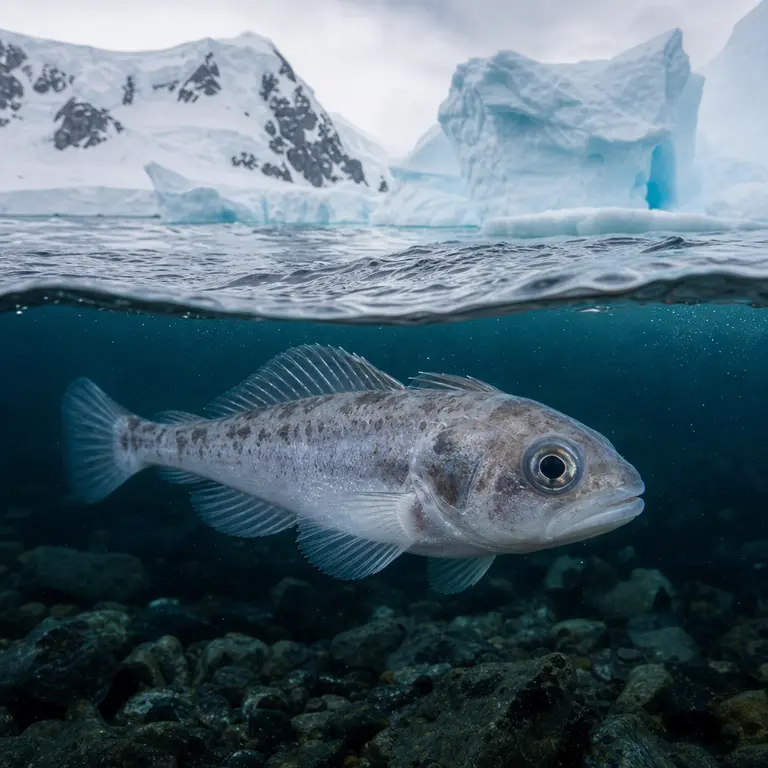
In the waters surrounding Antarctica, ocean temperatures regularly drop to minus 1.9 degrees Celsius — cold enough to freeze the blood of virtually any vertebrate on Earth. Seawater freezes at a lower point than fresh water due to its salt content, but fish blood, being less saline than the ocean, should crystallize and kill the animal outright. Yet the notothenioid fish — a group comprising roughly 130 species that dominate Antarctic fish diversity — swim freely in these lethal conditions. They do so because their blood carries one of the most biochemically peculiar molecules ever discovered: antifreeze glycoproteins, or AFGPs, substances that suppress ice crystal growth through a mechanism that still confounds physicists and chemists more than five decades after their discovery.
The story of how these proteins were found begins with a 1969 expedition led by Arthur DeVries, then a graduate student at Stanford, who collected blood samples from the Antarctic toothfish (Dissostichus mawsoni) and noticed that the fluid did not freeze at the temperature it theoretically should. When he isolated the responsible molecules, he found not a simple salt or sugar solution, but a repeating glycoprotein structure unlike anything in the biochemical literature. The discovery opened a field of research that continues to produce surprises today, touching disciplines as distant from each other as transplant surgery, materials science, frozen food manufacturing, and evolutionary genetics. What began as a curiosity about fish blood in one of the most remote places on Earth has quietly become one of the most practically consequential discoveries in modern biochemistry.
The Thermodynamic Paradox at the Heart of the Molecule
Antifreeze proteins work through what scientists call thermal hysteresis — a phenomenon in which the freezing point of a solution is depressed significantly below its melting point. In ordinary chemistry, a substance melts and freezes at the same temperature. Antifreeze proteins create a gap between these two points, allowing fish blood to remain liquid at temperatures where it would otherwise solidify. In notothenioid AFGPs, this gap can reach 1.5 to 2 degrees Celsius, which is more than sufficient to keep the fish alive in Antarctic waters. That may sound like a narrow margin, but in the context of an ocean that sits within a degree of the freezing point of seawater year-round, it represents the entire difference between life and death.
The mechanism is not colligative — meaning it does not work simply by adding more solute particles, the way table salt depresses the freezing point of water. Instead, the proteins bind directly to the surface of nascent ice crystals at specific lattice planes, physically blocking their growth. They do not prevent all ice from forming; rather, they arrest the propagation of ice crystals that do begin to nucleate, trapping them in a microscopic, harmless state. The binding is irreversible under physiological conditions, meaning the proteins essentially sacrifice themselves to keep each tiny crystal permanently stunted. This is a fundamentally different strategy from anything seen in simple chemistry, and it has no straightforward analog in synthetic materials science, which is part of why engineers find the proteins so difficult to replicate artificially.
What makes this stranger still is that the proteins appear to violate the Kelvin effect, a thermodynamic principle governing how curved surfaces on crystals should behave. Conventional models predict that very small ice crystals should actually melt faster than larger ones, yet the antifreeze proteins stabilize them anyway. Researchers at Queen's University in Canada and the Max Planck Institute for Dynamics and Self-Organization have used ultrafast spectroscopy and molecular dynamics simulations to probe this paradox, finding that the proteins restructure the hydrogen-bonding network of water molecules near the ice surface in ways that are not yet fully understood. The water itself, in other words, is being reorganized by the protein’s presence into a configuration that resists the thermodynamic pressures that would normally drive crystal growth. This capacity to reorganize the behavior of water at the nanoscale is one reason antifreeze proteins have attracted attention far beyond the biology of cold-water fish.
Convergent Evolution Across Five Separate Lineages
Perhaps the most astonishing aspect of biological antifreeze is how many times it evolved independently. Antifreeze proteins are not exclusive to Antarctic fish. They appear in Arctic cod (Boreogadus saida), winter flounder (Pseudopleuronectes americanus), ocean pout, sea ravens, and several insect species, including the spruce budworm and the Alaskan beetle Upis ceramboides, which can survive temperatures as low as minus 60 degrees Celsius. In plants, similar proteins have been identified in winter rye, carrot, and certain cold-hardy grasses. Each of these organisms faced the same fundamental problem — the destructive crystallization of internal water — and each arrived at a protein-based solution through an entirely independent evolutionary path.
Critically, these proteins are structurally distinct across lineages. The AFGPs of Antarctic notothenioids are built from repeating tripeptide units decorated with sugar chains. The Type I antifreeze proteins of winter flounder are simple alpha-helical peptides rich in alanine. Type II proteins resemble lectins — sugar-binding proteins with a completely different evolutionary origin. Type III proteins, found in ocean pout, have a globular structure that differs from the others. Type IV proteins, identified in longhorn sculpin, are related to apolipoproteins involved in fat transport. These are not variations on a single ancestral theme. They are genuinely different molecular architectures that happen to perform the same thermodynamic trick through different physical means.
This is one of biology’s most striking examples of convergent evolution: at least five separate molecular solutions to the same thermodynamic problem, arising independently across hundreds of millions of years of evolutionary history. The fact that life arrived at protein-based antifreeze so many times, in such different forms, suggests that this is one of a limited number of viable strategies available to organisms made of the particular chemistry that characterizes life on Earth. In the case of Antarctic notothenioids, genetic analysis published in the journal Science in 1997 by DeVries and colleagues demonstrated that the AFGP gene evolved from a trypsinogen-like digestive enzyme gene — a pancreatic protease was co-opted, through a series of gene duplications and insertions, into a blood-borne antifreeze. The evolutionary repurposing of a digestive enzyme into a life-sustaining blood component is itself a remarkable story, illustrating how natural selection can draft existing molecular machinery into entirely new roles when survival demands it.
Applications in Medicine, Food, and Cryopreservation
The biotechnological implications of antifreeze proteins have attracted sustained interest from industries that depend on controlling ice formation. In food science, AFGPs are being explored as additives that improve the texture of frozen foods. When ice cream freezes and thaws repeatedly during distribution, ice crystals grow larger — a process called recrystallization — producing a grainy, unpleasant texture. Antifreeze proteins dramatically slow this recrystallization. Unilever has patented an ice cream formulation using a protein derived from Arctic fish, and several research groups are engineering yeast strains to produce AFGPs at a commercial scale without the need for fish harvesting. The same principle applies to other frozen foods where texture degradation during cold chain distribution represents a significant economic and quality problem.
In medicine, the most urgent application is cryopreservation — the long-term storage of cells, tissues, and potentially organs at very low temperatures. Currently, the cryopreservation of complex organs like kidneys or hearts for transplantation is largely impossible because ice crystal formation during freezing and thawing destroys cellular architecture at the microscopic level. Antifreeze proteins offer a potential route around this barrier. Research published in Nature Medicine in 2017 demonstrated that adding synthetic antifreeze peptides to preservation solutions improved the viability of transplantable rat kidneys after cold storage. The field of vitrification — turning tissue into an amorphous glass rather than a crystalline solid — may benefit from antifreeze proteins as adjuncts that suppress nucleation events during the critical transition temperatures. If the organ transplant community could reliably store kidneys, livers, or hearts for days or weeks rather than hours, the logistical constraints that currently cause thousands of viable organs to go unused each year could be substantially reduced.
For blood banking, red blood cells can currently be stored frozen for up to ten years using glycerol as a cryoprotectant, but the process is expensive and requires washing before transfusion. Antifreeze protein-based alternatives that allow storage at higher subzero temperatures without the toxicity of glycerol are under active investigation. The U.S. Army, which has a direct operational interest in robust blood storage for field medicine, has funded several such research programs through DARPA and the Department of Defense. Beyond blood, there is growing speculation about whether antifreeze proteins might one day help preserve entire human bodies or organs for long-duration space travel — a possibility that remains firmly in the realm of speculative science but is no longer entirely outside the range of serious discussion.
The Unanswered Questions and a Cold Future
Despite decades of research, the precise atomic-level mechanism by which antifreeze proteins bind to ice remains incompletely resolved. Competing models argue over whether the binding is primarily hydrophobic — driven by water’s reluctance to accommodate nonpolar molecular surfaces — or whether it involves specific hydrogen bonds between the protein and ice lattice hydroxyl groups. A 2012 study using solid-state nuclear magnetic resonance found evidence for both mechanisms operating simultaneously in different protein types, suggesting the answer may be more complicated than either camp has allowed. The possibility that different antifreeze proteins work through subtly different mechanisms, even while achieving the same macroscopic result, adds another layer of complexity to a field that has never lacked for it.
There is also growing interest in what happens to antifreeze proteins inside the fish gut, where partially digested food may contain ice crystals that could seed dangerous internal freezing. Research from the University of Illinois has shown that notothenioid intestines secrete AFGPs directly into the gut lumen — an unusual deployment of the protein outside the bloodstream that suggests the antifreeze challenge is more pervasive than initially imagined. The fish is not merely protecting its blood; it is managing ice throughout its entire body, including in the digestive tract, where food items from near-freezing water arrive carrying their own crystalline hazards.
As climate change warms Antarctic waters, the ecological future of notothenioid fish is uncertain. Species that evolved their extraordinary biochemistry over 10 to 14 million years of Antarctic isolation may face competition from species moving in from warmer latitudes as the thermal barrier that protected their niche dissolves. The same proteins that make these fish marvels of molecular engineering may offer little help against a threat that operates on geological rather than biochemical timescales. In that irony, the antifreeze fish becomes a symbol not only of biological ingenuity but also of the fragility of solutions optimized for a rapidly changing world. A molecule that took millions of years to perfect, that has inspired medical breakthroughs and industrial patents, and that still puzzles the best physical chemists on Earth, may ultimately prove powerless against the one force that no protein can bind to and arrest: a warming planet that is simply melting the conditions that made the protein necessary in the first place.
Sources & Further Reading
- DeVries, A.L., and Wohlschlag, D.E. Freezing Resistance in Some Antarctic Fishes. Science, 1969. https://www.science.org/doi/10.1126/science.163.3871.1073
- Chen, L., DeVries, A.L., and Cheng, C.H.C. Evolution of Antifreeze Glycoprotein Gene from a Trypsinogen Gene in Antarctic Notothenioid Fish. Science, 1997. https://www.science.org/doi/10.1126/science.276.5320.1870
- Davies, P.L. Ice-binding proteins: a remarkable diversity of structures for stopping and starting ice growth. Trends in Biochemical Sciences, 2014. https://www.cell.com/trends/biochemical-sciences/fulltext/S0968-0004(14)00078-5
- Harding, M.M., Anderberg, P.I., and Haymet, A.D.J. 'Antifreeze' glycoproteins from polar fish. European Journal of Biochemistry, 2003. https://febs.onlinelibrary.wiley.com/doi/10.1046/j.1432-1033.2003.03617.x