
The Mysterious and Unpredicted Patterns of Pitch Behavior
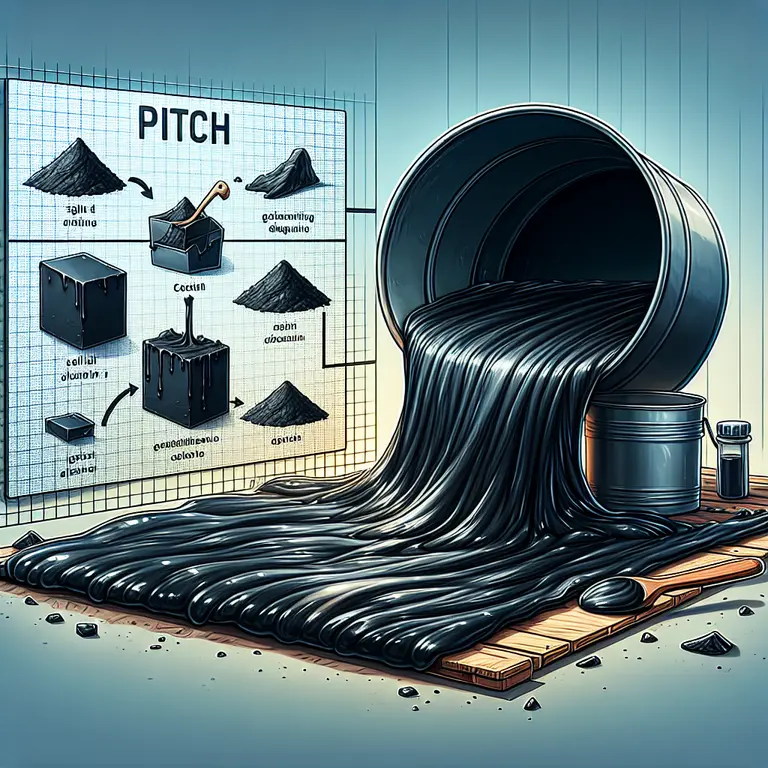
Pitch, a tar derivative, is classed as a very thick or viscous liquid despite looking and feeling like a solid.
 Watch on YouTube
 Watch on Rumble
The Pitch Drop Experiment: When Solids Aren’t Really Solid
There are a few experiments in the history of science that so elegantly challenge our everyday assumptions about the physical world. Most people sort matter into two intuitive categories: solid things that hold their shape, and liquid things that flow. Pitch, the dark, dense residue derived from coal tar or petroleum, appears to belong firmly in the first category. It looks solid. It feels solid. Strike it with a hammer, and it shatters like glass. Yet according to the laws of physics and the evidence of nearly a century of careful observation, pitch is technically a liquid. It flows. It just does so at a pace so incomprehensibly slow that no human being has ever watched a single drop fall in real time. This is the remarkable story of the Pitch Drop Experiment, one of the longest-running laboratory tests in recorded scientific history, and what it reveals about the hidden dynamism lurking inside materials we assume to be perfectly still.
What Makes Pitch a Liquid
To understand why pitch qualifies as a liquid rather than a solid, it helps to look past its surface appearance and into its molecular architecture. Solids, in the conventional sense, have atoms or molecules arranged in rigid, repeating crystalline lattices. These structures resist deformation because their internal bonds are strong and ordered. Liquids, by contrast, have molecules that are loosely associated, free to slide past one another and rearrange in response to gravity or applied force.
Pitch occupies a strange middle ground. It is what scientists call an amorphous material, meaning its molecules are not arranged in any regular crystalline pattern. Instead, they exist in a state of disordered chaos, much like the molecules in a liquid, but packed so densely and moving so sluggishly that the material behaves like a solid under short-term observation. The technical term for this kind of substance is a supercooled liquid, a material that has been cooled below its freezing point without actually crystallizing. Glass is perhaps the most famous example of this phenomenon, and pitch belongs to the same unusual category.
The viscosity of pitch, which is its resistance to flow, is estimated to be somewhere between 100 billion and 100 trillion times greater than the viscosity of water. To put that into some perspective, honey is roughly 10,000 times more viscous than water, and it pours noticeably slowly. Pitch makes honey look like a rushing river. At room temperature, pitch flows so imperceptibly that it takes approximately a decade for a single droplet to accumulate enough mass at the tip of a funnel to detach and fall. This is not a metaphor or an approximation. It is a measured, documented, painstakingly observed fact.
The Experiment That Started in 1927
The story of the Pitch Drop Experiment begins with Professor Thomas Parnell, the first Professor of Physics at the University of Queensland in Brisbane, Australia. Parnell was a meticulous educator with a gift for designing demonstrations that made abstract scientific principles tangible to students. In 1927, he conceived an experiment that would do exactly that, though he likely never imagined it would still be running nearly a century after his death.
Parnell began by heating a sample of tar pitch until it was fluid enough to pour, then sealed it into a glass funnel and allowed it to cool and consolidate for three full years. In 1930, he cut the sealed stem of the funnel open, allowing the pitch to begin its imperceptible descent under the influence of gravity alone. The apparatus was placed under a bell jar and left to do what pitch does: flow, at its own extraordinary pace.
The first drop fell in 1938, roughly eight years after the stem was opened. Subsequent drops occurred at intervals ranging from seven to thirteen years, influenced by factors such as seasonal temperature changes, which slightly alter the pitch's viscosity, and the room's ambient conditions. The experiment was not housed in a climate-controlled environment for much of its history, meaning that warmer Queensland summers likely marginally accelerated the flow, while cooler periods slowed it again.
Parnell himself died in 1948, never having witnessed a drop fall in person. His experiment, however, outlived him by decades and continues to this day under the stewardship of the University of Queensland’s School of Mathematics and Physics.
The Drop That Nobody Saw, and the One That Everyone Watched
Of all the curious episodes in the long history of this experiment, none is more poignant or more ironic than the events surrounding the ninth drop. By the late 1990s, the experiment had attracted significant public attention, and a webcam was installed to give the world the chance to witness firsthand what no scientist had ever seen: a drop of pitch actually falling. The anticipation was genuine. The setup was in place. And then, in December 2000, the ninth drop fell while the webcam was experiencing a technical fault. No one saw it. The footage was lost. Decades of waiting, and the moment slipped past unrecorded.
The disappointment was considerable, but the experiment pressed on. A new drop began to form at the tip of the funnel, and this time the monitoring systems were more robust. Researchers and enthusiasts around the world kept a close eye on the webcam feed. Years passed. The drop grew with agonizing slowness. Then, on April 17, 2014, nearly fourteen years after the previous drop had fallen, the tenth drop finally detached. This time, it was caught on camera. The footage, while not exactly action-packed by conventional standards, was celebrated by scientists and science communicators worldwide as a genuine milestone. The interval between the ninth and tenth drops remains one of the longest between any two consecutive drops in the experiment’s history, a reminder of how unpredictable even the slowest processes can be.
The experiment has since been recognized with a lighthearted but meaningful honor. In 2005, the custodians of the Pitch Drop Experiment received the Ig Nobel Prize in Physics, an award given annually for research that first makes people laugh and then makes them think. It is a fitting tribute to a project that has spent nearly a century doing exactly that.
What the Pitch Drop Teaches Us
Beyond its entertainment value and its status as a curiosity, the Pitch Drop Experiment carries genuine scientific and philosophical weight. It stands as a powerful reminder that our sensory experience of the world is not always a reliable guide to physical reality. We classify materials as solid or liquid based on how they behave in the fraction of a second it takes us to touch, press, or observe them. But matter does not organize itself around human timescales. Some processes simply operate on a clock that our lifespans cannot accommodate.
This insight has practical implications across multiple scientific disciplines. Materials scientists studying glass, ceramics, and polymers must account for the slow, long-term deformation of amorphous materials. Engineers designing structures meant to last for centuries need to understand how materials that appear rigid today may gradually creep over time. Even geologists encounter analogous phenomena in the behavior of glaciers, mantle rock, and certain types of sediment that deform plastically under sustained pressure.
The experiment also raises a quieter, more philosophical point about the nature of scientific patience. In an era of rapid publication cycles, instant results, and accelerating technological change, the Pitch Drop Experiment represents something almost countercultural: a commitment to observation that spans not just careers but generations. Parnell started something he knew he would not live to see concluded. That willingness to invest in knowledge for its own sake, without expectation of personal reward within a human lifetime, is itself a kind of scientific virtue worth celebrating.
Ultimately, this small glass funnel sitting on a shelf in Brisbane, slowly surrendering its contents to gravity one decade at a time, is one of the most elegant demonstrations in the history of experimental physics. It proves that the universe contains processes far slower than our intuition can grasp, and that the boundary between solid and liquid is far less clear than it appears. The pitch is flowing. It has always been flowing. We simply have to be patient enough to notice.