
Antifreeze Proteins: Nature's Solution to Ice Preservation
Certain organisms produce proteins that prevent ice crystals from forming inside their cells, a discovery that is now reshaping organ preservation, food science, and the future of cryogenic medicine.
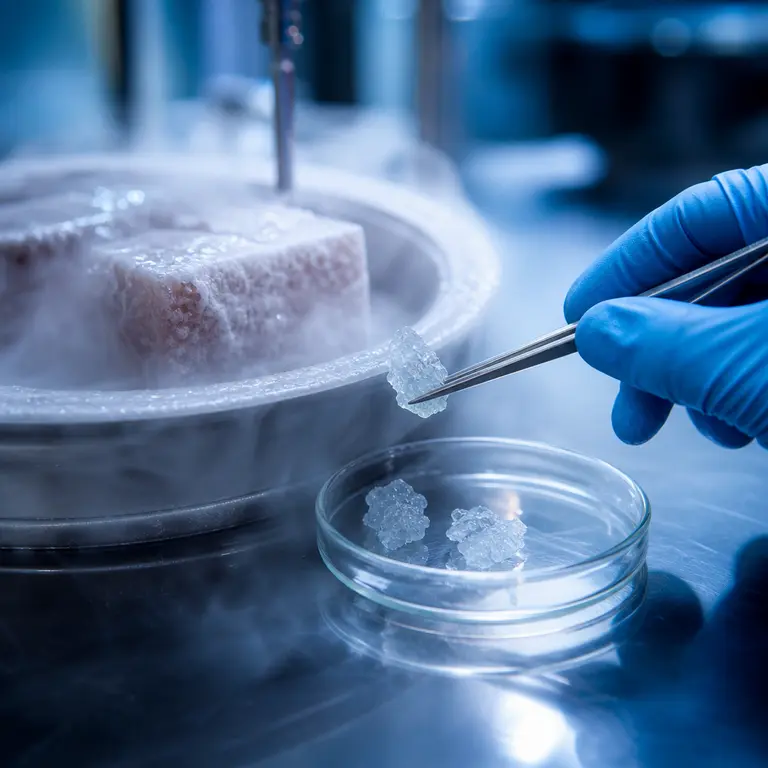
The Ice Problem That Biology Solved First
For decades, the central obstacle in cryobiology — the science of preserving living tissue at extremely low temperatures — has been ice itself. When water freezes inside a cell, it forms sharp crystalline structures that puncture membranes and destroy the molecular machinery of life. Engineers and physicians have spent enormous resources developing chemical antifreeze agents to slow or prevent this process, with limited success. The damage done by ice is not merely mechanical. The osmotic imbalances created as water is pulled into growing crystals, the dehydration of cytoplasm, and the physical shearing of protein complexes all compound into a cascade of failures that no simple chemical additive has reliably prevented. What researchers eventually discovered was that biology had already solved the problem quietly over hundreds of millions of years of evolution.
Antifreeze proteins, or AFPs, are a class of biomolecules produced by certain fish, insects, plants, bacteria, and even some fungi. They do not lower the freezing point of water in the conventional sense that dissolved salts or alcohols do. Instead, they bind directly to the surfaces of forming ice crystals and physically block their growth, a mechanism called adsorption inhibition. The result is a strange thermodynamic gap between the temperature at which ice begins to form and the temperature at which it actually grows — a phenomenon known as thermal hysteresis. In some Antarctic fish species, this gap is large enough to keep blood liquid at temperatures that would freeze ordinary seawater solid. The existence of such proteins challenges the intuition that freezing is a simple physical inevitability and instead suggests that the boundary between liquid and solid water is something biology has learned to negotiate on its own terms.
Where These Proteins Are Found
The first antifreeze proteins were identified in the 1960s by Arthur DeVries, a biologist studying the blood of Antarctic notothenioid fish. These fish survive in waters that hover around minus 1.9 degrees Celsius, slightly below the freezing point of their own blood under normal conditions. DeVries found glycoproteins in their serum that prevented ice from spreading through their circulatory systems. The discovery was initially treated as a curiosity, a biological footnote from an extreme environment that seemed too specialized to have broader relevance. That assessment proved to be spectacularly wrong.
Subsequent research revealed that AFPs had evolved independently at least five separate times across the tree of life, a striking example of convergent evolution. Winter flounder produce one structural type. Beetles and other insects produce a completely different class with far greater potency — some insect AFPs demonstrate thermal hysteresis values of 5 to 6 degrees Celsius, compared to less than 1 degree in most fish proteins. The spruce budworm moth produces an AFP that is among the most active biological antifreezes ever measured. Certain Antarctic bacteria secrete AFPs into their immediate environment, apparently to protect themselves from ice forming in the surrounding medium rather than inside their cells, an outside-in strategy that has no direct parallel in animal biology.
Perhaps most surprisingly, rye grass and carrot plants produce antifreeze proteins in their cell walls during winter months. These plant AFPs appear to work differently from their animal counterparts — rather than stopping ice growth entirely, they reshape ice crystals into forms less likely to damage surrounding tissue, a subtler and arguably more elegant strategy. The fact that such radically different organisms arrived at overlapping solutions to the same physical problem, using entirely different protein architectures, speaks to the severity of the selective pressure that ice imposes on living systems. Cold is not merely an inconvenience for biology. It is one of the oldest and most persistent threats life has faced, and the diversity of responses it has provoked reflects just how seriously evolution has taken the challenge.
The Cryopreservation Revolution in Medicine
The medical implications of these proteins are substantial and increasingly urgent. Currently, donated human hearts can survive outside the body for only four to six hours before becoming unusable for transplant. Livers last somewhat longer, but the window remains brutally narrow. Kidneys, the most commonly transplanted organ, tolerate cold ischemia for up to 36 hours under ideal conditions, but quality degrades significantly over time. These constraints mean that organs are frequently discarded, and patients die waiting for matches that cannot be reached in time. The logistics of transplant medicine are, in a very real sense, governed by the physics of ice formation in biological tissue.
Researchers at the University of Warwick and elsewhere have demonstrated that incorporating antifreeze proteins into preservation solutions can extend the viability of stored tissue by reducing ice-induced damage during cooling and rewarming. A 2017 study published in Nature Communications by Matthew Gibson’s group showed that synthetic polymers that mimic AFP behavior could dramatically improve the survival of red blood cells after freeze-thaw cycles, without the toxicity associated with conventional cryoprotectants such as dimethyl sulfoxide. That toxicity problem has been a persistent obstacle. Many of the chemical agents capable of suppressing ice formation are themselves damaging to cells at the concentrations required, creating a trade-off that has frustrated clinical progress for decades.
The challenge with natural AFPs is that they are difficult to produce in sufficient quantities and can trigger immune responses if introduced into human tissue. The field has therefore pivoted toward biomimetic chemistry — designing synthetic molecules that replicate the ice-binding behavior of AFPs without their biological complexity. Polyvinyl alcohol, a cheap and widely available polymer, has shown unexpected AFP-like properties and is now being explored as a cryoprotective additive in clinical organ storage protocols. The convergence of polymer chemistry and evolutionary biology in this space is one of the more unusual examples of cross-disciplinary problem-solving in modern medicine, and it is producing results that neither field could have reached independently.
There is also a longer-term ambition within the cryobiology community that antifreeze research has quietly revived: the prospect of vitrification, or converting biological tissue into a glass-like state rather than a crystalline one, as a route to indefinite preservation. Some researchers believe that sufficiently potent AFP analogs, combined with other cryoprotective strategies, could one day allow whole organs to be stored for weeks or months rather than hours. That goal remains distant, but it is no longer regarded as impossible.
Food Science, Frozen Cells, and the Texture Problem
The food industry has long grappled with a problem structurally identical to the one facing transplant medicine: ice recrystallization. When frozen food is stored and then partially thaws and refreezes during transport or in a consumer’s freezer, ice crystals grow larger over time through a process called Ostwald ripening, in which smaller crystals dissolve, and their water molecules migrate to larger ones. This degrades texture, releasing moisture and turning vegetables mushy and ice cream grainy. Antifreeze proteins prevent this recrystallization by capping the surface of existing crystals and preventing them from merging or growing, effectively locking the microstructure of the frozen product in place.
Unilever and other food manufacturers have explored AFP incorporation into commercial ice cream formulations. Transgenic plants engineered to express fish AFPs have been developed in laboratory settings, though regulatory and public acceptance barriers have considerably slowed commercial adoption. More recently, companies have turned to microbial fermentation, using yeast or bacteria engineered to produce food-grade AFPs at scale. The Canadian biotech firm A/F Protein Inc. developed AFP-enriched products in the early 2000s. While widespread commercial release has been gradual, the scientific groundwork is firmly established, and the economic incentive is substantial, given the global scale of the frozen food market.
A particularly intriguing application involves preserving meat texture during freezing. Research published in the journal Cryobiology has shown that treating meat with AFP solutions before freezing reduces drip loss — the liquid expelled when frozen meat thaws — by a measurable margin, preserving both nutritional content and consumer appeal. The same principle applies to seafood, where freeze-thaw damage is a major source of quality degradation between catch and consumption. In this context, the proteins are not used to keep anything alive, but simply to maintain the structural integrity of already-dead tissue, demonstrating that the utility of AFP biology extends well beyond the preservation of living cells.
The Deeper Question: What Ice Binding Reveals About Life
Beyond their practical applications, antifreeze proteins have forced biologists and physicists alike to reconsider some fundamental assumptions about how proteins interact with water and ice. The mechanism by which an AFP binds to a specific crystal face of ice — and only that face — while leaving liquid water unaffected is not yet fully understood at the atomic level. The proteins appear to match the spacing of oxygen atoms on the ice surface with their own hydrophobic residues, effectively locking onto the crystal lattice through a combination of van der Waals forces and the entropic cost of disrupting ordered water layers. The precision involved is extraordinary, and the fact that it arose through natural selection rather than deliberate design continues to humble researchers working to replicate it synthetically.
Ice has multiple crystal structures, and different AFP types preferentially bind to different crystal planes, suggesting that the evolutionary pressures shaping these proteins were exquisitely specific to the ice environments each organism faced. The winter flounder lives in conditions quite different from those faced by the spruce budworm or the Antarctic bacterium, and the geometry of the ice each encounters differs accordingly. Studying these binding geometries has opened new windows into the physics of water at interfaces, with implications for materials science, atmospheric chemistry, and the study of ice nucleation in clouds. Understanding how proteins prevent ice growth may, somewhat counterintuitively, help scientists understand how ice forms in the first place.
There is also a speculative yet serious line of research exploring whether AFP-like molecules might exist on icy moons such as Europa or Enceladus, where liquid water is thought to persist beneath their frozen surfaces. If life has arisen in such environments, managing the ice-water boundary would be among its most fundamental challenges — and Earth biology suggests that proteins capable of doing so are not only possible but evolutionarily inevitable given sufficient time and selective pressure. The fact that antifreeze proteins evolved at least five times independently on this planet implies that they are not a rare accident but a predictable response to a universal physical problem. That pattern of inevitability is precisely what makes them interesting to astrobiologists scanning the outer solar system for signs of life.
What began as a footnote about Antarctic fish blood has expanded into one of the more quietly consequential stories in modern biology. The ice problem that stumped engineers and physicians for generations turned out to have been solved already, in multiple ways, by organisms that had no choice but to find an answer or perish. The lesson is one that applied science keeps relearning: when a problem is old enough and hard enough, evolution has usually gotten there first.
Sources & Further Reading
- DeVries, Arthur L. Biological Antifreeze Agents in Coldwater Fishes. Comparative Biochemistry and Physiology, 1971.
- Gibson, Matthew I. et al. Antifreeze Protein Mimetic Metallohelices with Potent Cryoprotectant Activity. Nature Communications, 2017. https://www.nature.com/articles/ncomms14079
- Davies, Peter L. Ice-Binding Proteins: A Remarkable Diversity of Structures for Stopping and Starting Ice Growth. Trends in Biochemical Sciences, 2014.
- Brierley, Andrew S. and Thomas, David N. Ecology of Southern Ocean Pack Ice. Advances in Marine Biology, 2002.