
Shaping the Future: The Rise of Shape Memory Polymers
Shape memory polymers are materials that can be deformed, frozen in a temporary shape, and then return to their original form on command — a property now driving breakthroughs in medicine, aerospace, and soft robotics.
 Watch on YouTube
 Watch on Rumble
A Material That Obeys Instructions Written Into Its Structure
In 1941, American chemist Vernon Knight at the General Electric Company filed one of the earliest patents describing a thermoplastic material capable of recovering a previously held shape after deliberate deformation. At the time, the phenomenon attracted modest industrial curiosity. A material that could be bent out of shape and then return to its original form on command seemed like a laboratory novelty rather than the seed of a transformative technology. Decades later, that same principle — encoded memory in a polymer’s molecular architecture — would become the foundation for one of materials science’s most consequential and least publicly understood fields.
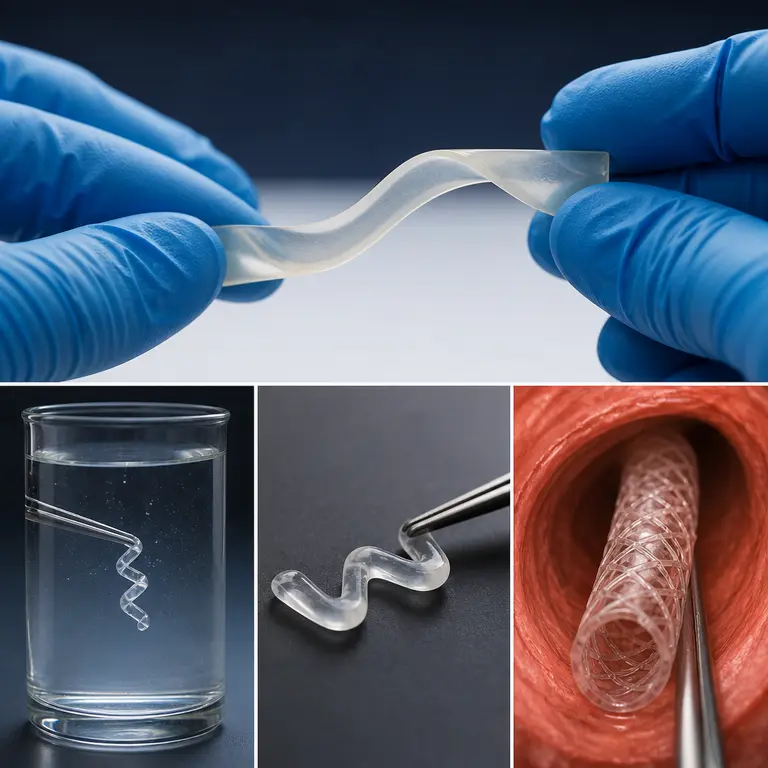
Shape memory polymers, or SMPs, are a class of smart materials that can be programmed into a temporary shape and then triggered to snap back to a permanent, pre-set configuration. The trigger can be heat, light, moisture, magnetic fields, or even specific chemical environments. Unlike shape memory alloys such as Nitinol, which rely on crystalline phase transitions in metals, SMPs achieve their behavior through the interplay of two distinct polymer networks: a fixed network that stores the permanent shape and a reversible switching network that can be locked and unlocked in response to external conditions. The result is a material that carries instructions inside its own molecular structure, waiting for the right signal to act. What makes this more than a scientific curiosity is the extraordinary range of environments and applications in which those instructions can be written, stored, and executed.
The Mechanics of Molecular Memory
To understand why an SMP returns to its original form, it helps to think of the polymer as a tangled web of long molecular chains held together at certain points by permanent chemical crosslinks. When heated above a critical transition temperature — often called the glass transition temperature or the melting point of a soft segment — the chains become mobile, and the material can be stretched, compressed, or twisted into a new shape. Cooling the material while it remains deformed locks the new configuration in place, because the chains lose mobility and become rigid. The permanent crosslinks, however, still remember the original geometry. When heat is reapplied, the chains regain mobility, and the stored elastic energy pulls the structure back toward its programmed form with measurable force.
The precision of this recovery is striking. Under laboratory conditions, some SMPs exhibit shape recovery ratios exceeding 99 percent over dozens of cycles. Researchers at MIT’s Institute for Soldier Nanotechnologies, working in the early 2000s, demonstrated that recovery speed and force could be tuned by adjusting the density of crosslinks and the chemistry of the switching segments — effectively writing different behavioral scripts into different regions of the same material. This tunability is one of the central advantages SMPs hold over their metallic counterparts. A shape memory alloy is constrained by its elemental composition and crystalline structure, but a polymer chemist can modify an SMP’s behavior by changing molecular weight, crosslink density, or the identity of the switching segment, producing a wide spectrum of transition temperatures, recovery forces, and response times from a single class of material.
Light-activated SMPs represent a newer and particularly elegant frontier. By incorporating photosensitive molecular switches, such as azobenzene or cinnamic acid derivatives, into the polymer backbone, researchers at the University of Freiburg and later at Zhejiang University demonstrated materials that change shape under ultraviolet or visible light without contact or heating. Azobenzene molecules undergo a reversible geometric change when irradiated, shifting between linear and bent molecular configurations, and when these switches are embedded at sufficient density within a polymer network, their collective motion translates into macroscopic shape change in the bulk material. This opens possibilities for remote actuation in sealed environments where wires or heat sources are impractical, including inside living tissue, in vacuum chambers, or within microfluidic systems too small for conventional actuators.
Moisture-responsive and chemically triggered SMPs add further dimensions to this landscape. Certain polyurethane-based SMPs absorb water molecules that act as plasticizers, lowering the effective glass transition temperature and triggering shape recovery at room temperature simply through exposure to humidity. This behavior has been proposed for applications in environmental sensing and in medical implants that respond autonomously to the body’s own chemistry without any external signal.
From the Operating Room to Orbit
The medical applications of SMPs have moved from laboratory curiosity to clinical relevance with unusual speed, driven in large part by the development of biodegradable variants — materials that recover their shape and then dissolve harmlessly inside the body. Andreas Lendlein, a German polymer chemist who first worked at MIT and later at the Helmholtz-Zentrum Hereon in Germany, pioneered the development of biodegradable shape-memory sutures in the early 2000s. These sutures are implanted in a straight or loosely tied configuration, and then body heat causes them to tighten automatically to a precise, pre-programmed tension — eliminating the risk of a surgeon over- or under-tightening a stitch in a difficult-to-access surgical site. Lendlein’s 2002 paper in Science describing this concept has since been cited in hundreds of subsequent studies, and it reframed the conversation around smart materials in medicine by demonstrating that a polymer could perform a clinical task autonomously after implantation.
Beyond sutures, SMP stents are under development that can be delivered in a compact, collapsed form through a catheter and then self-expand to their functional diameter once inside a blood vessel, triggered by body temperature. Unlike metal stents, biodegradable SMP stents would dissolve after the vessel has healed, eliminating the long-term complications associated with permanent implants, including chronic inflammation, restenosis, and the interference with subsequent imaging or surgical procedures that metal devices can cause. Clinical trials for some of these devices are ongoing as of 2024, and several research groups are simultaneously investigating SMP-based scaffolds for bone repair, in which a porous polymer structure can be compressed for minimally invasive delivery and then expanded to fill an irregular defect once in place.
In aerospace, NASA and the European Space Agency have both investigated SMPs for deployable structures. Antennas, solar panels, and structural booms that can be compacted for launch and then deployed in orbit using the temperature differential of space represent a compelling engineering application. The advantage over mechanical deployment systems is the elimination of hinges, motors, and actuators — components that can fail. A 2018 NASA Technical Report detailed prototype SMP composite panels that deployed reliably after simulated launch vibration and vacuum exposure, with no moving parts involved in the deployment sequence. The panels were fabricated from carbon-fiber-reinforced SMP laminates that could be folded flat for stowage and would unfurl predictably when exposed to the solar heating experienced in low Earth orbit. For small satellites, where mass and volume budgets are extremely constrained, eliminating mechanical deployment hardware represents a meaningful reduction in both cost and failure risk.
Soft Robotics and the Body That Moves Itself
Perhaps the most visually striking application of SMPs is in soft robotics, where researchers are building machines that move not through motors and gears but through the controlled deformation and recovery of smart materials. Conventional robotics relies on rigid components, precise tolerances, and complex control systems. Soft robotics proposes an alternative paradigm in which compliant, deformable structures interact with the world through shape change rather than rigid linkages, and SMPs are among the most promising material platforms for realizing that vision at small scales.
A 2019 study from Harvard’s Wyss Institute demonstrated a soft robotic gripper fabricated from SMP composites that could grasp an object, be cooled to lock its grip, and then release the object on command when reheated — all without any mechanical actuation system. The gripper weighed less than two grams, and because it contained no motors or gears, it was inherently robust against the kinds of mechanical failure that limit conventional robotic end-effectors in delicate or confined environments. Researchers noted that the gripping force could be tuned by adjusting the SMP composite's recovery stress, allowing the same basic design to be adapted to handle objects ranging from fragile biological tissue to small industrial components.
Researchers at the Southern University of Science and Technology in Shenzhen have taken this further by creating SMP structures capable of sequential, multi-step shape changes — folding through a programmed series of intermediate shapes before reaching a final configuration, mimicking the way proteins fold in biology. This programmable folding behavior, described in a 2022 paper in Advanced Materials, draws explicit inspiration from origami and kirigami geometry and has been proposed as a platform for drug-delivery capsules that open in stages as they pass through different chemical environments in the digestive tract. The ability to encode a sequence of distinct mechanical events into a passive material, without any electronics or external control signals, represents a genuinely new approach to device design.
The convergence of SMPs with 4D printing — three-dimensional printing of objects that change shape over time — has accelerated since roughly 2013, when Skylar Tibbits at MIT’s Self-Assembly Lab coined the term and demonstrated printed hydrogel structures that self-folded when placed in water. Since then, groups at multiple institutions have printed SMP composites with spatially varied properties, so that different regions of the same printed object respond to the same trigger at different rates or in different directions, producing complex, pre-choreographed motions from a single material system. The geometric design of these printed structures draws heavily on computational mechanics, with researchers using finite element simulations to predict how a flat printed sheet will curve, twist, or fold when activated, and then working backward to determine the spatial distribution of material properties required to produce that motion.
What Comes Next: Multiple Memories and Reversible Actuation
The next frontier in SMP research is the creation of materials capable of storing not one but multiple distinct shapes, retrievable in sequence or selectively on command. Most current SMPs are dual-shape systems: one permanent shape and one temporary shape. This binary architecture is sufficient for many applications, but it limits the complexity of behavior a single material can encode. Triple- and quadruple-shape SMPs have been demonstrated in research settings by using polymers with two distinct thermal transition temperatures, each associated with a different temporary shape. Switching the material through a programmed temperature sequence retrieves each shape in turn, effectively giving the material a short-term memory of several distinct configurations rather than just one.
Fully reversible SMPs — materials that cycle back and forth between two shapes repeatedly without any reprogramming step — represent a more fundamental challenge, because the thermodynamic asymmetry of current systems means that recovery requires an external energy input each time. A conventional SMP must be deformed into its temporary shape manually before each recovery cycle, which limits its usefulness as a true actuator in applications requiring continuous, repeated motion. Several research groups, including one led by Yiqi Yang at the University of Nebraska-Lincoln, have reported progress in reversible actuation using liquid crystal elastomers and semi-crystalline polymer architectures, though fully reversible, high-force SMP actuators remain an open engineering problem as of 2025. Liquid crystal elastomers are particularly promising in this regard, as the orientational ordering of their mesogenic units can be coupled to macroscopic shape change in a thermodynamically reversible way, but achieving the combination of large stroke, high force, and long cycle life in a single material system has proven elusive.
Researchers are also exploring the integration of SMPs with sensing and computation, creating composite systems in which the material not only responds to environmental stimuli but also modulates its own response based on embedded logic. Early demonstrations have combined SMP actuators with printed electronic circuits that monitor temperature and selectively heat different regions of the polymer, enabling more sophisticated and programmable motion sequences than passive triggering alone can provide.
The field that began with a modest 1941 patent has grown into a discipline spanning polymer chemistry, mechanical engineering, surgical medicine, and space technology. Its central insight — that a material’s future behavior can be encoded into its present structure — remains as conceptually striking today as it was when the first shape-recovering thermoplastics puzzled their inventors on a laboratory bench in upstate New York. As the tools for designing and printing complex polymer architectures continue to improve, and as the range of available triggers expands from heat and light to chemistry, magnetism, and electrical fields, the boundary between a material and a machine will continue to blur in ways that even the most optimistic researchers of the mid-twentieth century could not have anticipated.
Sources & Further Reading
- Lendlein, A., and Langer, R. Biodegradable, Elastic Shape-Memory Polymers for Potential Biomedical Applications. Science, 2002. https://doi.org/10.1126/science.1066102
- Tibbits, S. 4D Printing: Multi-Material Shape Change. Architectural Design, 2014. https://doi.org/10.1002/ad.1710
- Liu, C., Qin, H., and Mather, P.T. Review of Progress in Shape-Memory Polymers. Journal of Materials Chemistry, 2007. https://doi.org/10.1039/B615954K
- NASA Technical Reports Server. Shape Memory Polymer Composites for Deployable Space Structures. NASA, 2018. https://ntrs.nasa.gov