
The Bones That Glow: Fluorescent Scorpions Decoded
Scorpions have glowed under ultraviolet light for millions of years, but scientists are only now uncovering why — and what it might mean for neuroscience, materials science, and the detection of life beyond Earth.
 Watch on YouTube
 Watch on Rumble
Introduction
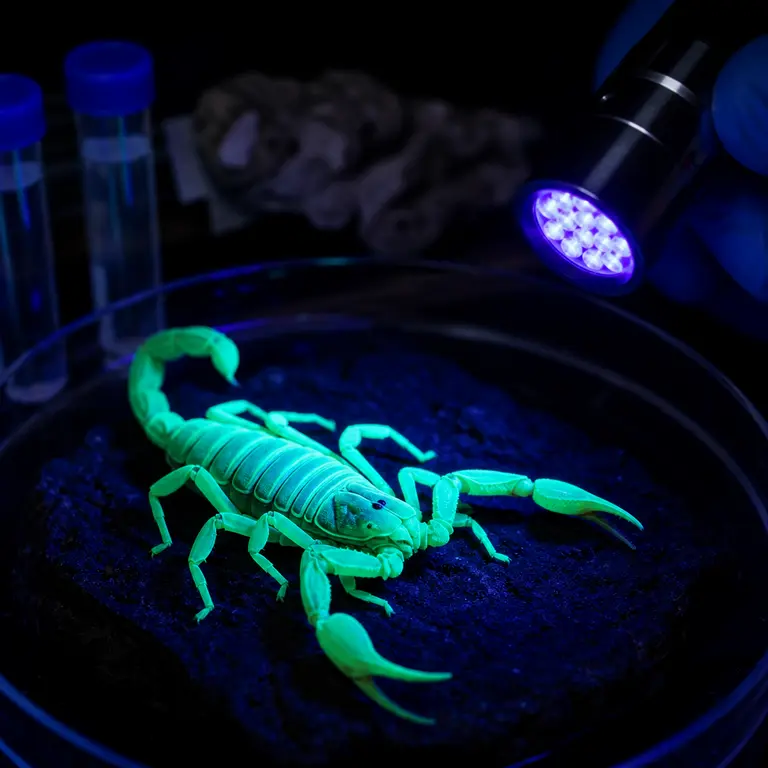
Stand in a desert at night with an ultraviolet flashlight, and the ground may suddenly seem alive with pale blue-green fire. Scorpions, nearly invisible in ordinary darkness, become luminous phantoms under UV light. This phenomenon has been documented since at least the 1950s, when entomologists first noticed it under laboratory blacklights. What took considerably longer to understand was why it happens at all — and whether it serves any biological function whatsoever.
The fluorescence is produced by compounds embedded in the scorpion’s cuticle, the tough outer exoskeleton. Two molecules in particular, beta-carboline and 4-methylcoumarin, absorb ultraviolet wavelengths between 320 and 400 nanometers and re-emit them as visible blue-green light. These compounds are not present in newly molted scorpions, whose soft, pale cuticles do not glow. The fluorescence develops gradually as the exoskeleton hardens through a process called sclerotization, suggesting the glowing compounds are byproducts of cuticle chemistry rather than deliberately synthesized pigments.
This developmental detail is important because it shifts the question's initial framing. If the compounds were deliberately produced for signaling or defense, one might expect them to appear earlier or at higher concentrations in younger, more vulnerable animals. Instead, the glow intensifies only as the cuticle matures, which is more consistent with a chemical consequence of structural hardening than with a trait under direct selective pressure. And yet, as decades of subsequent research have demonstrated, the story is far more complicated than a simple biochemical accident.
The Fossil Record of Glowing Exoskeletons
Scorpions are among the oldest terrestrial animals on Earth, with a fossil record extending back roughly 430 million years to the Silurian period. Some of those ancient marine ancestors, which preceded the colonization of land, possessed cuticle chemistry similar to that of modern scorpions, prompting researchers to examine fossilized specimens under UV illumination. In 2022, a team from the University of Kansas reported that several Carboniferous-era scorpion fossils — approximately 300 million years old — retained fluorescent compounds detectable under UV light, making them among the oldest fluorescent biological structures ever documented.
This discovery has significant implications. It suggests the chemical pathway producing fluorescence is extraordinarily conserved across deep evolutionary time, which typically indicates either strong selective pressure to maintain the trait or that the compounds are simply unavoidable byproducts of cuticle construction that natural selection has never found costly enough to eliminate. Neither explanation fully satisfies researchers because the sheer persistence of the trait over hundreds of millions of years and across more than 2,500 living scorpion species demands a better account.
The persistence of these fluorescent compounds in fossil material also raises interesting questions about the chemistry of preservation itself. Most organic compounds degrade rapidly after an organism dies, particularly over geological timescales. The fact that beta-carboline derivatives survive in recognizable form across 300 million years points to unusual molecular stability, likely a consequence of the same structural integration that makes them so difficult to replicate artificially in laboratory settings. This stability is not merely an academic footnote. It has direct consequences for how scientists interpret the trait's evolutionary history and how they might search for analogous biosignatures elsewhere in the solar system.
What the fossil record cannot yet tell us is whether those ancient scorpions glowed in their living state in the same way their modern descendants do, or whether the fluorescent compounds have shifted in composition, intensity, or distribution over evolutionary time. Comparative studies using phylogenetic methods and spectroscopic analyses of multiple fossil specimens from different geological periods are ongoing and may eventually allow researchers to reconstruct a timeline of when and how the fluorescent chemistry first appeared, and whether it has changed meaningfully since.
Competing Hypotheses and a Possible Sensory Function
For decades, the dominant assumption was that scorpion fluorescence was biologically irrelevant — a chemical accident with no adaptive value. That view has shifted substantially since 2011, when biologists Carl Kloock and Douglas Gaffin proposed a provocative alternative: scorpions may use their own bodies as UV detectors.
The hypothesis rests on behavioral evidence. Scorpions are strongly photophobic, retreating from light sources with remarkable speed and consistency. Gaffin’s team at the University of Oklahoma demonstrated that scorpions could detect and respond to UV light even when their eyes were painted over, suggesting the cuticle itself may act as a distributed photosensory surface. The fluorescent compounds would function as a kind of whole-body light meter, converting UV radiation into visible wavelengths that could be detected by photoreceptors distributed across the cuticle or by the scorpion’s simple median eyes, which are sensitive to longer wavelengths.
If confirmed, this would represent a genuinely novel sensory mechanism — an animal using its own fluorescence not for signaling but for environmental sensing. A 2020 study published in the journal Scientific Reports added further weight to this idea by showing that scorpions under UV illumination modified their burrowing and foraging behavior in ways consistent with using fluorescence as a moonlight-intensity gauge, helping them assess predation risk before emerging from shelters.
The ecological logic behind this sensory function is worth examining closely. Scorpions are nocturnal predators that are themselves prey to a variety of owls, bats, and larger arthropods. Emerging from a burrow on a bright moonlit night carries substantial risk. A scorpion that could accurately assess ambient UV levels — which correlate with lunar phase and cloud cover — would have a meaningful survival advantage. The moonlight hypothesis, therefore, connects the fluorescence directly to one of the most fundamental behavioral decisions a nocturnal animal makes: when it is safe to come out. The fact that the cuticle already fluoresces as a byproduct of sclerotization means that natural selection would not need to build a new system from scratch. It would only need to wire existing photoreceptors to respond to the light the animal was already producing.
Critics of the sensory hypothesis point out that the experimental conditions used to demonstrate cuticle-based photoreception have not always been cleanly replicated across species and laboratories. The painted-eye experiments, while suggestive, leave open the possibility that UV light is being detected through other sensory pathways not yet identified. The field awaits a more controlled experimental framework before the hypothesis can be considered confirmed rather than merely compelling.
Materials Science and Astrobiology Applications
The chemical compounds responsible for scorpion fluorescence have attracted serious attention from materials scientists. Beta-carbolines are a class of naturally occurring alkaloids with remarkable optical properties, including high quantum yield — meaning they convert absorbed light into emitted light with unusual efficiency. Synthetic analogs are already used in organic light-emitting diodes and fluorescent sensors, and the scorpion compounds represent a naturally optimized version of this chemistry, refined over geological timescales.
Researchers at the University of California, Riverside, have been studying the structural arrangement of fluorescent molecules within scorpion cuticle as a model for designing flexible, self-assembling photonic materials. Unlike rigid laboratory-synthesized structures, the cuticle integrates fluorescent compounds into a mechanically robust, self-repairing matrix — a combination that remains difficult to replicate artificially. The cuticle achieves something that materials engineers have long pursued: a photonic structure that is simultaneously tough, flexible, and capable of self-repair without losing its optical properties. Understanding how scorpions accomplish this at the molecular level could inform the design of next-generation wearable sensors, flexible display technologies, and structural materials that double as light-responsive surfaces.
The astrobiology angle is perhaps the most speculative, but not without foundation. NASA’s Jet Propulsion Laboratory has explored UV fluorescence as a biosignature detection method for planetary exploration. The logic is straightforward: if biological organisms on Earth routinely produce compounds that fluoresce under UV illumination, then UV-scanning instruments aboard rovers or landers on Mars or Europa might detect similar signatures in ancient organic deposits. The scorpion cuticle, specifically because its fluorescent compounds survive for 300 million years in fossil form, provides proof of concept that such biosignatures can persist long after the organisms themselves are gone.
This line of reasoning has influenced discussions on instrument design for future planetary missions. If a rover equipped with a UV light source and a spectral imaging system were to scan a rocky outcrop on Mars, it might detect fluorescent emission from ancient organic compounds even if those compounds had been chemically transformed over billions of years. The scorpion fossil data establishes a lower bound for how long such signatures can survive under terrestrial conditions, though Martian conditions — lower radiation exposure in subsurface environments, extreme cold, and the absence of liquid water — might actually be more preserving in some respects.
What the Glow Still Does Not Explain
Despite two decades of renewed investigation, fundamental questions remain unanswered. No study has conclusively demonstrated a fitness advantage to fluorescence in wild scorpion populations. The sensory hypothesis is compelling but not yet experimentally watertight. Some researchers continue to argue that the glow is a metabolic artifact — a consequence of cuticle chemistry that is detectable but does not benefit the animal in any measurable way.
There is also the question of sexual selection. A small number of studies have examined whether fluorescence intensity varies between males and females, or whether it correlates with age, health, or reproductive status in ways that might make it a signal to conspecifics. Results have been inconclusive. Scorpions do possess UV-sensitive photoreceptors, so the visual information is theoretically accessible to them, but behavioral evidence of mate assessment based on fluorescence remains anecdotal.
It is also worth noting that scorpion fluorescence varies across species. Some species glow more intensely than others, and the spectral profile of the emitted light varies in ways that do not obviously correlate with habitat, behavior, or phylogenetic position. If fluorescence were a neutral byproduct, one might expect it to drift more randomly across the scorpion family tree. The fact that it is present in essentially all species, but varies in intensity and spectral character, suggests a more nuanced evolutionary history than either pure neutrality or strong directional selection can fully account for.
Conclusion
What is certain is that the scorpion’s glow, once dismissed as a curiosity of the blacklight era, has become a legitimate research frontier sitting at the intersection of evolutionary biology, sensory neuroscience, materials engineering, and the search for life beyond Earth. The animal that lights up the desert floor may be carrying, quite literally in its skin, answers to questions that range from how life senses its environment to how we might recognize it on another world.
The scorpion’s fluorescence is a reminder that biology is under no obligation to be tidy. A trait can be ancient, universal, chemically stable, and behaviorally significant while still resisting a clean explanatory narrative. Science tends to reward patience in these cases. The compounds that make a scorpion glow have been waiting in the dark for 300 million years. They are unlikely to give up their secrets quickly — but the questions they raise are worth every year of the search.
Sources & Further Reading
- Gaffin, D.D., et al. Scorpion fluorescence and reaction to light. Animal Behaviour, 2012. https://doi.org/10.1016/j.anbehav.2011.12.018
- Shankar, A., et al. Scorpion fluorescence under UV light: behavioral and ecological implications. Scientific Reports, 2020. https://doi.org/10.1038/s41598-020-69833-8
- Kloock, C.T. Aerial insects avoid fluorescing scorpions. Functional Ecology, 2005.
- University of Kansas Biodiversity Institute. Fluorescence in Carboniferous scorpion fossils. KU ScholarWorks, 2022. https://kuscholarworks.ku.edu