The Unsung Role of Geckos in Artificial Adhesive Technology
Inspired by geckos, new adhesives mimic their foot microstructures, offering strong, versatile adhesion for medical, robotic, and space applications.

Discover strange, surprising, and little-known facts from science, history, nature, and beyond.

How a century-old industrial incendiary reaction is now being repurposed to date ancient iron artifacts and rewrite the timeline of early metallurgy.
Read Article → Technology
Inspired by geckos, new adhesives mimic their foot microstructures, offering strong, versatile adhesion for medical, robotic, and space applications.
 Science
The durability of ancient Roman concrete has puzzled scientists for centuries, leading to a recent unexpected discovery related to its longevity.
 Animals
The dark blue-black coloration of a giraffe's tongue acts as a natural sunscreen to prevent sunburn.
 Science
Cosmic rays, high-energy particles from space, induce DNA mutations, significantly influencing evolution and biodiversity through increased mutation rates and adaptation.
 Technology
The Super Soaker, a popular water gun, was accidentally invented by a NASA engineer while working on heat pumps.
 Mysteries
An ancient Greek device known as the Antikythera Mechanism has been dubbed the world's first analog computer. Discovered in a shipwreck off the coast of Greece, it dates back to around 100 BCE and features intricate gears and dials that could predict astronomical positions and eclipses with remarkable precision.
 Mysteries
A lake in Cameroon, Lake Monoun, exploded in 1984, causing the death of 37 people. The cause was discovered to be a sudden release of CO2 from its depths.
 Nature
Plants communicate with each other using an underground network of fungi, often referred to as the 'Wood Wide Web'.
 Animals
Some species of bees, known as sweat bees, surprisingly prefer human tears over nectar due to their sodium content.
 Food
FoodA berry that changes your taste perception, making sour foods taste sweet.
 Mysteries
A low-frequency sound has been heard by locals and visitors alike in Taos, New Mexico, but it is still untraceable.
 Space
SpaceIn a remarkable endeavor to communicate with potential extraterrestrial life, NASA sent two phonograph records into space in 1977 containing sounds and images epitomizing the diversity of life on Earth.
 Mysteries
Traffic jams can occur without any apparent cause.
 Animals
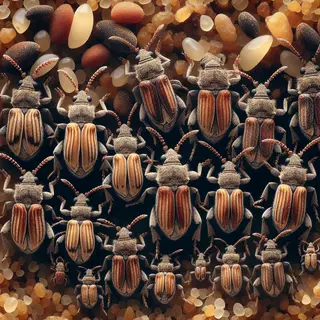
A group of insects called Ptiliidae, commonly known as feathering beetles, are minute in size, some even smaller than a single grain of sand. Despite their size, they have the full complement of body parts that more giant insects have.
 Health
It is possible to catch a disease or get sick from an old book due to the microbes and bacteria that can survive within its pages.
 Science
Teflon, a material commonly known for its non-stick properties in cookware, was accidentally discovered by a chemist named Roy Plunkett.
 Nature
Clathrus archeri, also known as Devil’s Fingers or Octopus Stinkhorn, is a unique species of fungus that resembles an octopus.
 Language
Learn a language by reading children's books in that language.
 Animals
Hummingbirds hold the record for the fastest wing beat speed among birds, with a staggering average of 50-80 beats per second.
 Technology
Bluetooth was named after a 10th-century Scandinavian king, and the symbol of his initials is in ancient runes.
 Science
A type of fungi discovered in Chernobyl that converts radiation into energy for growth.
 Nature
Noctiluca scintillans, commonly known as 'sea sparkle', is a type of phytoplankton that glows in the dark.
 Culture
In Japan, asking for one's blood type, or Ketsueki-gata is as common as asking for an astrological sign in Western countries. This is based on the belief that someone's blood type affects their personality.
 Animals
Glass frogs are unique creatures with transparent abdominal skin that allows viewing their internal organs.
Many of our articles come with a video companion. Sit back and explore.



No spam. Just strange, useful, and fascinating knowledge.
We only use your email for site updates.