
Coleridge's Albatross and the Real Bird Behind the Myth
The wandering albatross inspired one of English literature's most enduring symbols, but the biology, navigation, and conservation crisis of the real bird are stranger and more urgent than the poem suggests.
 Watch on YouTube
 Watch on Rumble
Introduction
Samuel Taylor Coleridge published The Rime of the Ancient Mariner in 1798 as part of the Lyrical Ballads collection, co-authored with William Wordsworth. The poem introduced the albatross to mass literary consciousness as an omen, a burden, and a symbol of moral consequence. For more than two centuries, the phrase “albatross around one’s neck” has described any persistent, self-inflicted misfortune, embedded so deeply in the English language that most speakers deploy it without a second thought about the animal it references. Yet the actual bird that inspired the poem’s setting has a biology so extraordinary that the legend seems almost understated in comparison. Coleridge almost certainly drew on accounts from sailors and navigators, possibly including George Shelvocke’s 1726 voyage narrative, which described a black albatross shot by a crewman named Hatley during a storm near Cape Horn. Wordsworth later confirmed he had suggested the shooting incident to Coleridge. The poem, in other words, was built on a real maritime encounter with a real species, and that species is worth examining on its own terms, not merely as a vehicle for human guilt, but as one of the most physiologically and behaviorally sophisticated animals that has ever taken flight.
What makes the albatross particularly compelling as a subject is the gap between its cultural familiarity and its scientific obscurity. Millions of people recognize the symbolic weight of the bird without knowing anything about how it flies, how long it lives, how it chooses a mate, or how close several of its species are to permanent disappearance. That gap is not merely a curiosity. It has real consequences for conservation, public engagement, and the degree to which ordinary people feel any connection to the ecological crisis unfolding across the Southern Ocean. Closing that gap begins with understanding what the albatross actually is.
A Bird That Barely Flaps Its Wings
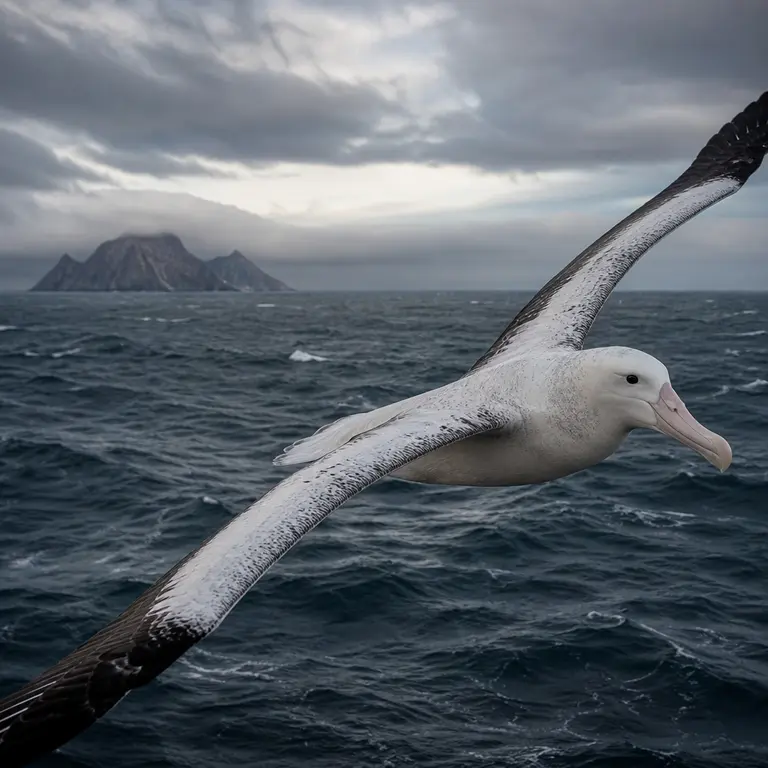
The wandering albatross, Diomedea exulans, holds the largest wingspan of any living bird, reaching up to 3.5 meters from tip to tip. But wingspan alone does not explain the animal’s most remarkable attribute. The bird can travel more than 75,000 kilometers in a single year, circumnavigating the Southern Ocean multiple times, while expending almost no muscular energy in flight. It achieves this through a technique called dynamic soaring, a precise exploitation of the wind gradient that exists just above ocean waves. By repeatedly climbing into faster upper winds and descending toward slower surface air, the albatross converts wind-speed differential into forward momentum with minimal wing-flapping. Researchers at the University of California, Davis, and the British Antarctic Survey have used GPS loggers and accelerometers attached to birds to confirm that albatrosses can sustain hours of flight without a single active wingbeat. The birds essentially extract kinetic energy from the atmosphere itself, functioning less like conventional fliers and more like living sailplanes tuned to exploit the specific aerodynamic conditions of open ocean environments.
The skeletal architecture supporting this feat is equally unusual. Albatrosses possess a tendon-locking mechanism in their shoulder joint that holds the wing extended without continuous muscular contraction. A small sheet of fibrous tissue clicks the wing into its open position, meaning the bird can glide with its wings fully spread at essentially zero metabolic cost. This adaptation allows albatrosses to sleep during flight by entering a state known as unihemispheric slow-wave sleep, in which one hemisphere rests while the other remains active, allowing the bird to continue navigating and soaring. The two hemispheres alternate, providing the bird with rest without requiring it to land. The birds may remain airborne for years after fledging, touching land only when they return to breed. For a young albatross, the first return to land after leaving the nest may come five or six years after departure, making the open ocean not merely a habitat but something closer to a permanent home.
The aerodynamic efficiency of dynamic soaring has attracted attention beyond ornithology. Engineers studying long-range unmanned aerial vehicles have looked closely at albatross flight mechanics as a potential model for aircraft that could patrol ocean areas without fuel by harvesting energy from wind gradients. The albatross solved this engineering problem approximately 30 million years ago, which gives some indication of how well-refined the solution is.
Monogamy, Longevity, and the Oldest Wild Bird on Record
Albatrosses are among the longest-lived wild birds on record. A Laysan albatross named Wisdom, banded at Midway Atoll National Wildlife Refuge in 1956 by biologist Chandler Robbins, was still alive and breeding as of 2024, making her at least 74 years old. She has raised an estimated 30 to 36 chicks over her lifetime and has outlived multiple banding researchers who originally documented her. Wisdom’s case is not merely sentimental. It has reshaped ornithological understanding of avian senescence. Most bird species show clear signs of reproductive decline in old age, but Wisdom continued to successfully fledge chicks well into her seventh decade, suggesting that some seabirds may experience negligible or significantly delayed senescence in ways that remain poorly understood by science. Researchers studying aging have taken an interest in albatrosses as a result, since understanding how a vertebrate animal can maintain reproductive function and physical health across seven or more decades may have implications for the broader biology of aging.
Albatross pair bonds are among the most stable in the animal kingdom. Pairs spend years performing elaborate synchronized courtship dances before committing to a partner, and once bonded, they typically remain together for life, which can mean several decades of shared breeding seasons. The choreography of these dances involves bill-clapping, sky-pointing, wing-spreading, and synchronized vocalizations, and it is learned and refined over years of practice with multiple potential partners before a final pairing is made. Young birds essentially rehearse courtship in adolescent social groups before they are reproductively mature, developing the specific movement sequences that will eventually attract a permanent mate. The process can take years, and birds that rush into pairing before their dance is sufficiently refined tend to have lower reproductive success.
Divorce, while rare, does occur and is more common following breeding failures, a pattern that mirrors findings in human pair-bond research in ways that are probably coincidental but nonetheless striking. When a pair fails to raise a chick, the probability of separation the following season increases, suggesting that reproductive outcomes influence pair stability in ways that go beyond simple fidelity. The parallels to human behavior are superficial but persistent enough that albatross pair dynamics have appeared in popular discussions of evolutionary psychology, usually with more enthusiasm than rigor.
The Longline Crisis and an Unexpected Conservation Alliance
The same Southern Ocean that albatrosses have mastered for millions of years has become a lethally dangerous environment due to industrial longlining, a fishing technique in which vessels deploy lines up to 130 kilometers long, each carrying thousands of baited hooks. Albatrosses dive for the bait as lines are set, become hooked, and drown before they can surface. Estimates from BirdLife International suggest that approximately 100,000 albatrosses are killed as bycatch each year across global fishing fleets. Of the 22 recognized albatross species, 15 are currently listed as threatened or endangered on the IUCN Red List, making albatrosses the most threatened family of seabirds in the world. The scale of the crisis is difficult to reconcile with the relative obscurity it occupies in public awareness, particularly given the bird's cultural prominence.
The response to this crisis produced an unexpected alliance among conservation groups, the fishing industry, and naval forces. The Agreement on the Conservation of Albatrosses and Petrels, known as ACAP, was signed in 2001 and entered into force in 2004. It coordinates mitigation measures across the Southern Ocean and beyond, bringing together governments, fisheries managers, and scientific bodies to share data and enforce best practices. One of the most effective interventions to emerge from this collaboration is the tori line, a brightly colored streamer towed from the stern of a fishing vessel during line-setting that deters birds from approaching the hooks. When properly deployed alongside night-setting and line-weighting techniques, tori lines can reduce albatross bycatch by more than 90 percent, according to studies published in the journal Biological Conservation. The technology is cheap and simple, costing roughly 200 US dollars per line, yet adoption remains inconsistent across fleets operating under different national jurisdictions and varying levels of enforcement capacity.
A separate and less expected conservation tool involves the French Navy. Since 2018, frigates operating in the Southern Ocean have been using albatrosses fitted with small data-logging tags to detect illegal fishing vessels. Albatrosses naturally range across vast ocean areas and are attracted to fishing activity, making them effective sentinels for human operations across otherwise unmonitored stretches of open water. When a tagged bird detects a radar signal consistent with a vessel that is not broadcasting an Automatic Identification System transponder signal, the discrepancy is relayed via satellite to authorities. The program, run by the French National Center for Scientific Research in collaboration with the French Southern and Antarctic Lands, demonstrated in a 2020 paper in the Proceedings of the National Academy of Sciences that roughly a third of fishing vessels detected by albatrosses in the Southern Ocean were not transmitting their location, a strong indicator of illegal, unreported, or unregulated fishing activity. The birds, in other words, have become instruments of maritime law enforcement, patrolling territories that no human vessel could monitor continuously.
What the Mariner’s Symbol Still Gets Wrong
Coleridge’s poem encodes a genuine ecological intuition that deserves credit. The mariner kills the albatross without reason, and the consequences are catastrophic and communal, spreading guilt and suffering beyond the individual who committed the act. Read as an environmental allegory, the poem anticipates modern conservation ethics by nearly two centuries, articulating something close to the idea that harm done to the natural world rebounds on those who cause it and on the communities that surround them. The poem has been interpreted as a proto-ecological text by several literary scholars, and the reading is not unreasonable. There is something in the mariner’s compulsive retelling of his crime that resembles the compulsion to confess to environmental damage that runs through contemporary climate discourse.
But the cultural weight of the symbol has also had an ironic effect. The albatross is so thoroughly associated with literary guilt and romantic doom that its actual biology remains largely invisible to the general public. Most people who use the phrase know nothing of dynamic soaring, tendon-locking wings, unihemispheric sleep, or the longline crisis that is quietly eliminating species that evolved over 30 million years of oceanic life. The symbol has become a substitute for the animal, which is a particular kind of cultural irony, given that the poem is ostensibly about the consequences of failing to see a living creature as something more than a symbol.
The oldest fossil albatrosses date to the Eocene epoch, roughly 30 to 34 million years ago, predating the formation of the Himalayas to their current height and the Antarctic ice sheet reaching its full extent. These birds survived geological epochs, continental rearrangements, and mass extinction events that eliminated far more prominent lineages. The current threat is not a geological catastrophe or a planetary transformation beyond human control. It is a set of industrial practices that could be substantially modified at relatively low cost using existing, proven technology. The albatross does not need the poem to be remarkable. It needs the fishing fleets to use a 200-dollar streamer, and it needs the public that recognizes its name to know enough about its life to care what happens to it.
Sources & Further Reading
- BirdLife International. State of the World's Birds: Taking the Pulse of the Planet. BirdLife International, 2022. https://www.birdlife.org/state-of-the-worlds-birds/
- Weimerskirch, H., et al. "Frigate birds track atmospheric conditions over months-long transoceanic flights." Science, 2016. https://www.science.org/doi/10.1126/science.aaf4374
- Tixier, P., et al. "Albatrosses as a monitoring tool for illegal fishing in the Southern Ocean." Proceedings of the National Academy of Sciences, 2020. https://www.pnas.org/doi/10.1073/pnas.1915499117
- Chandler Robbins, USGS Patuxent Wildlife Research Center. Wisdom banding records, 1956–ongoing. U.S. Fish and Wildlife Service. https://www.fws.gov/media/wisdom-albatross