
Exploring the Intriguing Spectacle of Singing Sand Dunes
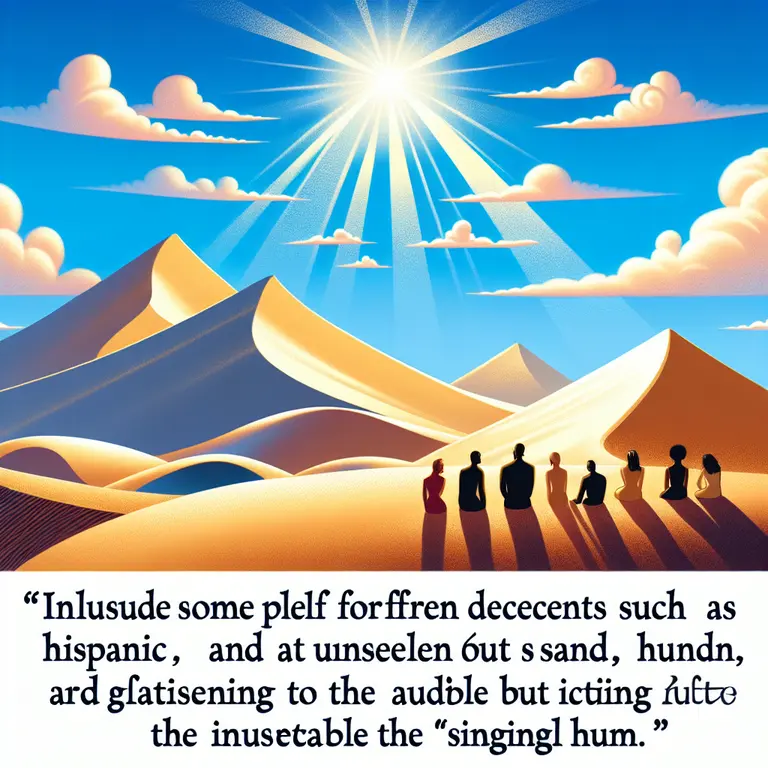
Certain sand dunes around the world are known to emit a musical hum, a phenomenon referred to as 'singing sand'.
 Watch on YouTube
 Watch on Rumble
The Mystery of Singing Sands: When Deserts Find Their Voice
Have you ever heard of a dune that sings? It may sound like a chapter from an epic mythical story or supernatural folklore, but the truth is scientifically fascinating. Certain dunes around the world exhibit this unlikely behavior, emitting noises akin to the low-frequency rumble of distant traffic or the steady drone of an airplane flying overhead. This natural mystery is more commonly known as “singing sands,” and it has engaged scientists, explorers, and curious minds across geographical and cultural boundaries for centuries. Far from being a rare curiosity confined to a single corner of the globe, singing sands are among the most intriguing acoustic phenomena the natural world has to offer.
A History Written in Sound
The earliest well-known documentation of singing sands in the Western world came from the Venetian explorer Marco Polo, who first recorded the phenomenon during his extensive travels through China in the late 13th century. He referred to it as “booming sands,” a name that captures the audible drama of the experience. Polo described the sounds as arising from the work of spirits and demons, a supernatural explanation that made perfect sense in the era's context. For a traveler crossing vast, alien deserts far from home, hearing an inexplicable roar rise from the ground beneath his feet must have been a deeply unsettling experience.
Polo was not alone in his wonder. Arab geographers writing as early as the 9th century noted peculiar sonic activity in certain desert regions, and accounts from travelers crossing the Gobi Desert frequently described mysterious musical emanations from the dunes. Indigenous communities living near singing dune fields in various parts of the world developed their own mythological frameworks to explain the sounds. Some cultures believed the dunes were inhabited by spirits or that the earth itself was communicating warnings to those who dared to cross it. Others incorporated the sounds into ceremonial life, treating the singing dunes as sacred places worthy of reverence.
It was not until the 19th and 20th centuries that scientists began approaching the phenomenon with systematic inquiry. Charles Darwin himself noted the existence of musical sands during his voyage on the HMS Beagle, observing a similar effect on a beach in Chile. His brief notation on the subject helped draw the attention of the broader scientific community to a phenomenon that had previously been dismissed as a traveler’s exaggeration or local superstition.
Where in the World Do Dunes Sing
Instances of singing sands have been recorded in dozens of locations across the globe, and each site carries its own acoustic personality. The Sahara Desert is home to some of the most dramatic examples, particularly in regions of Algeria, Morocco, and Egypt, where towering dune systems can produce sounds that carry for miles across the open landscape. The Kelso Dunes in the Mojave Desert and the Sand Mountain area in Nevada are among the most accessible singing dune sites in North America, while Death Valley National Park in California also hosts notable acoustic dune activity.
In Asia, the phenomenon is especially well documented. The Mingsha Shan dunes near Dunhuang in China have been described as singing for over a thousand years, and they remain a popular destination for travelers seeking to witness the phenomenon firsthand. The Gobi Desert contains multiple singing dune sites scattered across both China and Mongolia. The Arabian Peninsula, particularly in Oman and Saudi Arabia, also hosts impressive, booming dunes, as does the Namib Desert in southern Africa and parts of coastal Peru and Chile.
What is particularly striking is that not every desert produces singing sands, and not every dune within a singing desert will produce sound. The conditions required are specific and somewhat fragile, which is part of what makes the phenomenon so scientifically intriguing. Researchers have found that even modest changes in humidity or the introduction of foreign particles to the sand can silence a dune entirely, sometimes permanently.
The Acoustics of a Desert Symphony
The sounds produced by singing sands are remarkably varied and can be surprisingly loud. Measurements taken at active singing dune sites have recorded sound levels reaching up to 105 decibels, roughly equivalent to standing near a running chainsaw or attending a loud rock concert. The notes produced can sustain for several minutes at a time, creating an almost meditative drone that seems entirely out of place in the silence of a desert landscape.
The frequency of the sounds typically falls within a relatively narrow range, usually between 70 and 105 hertz, which places them in the low bass register of human hearing. This is part of what gives the experience its haunting, almost physical quality. Low-frequency sounds are felt as much as they are heard, creating a sensation of vibration in the chest and bones that reinforces the impression that the earth itself is speaking. Some observers have compared the sound to a pipe organ playing a single sustained note, while others describe it as resembling the hum of a distant aircraft engine that never quite arrives.
Interestingly, the sound is not random noise but often exhibits a distinct tonal quality, meaning it has a recognizable pitch. This tonal consistency is one of the features that most puzzles researchers, because it implies a degree of coordination among the sand grains that is difficult to explain through simple physical models. The fact that thousands or millions of individual grains can collectively produce a coherent musical note, rather than a chaotic hiss, points to a level of self-organization in the system that scientists are still working to fully understand.
The Science Behind the Song
What causes these strange acoustics? Researchers have identified several contributing factors, though a complete and universally accepted explanation remains elusive. One of the most important variables is grain geometry. Studies of sand samples collected from singing dunes across multiple continents have consistently found that the grains are rounder and more uniform in size than those in typical desert or beach sands. This homogeneity is not accidental. It results from long periods of wind-driven abrasion that gradually smooth and sort the grains over geological time. When these uniformly sized, rounded grains move against one another, they create a highly consistent pattern of friction and vibration, which in turn generates sound waves of a predictable frequency.
The scale of movement also plays a critical role. Singing events most commonly occur when large quantities of sand slide down the steep slip face of a dune, either triggered by wind, by a person walking across the surface, or by natural avalanching. The sheer volume of grains moving in concert amplifies the vibrations produced by individual grain contacts into a sound powerful enough to be heard from a considerable distance. Some researchers have proposed that the dune's dry outer layer acts as a resonating surface, functioning somewhat like a drum's skin and helping project the sound outward.
Moisture is one of the phenomenon’s greatest enemies. Even a small increase in the humidity of the sand can dampen the vibrations between grains sufficiently to silence the dune. This is why singing sands are almost exclusively found in extremely arid environments, and why the same dune that roars on a dry afternoon may fall silent after a rare desert rain. The relationship between moisture and sound production has led some scientists to investigate whether singing sands could serve as a natural indicator of desert aridity over time, though this line of research remains in its early stages.
Conclusion
These naturally musical landscapes stand as outstanding examples of how even the simplest materials, individual grains of sand, can organize themselves into something that transcends mere geology and enters the realm of sensory wonder. Singing sands present a rare and delightful intersection of physics, acoustics, geography, and human curiosity, drawing together disciplines that rarely find common ground. They remind us that the natural world still holds phenomena that resist easy explanation, and that the deserts of the earth, often perceived as empty and lifeless, can produce some of the most unexpected and affecting experiences for the human senses. For scientists, they represent an ongoing puzzle worth pursuing. For everyone else, they offer something perhaps even more valuable: the humbling reminder that the ground beneath our feet is stranger and more alive than we tend to assume.