
How Forests Contribute to Rainfall: a Natural Phenomenon
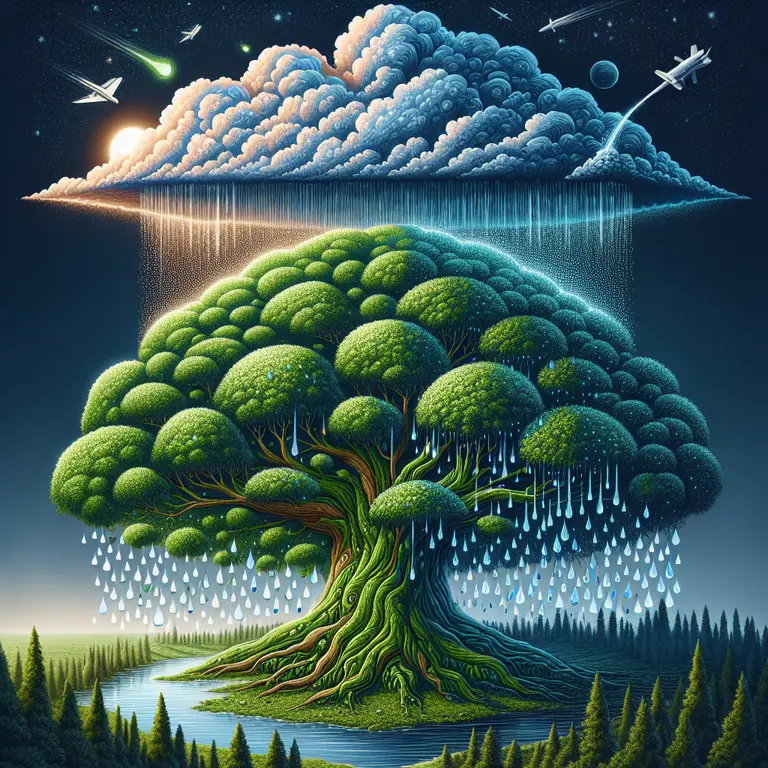
Trees have the ability to generate their own rain and influence local weather system.
 Watch on YouTube
 Watch on Rumble
How Trees Make Their Own Rain: The Hidden Science of Forests and Weather
The concept might sound straight out of a fantasy novel, but trees do indeed have the ability to generate their own rain. Far from being passive inhabitants of the landscape, forests are dynamic, living systems that actively shape the atmosphere around them. With an intricate link to local weather systems, plants and trees hold a vital position in the atmospheric water cycle through a combination of biological and physical processes. Understanding these mechanisms not only deepens our appreciation for forests but also reframes how we think about conservation, land use, and climate stability on a global scale.
Transpiration: The Breathing of Trees
At the heart of this phenomenon is transpiration, the movement of water through a plant from its roots to its leaves, where it is ultimately released into the atmosphere as vapor. This happens through microscopic pores on the underside of leaves called stomata, which open and close in response to light, temperature, and humidity. When conditions are right, these tiny openings allow enormous quantities of water vapor to escape into the surrounding air.
The scale of this process is staggering. A single mature oak tree can transpire hundreds of liters of water on a warm summer day. When you multiply this across an entire forest containing millions of trees, the cumulative output becomes a significant atmospheric force. Globally, around 10% of atmospheric moisture originates from transpiration by trees and other vegetation. This is not a marginal contribution. It means that forests are actively pumping water into the sky, seeding the conditions necessary for cloud formation and precipitation, extending far beyond their own boundaries.
What makes transpiration particularly remarkable is that it is not a passive leak. Trees regulate the process with considerable precision. Stomata open during daylight hours to allow gas exchange for photosynthesis and close at night or during drought conditions to conserve water. This biological control means that forests respond dynamically to their environment, adjusting their contribution to local humidity in response to the season, temperature, and available soil moisture.
Evapotranspiration: Combining Forces with the Landscape
Transportation does not act in isolation. It is one half of a broader process known as evapotranspiration, which combines the water released by plants with the evaporation of water from surface bodies such as lakes, rivers, and wetlands, as well as from soil. Together, these two mechanisms return vast quantities of water to the atmosphere that would otherwise remain locked in the ground or flow away through rivers and drainage systems.
Mature trees play an outsized role in this combined process because of their deep and extensive root systems. While grasses and shrubs draw moisture from the upper layers of soil, large trees can send roots many meters downward, tapping into groundwater reserves that surface evaporation could never reach. This groundwater is drawn up through the trunk and branches, eventually reaching the leaves where it is released as vapor under the influence of sunlight and wind. In effect, trees act as biological pumps, lifting hidden water reserves into the atmosphere and redistributing them across the landscape.
The contribution of evapotranspiration to local humidity levels is substantial enough to influence temperature as well. When water evaporates or transpires, it absorbs heat energy from the surrounding environment in a process called latent heat flux. This is the same cooling mechanism that makes sweating effective for humans. Forests, therefore, act as natural air conditioners, moderating temperatures in their surrounding areas and reducing the intensity of heat events. Regions with dense tree cover are measurably cooler than deforested areas, even when all other variables remain constant.
Microclimates and the Atmosphere Forests Create
The cumulative effect of transpiration and evapotranspiration on a large scale gives rise to something ecologists and climatologists call microclimates. These are localized atmospheric zones where temperature, humidity, wind patterns, and precipitation differ noticeably from the surrounding region. Dense forests, particularly those covering large continuous areas, can generate and sustain these microclimates with remarkable consistency.
The Amazon rainforest is perhaps the most dramatic example of this phenomenon. Scientists have described the Amazon as a biotic pump, a system in which the forest actively draws moist air inland from the Atlantic Ocean by continuously releasing water vapor that rises, cools, and falls as rain. This rain is then absorbed by the forest, transpired again, and the cycle repeats. Estimates suggest that a water molecule entering the Amazon basin from the ocean may fall as rain and be recycled by the forest multiple times before it eventually exits the system. Without the forest, this inland transport of moisture would collapse, and large portions of South America would experience significantly drier conditions.
This principle extends beyond the Amazon. Forests in central Africa, Southeast Asia, and even temperate regions of Europe and North America contribute to regional weather patterns through the same mechanisms. When large areas of forest are cleared, the disruption to local evapotranspiration can reduce rainfall, increase temperatures, and alter wind patterns in ways that affect agriculture and water availability for human populations living far from the cleared land.
Organic Molecules and the Chemistry of Cloud Formation
Beyond water vapor, forests contribute to rainfall through a more chemically complex mechanism that has only recently become well understood. Certain tree species, particularly conifers and many tropical broadleaf trees, emit volatile organic compounds into the atmosphere. These include substances such as isoprene and various terpenes, which give forests their distinctive earthy or resinous smell.
Once in the atmosphere, these organic molecules undergo chemical reactions with oxygen and other compounds, forming tiny particles called secondary organic aerosols. These particles are significant because they serve as cloud condensation nuclei, the microscopic surfaces around which water vapor condenses to form cloud droplets. Without sufficient nuclei, water vapor in the atmosphere cannot easily condense into the droplets that make up clouds, and cloud formation is inhibited.
By releasing these organic compounds, forests are not merely contributing moisture to the atmosphere. They are also providing the chemical scaffolding that allows clouds to form from that moisture. Research published in leading atmospheric science journals has confirmed that forests in pristine environments, far from industrial pollution, rely heavily on their own biogenic aerosols to sustain cloud cover and rainfall. This means that a healthy, chemically active forest is more effective at generating rain than a degraded or fragmented one, even if the total leaf area is similar.
The Importance of Forest Conservation in a New Light
Understanding the role forests play in generating their own rainfall reframes the entire conversation around conservation. For decades, the primary argument for protecting forests has centered on carbon sequestration and biodiversity. Both remain critically important, but the hydrological dimension adds a further layer of urgency that is often underappreciated in policy discussions.
Tropical rainforests like the Amazon are not simply storing carbon or housing millions of species. They are functioning as engines of regional climate stability, maintaining the rainfall patterns that support agriculture, river systems, and human settlements across entire continents. When these forests are destroyed, the consequences extend far beyond the cleared land itself. Downstream and downwind communities lose the rainfall they depend on, groundwater reserves decline, and temperatures rise, compounding the challenges of an already warming world.
Multiple scientific studies have established that deforestation in the Amazon has already begun to reduce rainfall in parts of Brazil, with measurable effects on crop yields and water availability. Similar findings have emerged from studies of deforestation in West Africa and Southeast Asia. The forests, in other words, are not simply responding to climate. They are actively participating in creating it.
In summary, trees are essential not only for carbon sequestration but for sustaining the very climates that make life possible across large portions of the planet. Through transpiration, evapotranspiration, microclimate formation, and the release of cloud-seeding organic compounds, forests generate and recycle rainfall in ways that science is only beginning to fully quantify. Preserving these systems is not a matter of sentiment or aesthetics. It is a practical necessity for environmental stability, agricultural security, and the long-term health of the global climate system.