
Unseen Ecosystems: The Vital Role of Biological Soil Crusts
Biological soil crusts — living communities of cyanobacteria, lichens, and mosses — form the invisible skin of the world's drylands, fixing nitrogen, preventing erosion, and taking decades to recover from a single footstep.
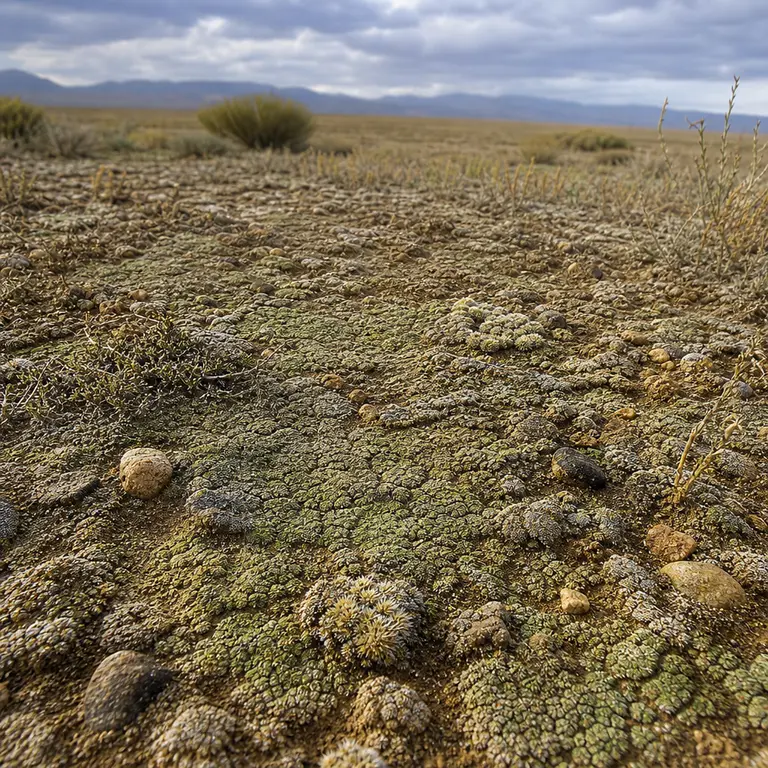
The Living Skin Beneath Your Feet
Across the Colorado Plateau, the Gobi Desert, and the Namib, the ground between the plants is not bare dirt. It is alive. Biological soil crusts, sometimes called cryptobiotic, microbiotic, or biogenic crusts, are dense communities of cyanobacteria, green algae, microfungi, lichens, and mosses that colonize the top few millimeters of arid and semi-arid soils. From a distance, they appear as a dark, slightly lumpy or wrinkled surface, easily mistaken for ordinary earth. Up close, under a hand lens, they reveal an intricate architecture of filaments, pigmented sheaths, and miniature lichen thalli that collectively bind soil particles into a coherent, erosion-resistant matrix.
These crusts are not a curiosity. They cover an estimated 12 percent of Earth’s terrestrial surface, making them one of the most spatially extensive ecosystems on the planet. In some dryland regions, biological soil crusts constitute more than 70 percent of the total living ground cover, dwarfing the contribution of vascular plants. Yet they remain almost entirely absent from public ecological awareness, overshadowed by the charismatic megafauna and towering vegetation that dominate conservation narratives. A grizzly bear or a giant sequoia commands attention, fundraising campaigns, and legal protections. A crust of cyanobacteria and lichen holding a desert together generates none of these responses, despite performing ecological work that neither the bear nor the tree could survive without.
Part of this invisibility is perceptual. Biological soil crusts do not move, do not make sounds, and do not flower. Their complexity is only apparent at scales most people never examine. But part of it is also historical. Dryland ecosystems have long been categorized in the popular imagination as wastelands, transitional spaces between places of greater interest, and the organisms that make those spaces function have inherited that dismissal. Correcting the record requires understanding not just what biological soil crusts are, but what they do, how vulnerable they are, and what the world would look like without them.
Nitrogen from Thin Air and Structural Engineering at Microscale
The ecological functions performed by biological soil crusts are disproportionate to their thin profile. The most significant is biological nitrogen fixation. Cyanobacteria, particularly filamentous species such as Microcoleus vaginatus and Nostoc commune, carry the enzyme nitrogenase, which converts atmospheric nitrogen gas into ammonia that plants and soil organisms can use. In ecosystems where synthetic fertilizers are absent and rainfall is too low to support nitrogen-fixing legumes, biological soil crusts may supply the majority of the biologically available nitrogen entering the system. Studies in the Colorado Plateau have measured annual nitrogen inputs from crusts ranging from 9 to 13 kilograms per hectare, a figure comparable to the inputs from nitrogen-fixing vascular plants in the same landscapes.
This contribution is not merely academic. The dryland plant communities that depend on crust-derived nitrogen include species that support entire food webs, from seed-eating rodents to raptors to the large predators that conservation efforts are most often organized around. Remove the crust, and you do not immediately see the predator disappear. You see a gradual impoverishment of the soil, a thinning of the plant community, a reduction in seed production, and a contraction of the animal populations that follow. The crust is several steps removed from the visible consequences of its loss, which is precisely why those consequences are so often misattributed or overlooked entirely.
Beyond chemistry, cyanobacterial filaments physically engineer the soil surface. As they move through the upper millimeters of soil in response to light and moisture, they secrete sticky polysaccharide sheaths that glue mineral grains together. When the soil dries, these sheaths harden into a flexible, water-repellent mesh. Wind tunnel experiments have demonstrated that crusted soils require wind speeds two to five times greater than those of equivalent uncrusted soils to initiate dust emission. In regions where dust storms pose public health and climate concerns, this biological armor is not trivial. Dust from degraded drylands contributes to respiratory disease across downwind populations, fertilizes ocean surface waters in ways that alter marine food webs, and even influences Atlantic hurricane intensity by absorbing solar radiation.
The water dynamics of crusted soils are also more complex than they first appear. Depending on the species composition and successional stage of the crust, the surface can either enhance or retard water infiltration. Early-stage crusts dominated by cyanobacteria tend to reduce infiltration by sealing soil pores, concentrating water flow toward the bases of vascular plants, and effectively irrigating them during low-rainfall events. Later-stage crusts incorporating mosses and lichens often increase infiltration by creating surface roughness that slows runoff and allows water more time to percolate. This dynamic regulation of water distribution is one of the mechanisms by which biological soil crusts influence the spatial patterning of vegetation across dryland landscapes.
A Century of Damage in a Single Step
The fragility of biological soil crusts is their most alarming characteristic. Because they grow at the soil surface and are held together by delicate filaments, they are catastrophically vulnerable to physical disturbance. A single footstep on a mature crust can shatter the surface structure across an area several times the size of the boot print, as the rigid lichen and moss components crack and the cyanobacterial network beneath is severed. Recovery timelines are sobering. In cool deserts such as those of the Great Basin in North America, where temperatures and moisture availability are low, a well-developed crust community dominated by lichens and mosses may require 50 to 250 years to fully recover from trampling. In hotter deserts, recovery can be faster for the early cyanobacterial stages but may still take decades for the later successional stages dominated by lichens.
The asymmetry between the speed of destruction and the speed of recovery is difficult to fully absorb. A hiker crossing a section of the Colorado Plateau in the afternoon, stepping off the trail to photograph a rock formation or take a shortcut back to the trailhead, can destroy crust communities that have been accumulating complexity since before the American Civil War. The damage is invisible at the moment it occurs. There is no sound, no visible wound, no immediate consequence. The crust simply becomes dust, and the soil beneath it becomes vulnerable to erosion in ways that will not be fully apparent until the next windstorm or flash flood.
Livestock grazing has been the dominant cause of crust degradation globally since domesticated animals were introduced to dryland regions thousands of years ago. A 2001 study published in the journal BioScience estimated that livestock grazing had reduced biological soil crust cover by more than 50 percent across the Colorado Plateau relative to ungrazed reference sites. Off-road vehicle use, recreational foot traffic in national parks, and military training exercises have compounded the damage. NASA and the U.S. Geological Survey have collaborated on remote sensing studies attempting to map crust degradation from satellite imagery, using spectral reflectance signatures of cyanobacterial pigments to distinguish healthy from disturbed crusts across vast areas inaccessible to ground surveyors.
What makes the grazing legacy particularly difficult to address is that the damage is cumulative and geographically diffuse. A single overgrazed allotment in the Great Basin does not produce a visible scar from a highway. It produces a gradual, landscape-scale impoverishment that becomes apparent only when compared to photographs taken decades earlier or to the few remaining ungrazed reference areas that ecologists have managed to protect. Those reference areas are now among the most scientifically valuable pieces of land in North America, not for their scenic qualities, but for what they reveal about the baseline condition of dryland ecosystems before industrialized land use began.
Climate Change and the Shifting Boundaries of Biological Crusts
The relationship between biological soil crusts and climate change is bidirectional and deeply concerning. Crusts are sensitive to shifts in precipitation timing, temperature extremes, and the frequency of soil surface disturbance events such as intense rainfall after drought. Research published in Nature Climate Change in 2016, drawing on a global database of crust observations, projected that climate change could reduce biological soil crust cover by 25 to 40 percent globally by 2070 under moderate warming scenarios. The loss would be concentrated in regions already experiencing desertification pressure, creating a feedback loop in which degraded crusts accelerate dust emission, which in turn alters regional precipitation patterns.
One of the less obvious mechanisms connecting crusts to climate is their role in surface albedo. Biological soil crusts are darker than bare mineral soil, which means they absorb more solar radiation. In a warming world, this has complex implications. In some models, the loss of dark-colored crust and its replacement with lighter bare soil could slightly reduce local warming through increased reflectivity, but this effect is more than offset by the increase in dust emissions from destabilized soils, since dust in the atmosphere has its own complex radiative effects depending on particle composition and altitude. The net result of widespread crust loss is almost certainly a warming feedback rather than a cooling one, though the precise magnitude remains an active area of research.
At the same time, biological soil crusts are themselves carbon sinks, though modest ones. Photosynthesis by crust organisms fixes atmospheric carbon dioxide into organic matter that accumulates in the soil. Global estimates suggest that dryland crusts may sequester between 0.6 and 1.5 petagrams of carbon per year, a figure that becomes significant in the context of nature-based climate solutions if crusts can be protected or restored. Active restoration research is underway at institutions including the University of Colorado and the USDA Agricultural Research Service, where scientists are experimenting with inoculating degraded soils with cultured cyanobacteria to accelerate crust recovery. Early field trials have shown that inoculated plots develop measurable crust biomass within two to three years, compared to decades under natural recolonization, though achieving the full structural and species complexity of mature crusts remains an unsolved challenge.
The policy landscape around biological soil crust protection has been slow to develop. A handful of national parks and wilderness areas in the American Southwest have installed signage asking visitors to stay on trails specifically to protect cryptobiotic crusts, and some land management plans now include crust condition as an indicator of rangeland health. But these measures are piecemeal relative to the scale of the problem, and enforcement of trail-staying behavior in dispersed recreation areas is effectively impossible. What is needed is a broader shift in how dryland ecosystems are valued and managed, one that treats the soil surface as a living community rather than an inert substrate.
An Ancient Lineage in a Modern Crisis
Biological soil crusts are not a recent evolutionary experiment. Cyanobacteria are among the oldest life forms on Earth, with fossil evidence extending back more than 3.5 billion years, and filamentous cyanobacteria capable of soil surface colonization have likely existed since terrestrial environments first became available to life, perhaps 1.2 billion years ago. Before vascular plants colonized the land, crust-like microbial communities may have been the dominant form of terrestrial life, stabilizing soils and fixing nitrogen in a world otherwise hostile to complex organisms. In this sense, the thin dark skin that hikers unknowingly crush underfoot in Utah or Mongolia is a direct descendant of the communities that first made land habitable.
The evolutionary depth of these organisms adds a dimension to their loss that is rarely acknowledged in conservation discourse. When a species of large mammal goes extinct, the loss is recognized as irreversible and culturally mourned. When biological soil crusts are degraded across millions of hectares, the response is largely silent, even though the organisms being destroyed have been refining their ecological strategies over timescales that dwarf the entire history of vertebrate life on land. The lichen thallus crumbling under a boot in Arches National Park may represent a lineage of continuous adaptation stretching back further than the dinosaurs.
The casual destruction of something that ancient and that functionally irreplaceable in the span of a single recreational afternoon is one of the quieter ecological ironies of the modern era. We have built an elaborate culture of environmental concern around the visible and the dramatic while remaining largely indifferent to the foundational and the microscopic. Biological soil crusts will not appear on an endangered species list. They will not be the subject of a documentary narrated by a beloved naturalist. But the drylands of the world are held together by them, and the slow unraveling of that hold is already underway. Paying attention to the ground beneath our feet, literally and ecologically, may be one of the more consequential adjustments that conservation thinking has yet to make.
Sources & Further Reading
- Belnap, J. and Lange, O.L. (eds.). Biological Soil Crusts: Structure, Function, and Management. Springer, 2003. https://link.springer.com/book/10.1007/978-3-642-56475-8
- Belnap, J., Büdel, B., and Lange, O.L. Biological soil crusts: characteristics and distribution. BioScience, 2001. https://academic.oup.com/bioscience/article/51/12/1043/243118
- Rodríguez-Caballero, E. et al. Dryland photoautotrophic soil surface communities endangered by global change. Nature Geoscience, 2018. https://www.nature.com/articles/s41561-018-0072-1
- Proctor, M.C.F. and Tuba, Z. Poikilohydry and homoihydry: antithesis or spectrum of possibilities? New Phytologist, 2002.