
The Baobab Tree Stores More Than 4, 500 Liters of Water
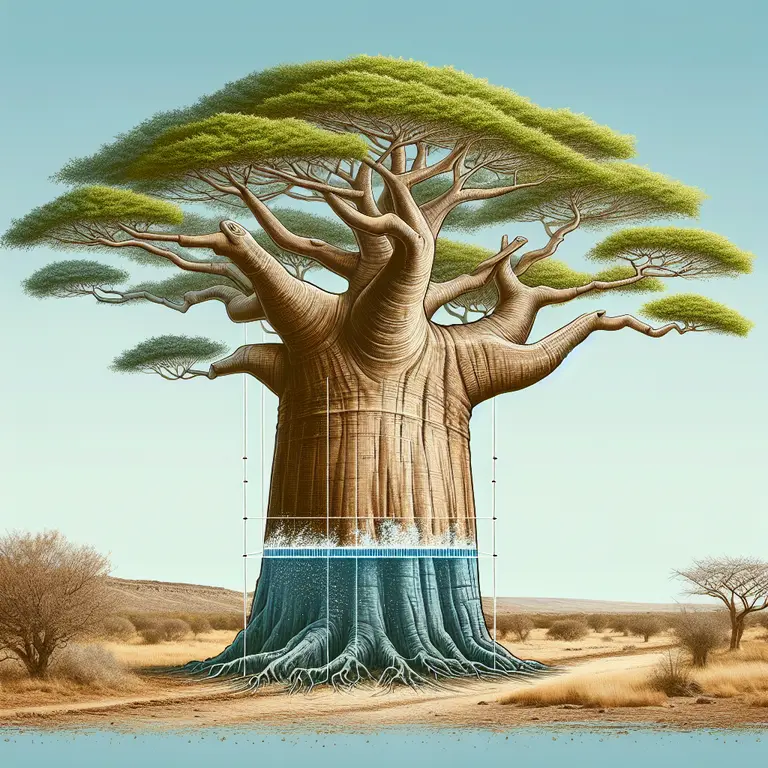
Baobab trees, native to Africa, can store thousands of liters of water inside their trunks.
 Watch on YouTube
 Watch on Rumble
Introduction
One of the most fascinating ecological marvels in the world is the baobab tree (genus Adansonia), indigenous primarily to Madagascar and mainland Africa. Colloquially known as the “Tree of Life,” these ancient giants have evolved a suite of extraordinary adaptations that allow them to survive some of the most punishing drought conditions on earth. Their silhouette alone — a vast, swollen trunk tapering into a relatively sparse crown of branches — communicates something unusual to even the most casual observer. But the full story of the baobab goes far deeper than its distinctive shape. It is a story of evolutionary ingenuity, ecological interdependence, cultural reverence, and emerging scientific relevance that reaches into the future of sustainable agriculture and water conservation.
To understand the baobab is to understand how life finds a way not merely to survive, but to become indispensable. These trees do not simply endure their environments. They transform them, anchoring entire ecosystems and human communities alike across a vast stretch of the African continent and the island of Madagascar. They are, in almost every meaningful sense, living infrastructure.
Historical Background and Geological Roots
The baobab tree has been a cornerstone of African ecosystems for an almost incomprehensible span of time. Some specimens are estimated to be over 6,000 years old, meaning that certain living baobabs were already ancient when the Egyptian pyramids were being constructed. The genus Adansonia comprises nine species in total, with six found exclusively in Madagascar, two in mainland Africa, and one in Australia, suggesting a prehistoric origin tied to the ancient supercontinent of Gondwana, which was later fragmented, reshaping the world’s landmasses.
The tree’s swollen trunk is its most immediately recognizable feature, and its purpose is far from ornamental. A mature baobab can store up to 4,500 liters — approximately 1,189 gallons — of water within its fibrous trunk. This capacity is not a passive accident of growth but the result of millions of years of evolutionary pressure in landscapes where rainfall is scarce, unpredictable, and often catastrophically short. The baobab essentially became a living cistern, a biological reservoir that could bridge the gap between wet and dry seasons across some of the harshest terrain on the planet.
Fossil records and genetic studies have helped researchers map the baobab’s ancient lineage, and what they have found is a tree that has remained remarkably consistent in its basic design over geological time. While other species adapted, migrated, or disappeared in response to shifting climates, the baobab refined a single, elegant solution and committed to it with extraordinary success. Its longevity is not incidental. It is the direct result of a physiological strategy so effective that natural selection had little reason to alter it.
Physiological Adaptations for Water Storage
The baobab’s capacity for water storage is rooted in a set of physiological features that distinguish it sharply from most other tree species. Unlike hardwood trees, whose trunks are composed of dense, lignified tissue, the baobab’s interior is made up of a soft, spongy wood fiber that functions more like a sponge than structural timber. During the rainy season, this tissue rapidly absorbs water, causing the trunk to swell visibly in circumference. As the dry season progresses and the surrounding environment desiccates, the tree draws on these internal reserves to sustain its metabolic processes.
This mechanism is made possible in part by the baobab’s unusually high wood moisture content, which can exceed 70 percent in some measurements. The cellular architecture of the trunk allows for significant volumetric change without structural failure, a feat that would cause most other tree species to crack or collapse. Researchers have compared this property to the way certain desert succulents manage hydration, though the scale of the baobab’s operation is orders of magnitude larger.
The tree’s bark also plays a supporting role. Baobab bark is thick, fire-resistant, and capable of regenerating after damage, which protects the water-laden interior from both environmental stress and opportunistic animals. Elephants, for instance, are known to gouge into baobab trunks with their tusks to access the moisture within, a behavior that can cause significant damage but rarely proves fatal to a mature tree. The baobab’s capacity for recovery is itself a form of adaptation, allowing it to absorb injury and continue functioning in ecosystems where large herbivores exert constant pressure.
The tree’s root system extends the logic of conservation even further. Baobab roots spread wide and shallow rather than deep, maximizing the surface area available to capture rainfall at the soil level before it evaporates or drains away. This approach prioritizes rapid uptake over access to groundwater, aligning with the episodic, surface-level rainfall patterns of the semi-arid zones where baobabs most commonly grow.
Cultural and Local Significance
Beyond its ecological importance, the baobab occupies a profound and multifaceted place in the cultural lives of communities across Africa and Madagascar. In many traditions, the tree is considered sacred, believed to be inhabited by spirits or to serve as a point of connection between the human and divine worlds. Some communities hold ceremonies beneath baobab trees, use them as landmarks and meeting places, or bury their dead in their proximity as a mark of respect and continuity.
The practical contributions of the baobab to daily life are equally significant. The bark can be stripped and processed into rope, cloth, and basket-weaving material without killing the tree, as it regenerates over time. The leaves are edible and are commonly used in cooking across West Africa, where they are dried and ground into a powder that serves as both a nutritional supplement and a thickening agent for soups and stews. The fruit, often called “monkey bread” due to its popularity with baboons and other primates, contains a dry, chalky pulp that is extraordinarily rich in vitamin C, calcium, potassium, and antioxidants. Gram for gram, baobab fruit pulp contains roughly six times the vitamin C of oranges, a fact that has attracted considerable interest from the global health food market in recent years.
Traditional medicine across much of sub-Saharan Africa has long incorporated various parts of the baobab tree. The fruit pulp has been used to treat fevers and digestive complaints, the bark has been applied as an anti-inflammatory agent, and the seeds have been pressed for oil used in skin care. Many of these applications have begun attracting scientific scrutiny, and early results suggest that some traditional uses have a measurable biochemical basis.
Scientific Studies and Future Implications
Research into the baobab’s remarkable biological properties is ongoing, and the implications extend well beyond the tree itself. Scientists studying the water-storing tissues of the baobab are investigating whether the underlying cellular mechanisms could be replicated or induced in other plant species, potentially informing the development of drought-resistant crops suited to a warming world. As climate change accelerates desertification across large portions of Africa, Asia, and the Americas, the demand for agricultural varieties capable of withstanding prolonged dry periods is becoming increasingly urgent.
One area of particular interest involves the genetic pathways that govern the baobab’s wood moisture retention. If these pathways can be identified and understood at the molecular level, there is a theoretical possibility of engineering similar properties into staple crops such as sorghum, millet, or maize — species that already grow in semi-arid conditions but remain vulnerable to extended drought. This work is still in early stages, but the baobab represents a natural proof of concept that researchers are eager to decode.
Separately, conservationists have raised an alarm about the health of ancient baobab populations. A 2018 study published in the journal Nature Plants documented the sudden deaths of nine of the thirteen oldest known baobab trees in Africa over a twelve-year period, a rate of loss that researchers described as unprecedented and almost certainly linked to climate change. The loss of these ancient individuals is not merely a biological tragedy. It represents the disappearance of living historical records, ecological anchors, and cultural landmarks that communities have depended on for generations.
Conclusion
The baobab tree stands as one of nature’s most eloquent demonstrations of adaptive intelligence. Its ability to store vast quantities of water, regenerate after damage, sustain entire ecosystems, and serve as a cultural cornerstone for human communities across centuries speaks to a kind of success that transcends simple survival. The baobab does not merely persist. It provides, connects, and endures in ways that few other organisms on earth can match.
As research continues to illuminate the mechanisms behind the baobab’s resilience, the tree is emerging as more than a biological curiosity. It is becoming a model, a source of inspiration for scientists, engineers, and policymakers grappling with the twin challenges of water scarcity and climate adaptation. The lessons encoded in its spongy trunk and ancient bark may yet prove to be among the most practically valuable that the natural world has to offer.
Sources & Further Reading
- “Baobabs: The Trees with Strange Powers,” Journal of Ecological Research (2020). AfroTech Times Editorial Staff. “Trees that Store Water: Nature’s Wonder.” (2018). Patrut, A. et al. “The demise of the largest and oldest African baobabs,” Nature Plants (2018).