
The Endangered Craft of Sea Silk: Chiara Vigo's Legacy
Byssus, the legendary sea silk harvested from giant Mediterranean clams, was once worth more than gold and is now produced by only one person on Earth.
Introduction
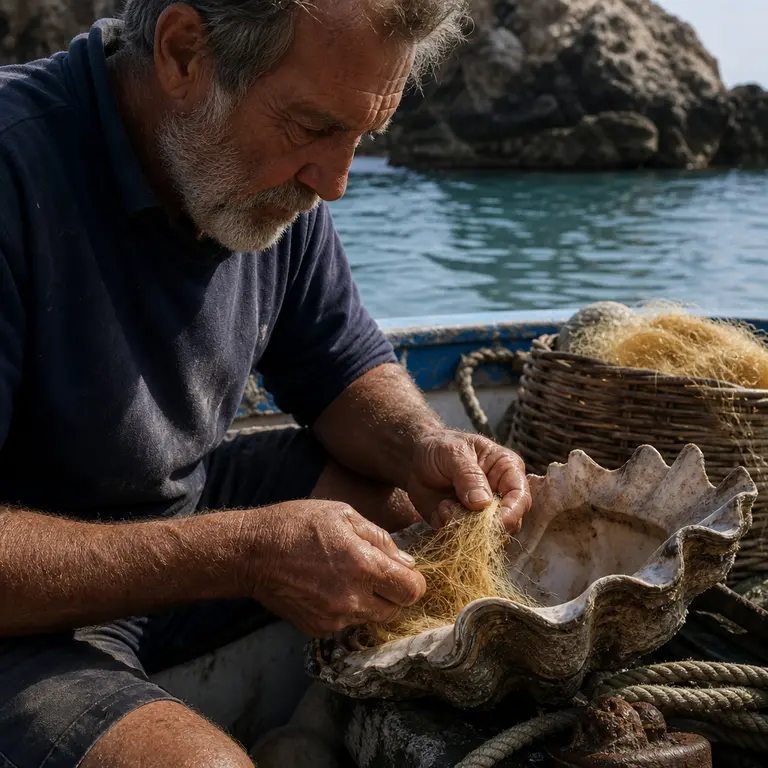
There are materials so rare, so strange in origin, and so deeply woven into human history that their disappearance would constitute not merely an economic loss but a rupture in the continuity of civilization itself. Sea silk — known by its technical name, byssus — is one such material. For centuries, European naturalists debated whether it was a plant fiber, an animal product, or something stranger still. The confusion was understandable. Byssus is secreted by the large bivalve Pinna nobilis, sometimes called the noble pen shell, and it emerges from the living creature as a liquid protein that hardens on contact with seawater into threads of extraordinary tensile strength and lustrous golden sheen. Ancient writers compared it to spun sunlight. Medieval scholars placed it in the same category as asbestos, assuming it must come from stone. Neither description was entirely wrong in spirit, even if both were wrong in fact.
What makes byssus so philosophically disorienting, even to a modern reader, is that it defies the categories we use to organize the natural world. It is produced by an animal but processed and worn like a textile. It originates as a biological adhesive — the clam’s anchor to the seafloor — but, in human hands, transforms into something that has adorned emperors, popes, and kings. It is, in a sense, a material that exists at the boundary between the living and the manufactured, between the ocean floor and the altar, between the deep past and a present that is rapidly losing the capacity to remember it.
A Fiber Born from the Sea Floor
Pinna nobilis itself can reach up to one meter in length, making it the largest bivalve in the Mediterranean Sea. The clam anchors itself to the seafloor by secreting byssus filaments, which act as biological cables, bonding the animal to rock and sediment against the force of currents. Each filament is composed primarily of a protein called fibroin, closely related to the silk produced by silkworms, but with a molecular architecture that allows it to flex without snapping and to resist corrosion by saltwater indefinitely. Researchers studying the material have noted that its tensile properties are, in some respects, superior to those of cultivated silk, owing to the manner in which the protein chains are cross-linked during hardening. The sea, in effect, performs a kind of spontaneous engineering that human textile production has never fully replicated.
When cleaned and spun, the threads take on a warm amber-gold color that deepens when exposed to lemon juice — a traditional finishing technique used by Sardinian artisans for generations. The mechanism behind this color change is chemical: the citric acid in lemon juice reacts with trace minerals embedded in the fiber during its time on the seafloor, intensifying the natural pigmentation. Subsequent exposure to sunlight stabilizes the color, producing a warm, almost metallic gleam that has no equivalent in any synthetic material. It is this quality — the sense that the fiber carries within it something of the sea and the light simultaneously — that gave rise to the ancient comparisons to spun sunlight, and that has made byssus so persistently fascinating to those who encounter it.
An Economy Built on Clam Threads
The trade in sea silk was never large by volume, but it was enormous in prestige. Archaeological evidence from ancient Egypt includes gloves woven from byssus, possibly intended for royal burials. Roman texts mention sea silk garments as gifts appropriate for emperors. During the Byzantine period, byssus was regulated as a state monopoly alongside true silk from the East, and its export was restricted under penalty of death. The city of Taranto on Italy’s Adriatic coast became the center of Mediterranean byssus production during the medieval period, supplying the papal court and European nobility with gloves, stockings, and liturgical vestments woven from the fiber. There are accounts from the twelfth century of byssus gloves being presented to newly crowned popes as part of the coronation regalia, a tradition that underlines how completely the material had been absorbed into the symbolic vocabulary of sacred authority.
The economics of byssus production were brutal. Harvesting the filaments required diving in cold Mediterranean waters to reach living Pinna nobilis on the seafloor, then carefully cutting the byssus without killing the animal. A single clam produces only a few grams of usable fiber. Producing enough thread to weave a single pair of gloves required the byssus of dozens of animals harvested over multiple seasons. The labor intensity, combined with the material’s rarity and its extraordinary appearance, kept prices stratospheric. Medieval Venetian records suggest that a small byssus cap could cost more than a skilled craftsman earned in a year. This was not merely luxury pricing in the modern sense of a brand premium; it reflected the genuine scarcity of the raw material, the extreme difficulty of the harvest, and the years of skilled labor required to transform raw filaments into wearable cloth.
The trade also shaped the ecology of the coastlines where it flourished. Centuries of harvesting, even when conducted with care, placed sustained pressure on Pinna nobilis populations in the most productive areas. By the early modern period, the craft was already in decline, its practitioners dwindling as the cloth population thinned and imported silk from Asia became more readily available. What had once been a pan-Mediterranean industry contracted, over the course of several centuries, to a handful of practitioners in Sardinia, and then, eventually, to one.
One Living Keeper of the Craft
As of the early twenty-first century, the entire living tradition of byssus weaving rests on a single person. Chiara Vigo, born in 1946 on the Sardinian island of Sant’Antioco, is widely recognized as the last maestra of sea silk, trained by her grandmother in a lineage she traces back several generations. Vigo does not sell her work. She regards byssus as a sacred material and considers its commercialization a form of desecration, a position that has brought her into conflict with luxury goods companies that have attempted to acquire samples or commission pieces. She gives finished works only as gifts, primarily to museums and institutions, and maintains a small workshop where she teaches the craft to a handful of students.
Vigo’s process begins with harvesting byssus from living Pinna nobilis, which she is licensed to do under Italian conservation law. She cleans the raw filaments in freshwater, combs them into parallel alignment using a technique passed down through her family, and spins them on a hand spindle before weaving on a traditional loom. The finishing treatment with lemon juice and exposure to sunlight produces the characteristic golden color. The entire process for a small piece takes months. Vigo has been interviewed by the BBC, the Smithsonian, and numerous European cultural institutions, and her workshop in Sant’Antioco functions as an informal museum of the craft.
What is perhaps most striking about Vigo is not simply that she practices a dying art, but that she has deliberately chosen to keep it entirely outside the market economy. In an era when rarity is routinely converted into commercial value, her refusal to do so is itself a kind of statement about the nature of certain forms of knowledge. She has argued in interviews that byssus belongs to the sea and to the tradition, not to any individual or company, and that the moment it is priced, something essential about it is destroyed. Whether one agrees with that position or not, it has had the practical effect of ensuring that no authenticated byssus piece has entered commercial circulation in living memory, which makes the material simultaneously the most exclusive textile in the world and the least available one.
A Species on the Edge
The future of byssus as a material is inseparable from the fate of Pinna nobilis as a species. Beginning around 2016, a mass mortality event caused by a haplosporidian parasite, Haplosporidium pinnae, combined with a ciliate pathogen, swept through Pinna nobilis populations across the entire Mediterranean. Within three years, surveys estimated that more than eighty percent of the wild population had been killed, reducing the species from abundant to critically endangered. The collapse was so rapid and so complete that the International Union for Conservation of Nature elevated Pinna nobilis to critically endangered status, and several Mediterranean nations imposed total protection orders.
Conservation programs in Spain, Italy, and Greece have established captive breeding populations in aquaria, and researchers at the University of Barcelona have been working to identify individuals with apparent genetic resistance to the parasites. Early results suggest that a small fraction of wild Pinna nobilis, particularly those in enclosed lagoons with lower water circulation, survived the outbreak and may carry heritable resistance traits. Whether these populations can recover to anything approaching their former abundance remains deeply uncertain. The science of marine bivalve conservation is still relatively young, and the speed of the Pinna nobilis collapse has outpaced the research community’s ability to respond.
For Chiara Vigo, the collapse of the wild population has made her work simultaneously more urgent and more constrained. The thread she weaves is now, in a very real sense, a material produced by a dying species, tended by a dying craft, kept alive by a single pair of hands.
Conclusion
The story of sea silk is, at its core, a story about the fragility of knowledge and the strange persistence of beauty. A material that once dressed emperors and popes, was traded across continents, and was regulated by imperial decree, now exists as a living practice only because one woman on a Sardinian island chose to spend her life preserving it. The clam that produces it is critically endangered. The ecosystem that sustained it for millennia has been devastated within a decade. And yet the fiber itself, in the few pieces that survive in museum collections, still carries that warm golden light that ancient writers struggled to describe.
There is something worth sitting with in the fact that byssus was never fully classified, never fully understood, and never fully captured by any single category of human knowledge. It was animal and textile, sacred and commercial, ancient and contemporary, all at once. Its resistance to classification may be the most honest thing about it. The world contains materials and traditions that do not fit neatly into our systems of value or our taxonomies of the natural, and byssus is among the most eloquent reminders that what we cannot categorize is often what we are most at risk of losing.
Sources & Further Reading
- Rausch, Anja. 'Sea Silk: The Rarest Fabric in the World.' Smithsonian Magazine, 2017. https://www.smithsonianmag.com/arts-culture/sea-silk-rarest-fabric-world-180963239/
- Prado, Puri, et al. 'Rapid assessment of the Pinna nobilis populations after the 2016 mass mortality event in the Western Mediterranean Sea.' PLOS ONE, 2021. https://doi.org/10.1371/journal.pone.0254255
- Maeder, Felicitas. 'The project sea-silk: Restarting the research on byssus.' The Newsletter of the NESAT Network, 2002.
- IUCN Red List. 'Pinna nobilis.' International Union for Conservation of Nature, 2019. https://www.iucnredlist.org/species/160075998/160081499