
Discover the Fascinating Actinia: Nature's Sea Tomato
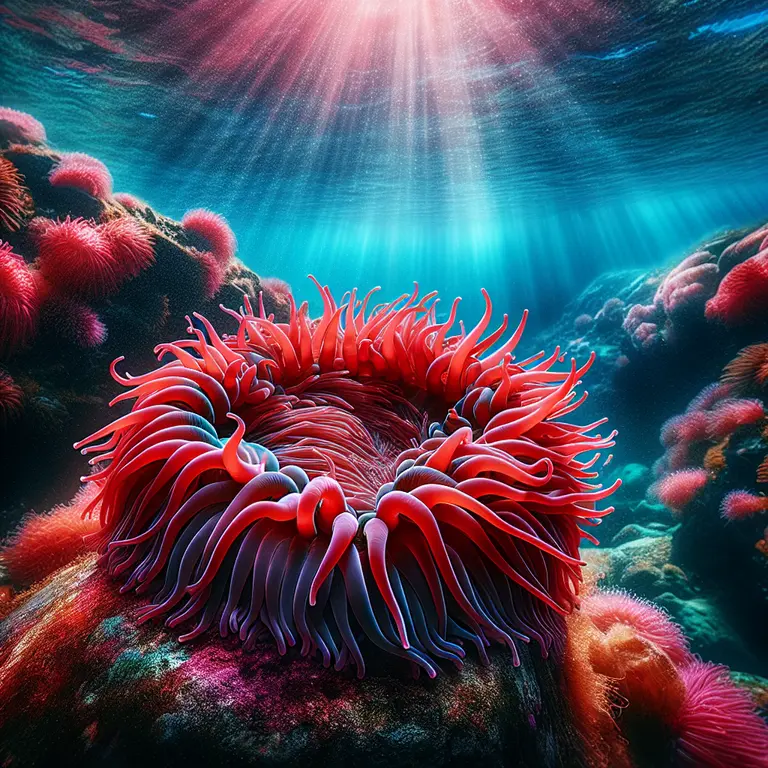
The Actinia equina, more commonly referred to as the 'sea tomato', is an intriguing marine creature with around 192 tentacles!
Introduction
Among the many strange and underappreciated creatures clinging to the rocky coastlines of Europe and Western Africa, few are as deceptively simple or biologically remarkable as Actinia equina. Colloquially known as the “sea tomato” or “beadlet anemone,” this small but tenacious cnidarian has occupied intertidal zones for thousands of years, outlasting civilizations, adapting to punishing tidal conditions, and quietly fascinating the scientists and coastal wanderers who encounter it. At first glance, it resembles little more than a blob of red or brownish jelly pressed against a wet rock. But look more closely, and you find a predator of considerable sophistication, a creature with a social life of sorts, a lifespan that rivals that of many vertebrates, and a history intertwined with human culture stretching back to prehistoric times.
Taxonomy, Physical Description, and Classification
Actinia equina belongs to the phylum Cnidaria, the same ancient lineage that includes jellyfish, corals, and hydroids. Within this phylum, it falls under the class Anthozoa and the order Actiniaria, placing it firmly among the true sea anemones. Though it is closely related to other anemone species, Actinia equina has developed a distinct identity through physical traits, behavioral quirks, and ecological habits that set it apart from its cousins.
In terms of physical appearance, the organism is roughly spherical when retracted, typically measuring around five centimeters in diameter at rest. Its coloration ranges from deep crimson to orange or occasionally green, and it is this vivid, tomato-like appearance when exposed at low tide that earned it the nickname most coastal observers recognize. When submerged and actively feeding, the creature transforms dramatically. It extends a crown of approximately 192 tentacles arranged in six concentric circles around its central oral disc, creating a delicate, flower-like structure that belies the predatory function those tentacles serve. Each tentacle is lined with specialized stinging cells called nematocysts, microscopic harpoon-like structures capable of firing venom into prey or potential threats with remarkable speed. When the organism senses danger or is exposed to air during low tide, all of these tentacles retract inward, and the animal seals itself into a compact, moisture-retaining dome that protects it from desiccation until the tide returns.
One of the more visually distinctive features of Actinia equina is the ring of vivid blue beads, known as acrorhagi, situated just below the tentacle crown. These structures are not merely decorative. They are weaponized organs packed with nematocysts, used primarily in territorial disputes with other anemones. This detail alone hints at a level of behavioral complexity that most casual observers would never expect from what appears to be a stationary, brainless blob on a rock.
Feeding Behavior and Predatory Strategy
Despite its sedentary appearance, Actinia equina is an active and efficient predator. Its diet consists primarily of small planktonic organisms, tiny crustaceans, marine worms, and occasionally small fish or insects that stray too close to the water’s surface. The feeding process is a coordinated effort involving the full array of tentacles working in concert. When prey makes contact with any tentacle, the nematocysts fire almost instantaneously, injecting a paralytic venom that immobilizes the target. The tentacles then curl inward, directing the captured prey toward the central mouth, which opens into a simple but effective gastrovascular cavity where digestion occurs.
What makes this feeding strategy particularly interesting is its efficiency under variable conditions. Actinia equina is capable of detecting chemical signals in the water that indicate the presence of food, triggering the extension of tentacles even before direct contact is made. This chemosensory ability, combined with the speed of the nematocyst discharge, makes the anemone a surprisingly effective ambush predator despite its apparent immobility. The tentacles also play a secondary role in locomotion, though the animal moves slowly and infrequently. When it does relocate, it does so by gliding on its muscular basal disc, a movement so gradual it is rarely observed in real time.
Habitat, Social Behavior, and Ecological Role
Actinia equina is a creature of consistency. It favors rocky intertidal and subtidal zones where wave action is moderate, and the substrate provides reliable anchorage. Across the coastlines of the British Isles, the Atlantic coast of Europe, and parts of Western Africa, it can be found in extraordinary densities, with individuals clustering so tightly on rock faces that the surface appears to be carpeted in red. These aggregations can number in the hundreds, and while the anemones do not cooperate in any meaningful social sense, their proximity creates a dynamic, often combative microenvironment.
The territorial behavior of Actinia equina is one of the more surprising aspects of its biology. When two individuals come into contact, they engage in what researchers have described as anemone warfare. The acrorhagi, those vivid blue beads mentioned earlier, are pressed against the opponent’s body and discharged, leaving behind patches of stinging cells that can cause tissue damage. These confrontations determine spatial boundaries and are waged with a consistency and apparent recognition of neighbors that has led some researchers to investigate whether the species possesses a rudimentary form of individual recognition. Studies have suggested that Actinia equina may behave less aggressively toward genetically related individuals, raising intriguing questions about kin recognition in animals without a conventional nervous system.
Ecologically, the species plays a meaningful role in intertidal food webs. As a predator of small invertebrates and plankton, it helps regulate prey populations. It is, in turn, consumed by certain fish species, sea slugs, and starfish, occupying a middle tier in the coastal food chain. Its presence in dense aggregations also provides a microhabitat for smaller organisms that shelter among the clustered bodies.
Longevity, Fossil Record, and Cultural History
One of the most striking facts about Actinia equina is how long individual animals can live. Under favorable conditions, specimens have been recorded surviving for 20 to 30 years, an impressive lifespan for an invertebrate of this size. Laboratory populations have been maintained for decades, and there is reason to believe that in undisturbed natural habitats, some individuals may live even longer. This longevity is thought to be connected to the species’ relatively low metabolic rate and its remarkable capacity for cellular repair and regeneration.
The fossil and archaeological records add another dimension to the story of this species. Evidence from Neolithic coastal settlements suggests that early human populations along European shorelines were familiar with Actinia equina, and there is credible archaeological indication that it was harvested and consumed as a food source. References in historical texts, including entries in encyclopedic records of Irish natural history, confirm that anemones of this type were part of the coastal diet in various regions. This tradition has not entirely disappeared. In parts of Spain, particularly in coastal Andalusian cuisine, sea anemones, including species closely related to Actinia equina, are still prepared and eaten as regional delicacies, typically fried in batter and served as tapas. The practice connects modern diners to a culinary tradition that may be thousands of years old.
Conclusion
Actinia equina is a species that rewards attention. What appears on the surface to be an unremarkable smear of color on a tidal rock reveals itself, upon closer examination, to be a long-lived predator with sophisticated sensory capabilities, a territorial social life, and a history of interaction with human civilization stretching back to prehistory. Its 192 tentacles, weaponized acrorhagi, chemosensory hunting strategy, and capacity to survive for decades on a wet rock face all speak to an organism shaped by millions of years of evolutionary refinement. In an era when marine biodiversity faces mounting pressure from climate change, pollution, and habitat degradation, species like Actinia equina serve as important indicators of intertidal ecosystem health. They deserve not only scientific study but a measure of public appreciation that their modest appearance rarely earns them.