
Parasitic Wasp Turns Spiders into Web-Weaving Zombies
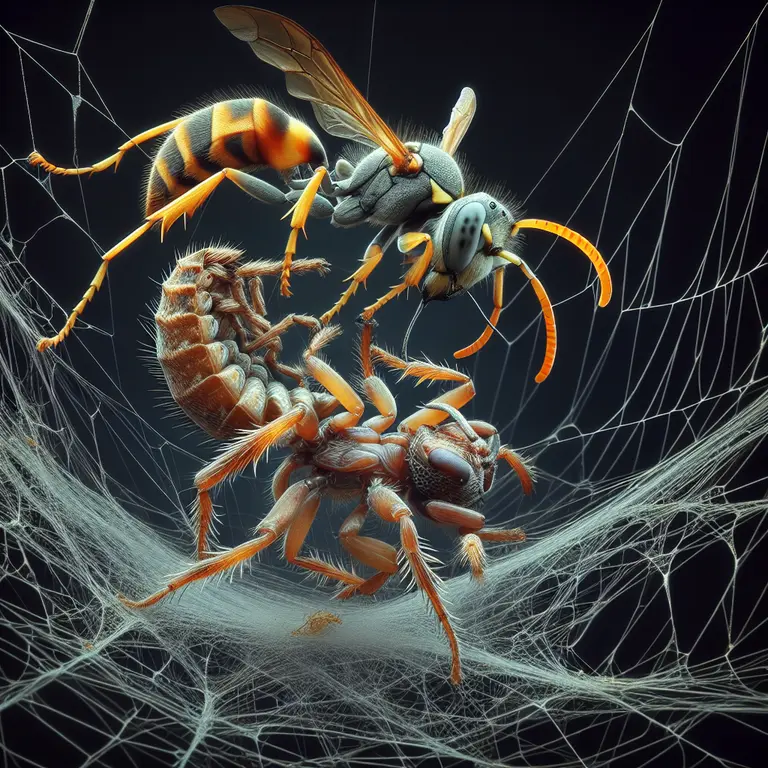
There is a species of parasitic wasp, named Reclinervellus nielseni, that can essentially turn its arachnid host into a zombie, forcing it to build a special web before the wasp kills it.
 Watch on YouTube
 Watch on Rumble
Mind Control in the Spider’s Web: How a Parasitic Wasp Rewires Its Host
In the natural world, survival strategies range from the elegant to the grotesque, but few are as unsettling or as scientifically fascinating as behavioral manipulation. Among the most striking examples is the relationship between the parasitic wasp Reclinervellus nielseni and its unwilling host, the orb-weaver spider Cyclosa argenteoalba. What unfolds between these two creatures is not a simple predator-prey interaction, nor a straightforward act of parasitism. It is something far more sophisticated: a calculated neurochemical takeover in which one organism effectively hijacks the behavior of another, bending it entirely to its own reproductive needs. This relationship challenges our assumptions about the boundary between instinct and control, and forces us to ask a deeply uncomfortable question — what does it mean to act of one’s own will?
The Initial Strike and the Invisible Chain
The cycle begins with an act of precision. A female Reclinervellus nielseni locates a suitable Cyclosa argenteoalba spider, typically one that has already established a web in a stable location. The wasp does not simply attack in the chaotic manner of a predator. Instead, she approaches with deliberate intent, delivering a carefully placed sting that temporarily paralyzes the spider without killing it. This distinction is critical. The spider must remain alive — it is not a meal, but a vehicle.
During the brief window of paralysis, the wasp deposits a single egg onto the spider’s abdomen. The act takes only moments, and when the venom wears off, the spider resumes its normal activity as if nothing had happened. It continues to build its web, catch prey, and behave in all outward respects like a healthy, autonomous creature. But something has changed. An egg is attached to its body, and a timer has begun. The spider is no longer entirely its own.
This phase of apparent normalcy is itself a remarkable element of the manipulation. The wasp’s strategy requires the spider to remain functional and alive for a specific period. Killing the host immediately would defeat the purpose. Instead, the larva that hatches from the egg will spend its early days feeding gently on the spider’s hemolymph — the fluid that serves as the spider’s blood — drawing just enough nutrition to grow without triggering the spider’s death. It is a relationship calibrated to a fine edge, extracting the maximum benefit from the host while keeping it operational for as long as necessary.
The Chemistry of Obedience
As the larva grows, it begins to secrete compounds that do something extraordinary: they alter the spider’s behavior at a fundamental level. The spider, which would ordinarily construct a classic orb web optimized for catching flying insects, begins to change its building patterns. Researchers studying this relationship have found that the infected spider begins producing what scientists call a cocoon web — a structure that bears little resemblance to the efficient, symmetrical prey-catching webs for which orb-weavers are known.
These cocoon webs are characterized by unusually thick, strong radial threads and a dramatic reduction in the sticky spiral threads that would normally form the trap portion of the web. In other words, the spider stops building a web designed to feed itself and instead constructs a web designed to support and protect the wasp larva during its vulnerable pupal stage. The spider has effectively become a construction worker laboring on behalf of its own parasite.
What makes this behavioral shift so scientifically compelling is that it is not random. The spider is not simply malfunctioning under the influence of a toxin. It is producing a specific, purposeful structure that serves the wasp’s needs with remarkable precision. This suggests that the chemical compounds secreted by the larva are not merely disrupting the spider’s nervous system but actively directing it, triggering specific behavioral subroutines that the spider would normally execute only under particular environmental conditions. Some researchers have proposed that the larva may mimic or amplify hormonal signals already present in the spider, essentially speaking the spider’s own biochemical language to issue new instructions.
The Final Consumption
Approximately ten days after the egg was first laid, the larva reaches a turning point. It has grown substantially, feeding steadily on the spider’s body fluids, and it is now ready to enter its pupal stage. But to do so, it needs the cocoon web to be complete and to eliminate the spider entirely. At this stage, the larva delivers what can only be described as a final dose of toxin — a concentrated injection that pushes the spider into a state of deep paralysis from which it will not recover.
With the spider rendered completely helpless, the larva proceeds to consume it in full. This is neither partial feeding nor gradual draining. The larva devours the spider entirely, leaving behind only the empty husk of an exoskeleton. It then spins itself into a pupal case, suspended within the reinforced cocoon web that the spider was manipulated into building specifically for this purpose. The web that was constructed under chemical compulsion now serves as the nursery in which the next generation of the wasp completes its development, eventually emerging as a fully formed adult ready to begin the cycle again.
The timing of every stage in this process is strikingly precise. The behavioral manipulation does not begin too early, which might exhaust the spider before the web is complete, nor does it linger too long, which might allow the spider to begin dismantling the structure. The larva’s chemical control appears finely tuned to the developmental schedule, suggesting an evolutionary refinement over an enormous span of time.
What This Reveals About Parasitism and the Nature of Behavior
The relationship between Reclinervellus nielseni and Cyclosa argenteoalba is not merely a curiosity of entomology. It sits at the intersection of neuroscience, evolutionary biology, and behavioral ecology, raising questions that extend well beyond the forest floor. The capacity of a larva — a creature without a brain in any conventional sense — to direct the complex, skilled behavior of a spider represents a level of biological sophistication that continues to challenge researchers.
This is not the only known example of parasitic behavioral manipulation. The fungus Ophiocordyceps unilateralis compels infected ants to climb to specific heights before killing them, positioning the fungal spores for optimal dispersal. The parasitic flatworm Leucochloridium paradoxum causes snails to expose themselves to predatory birds by making their eyestalks pulsate in imitation of caterpillars. Jewel wasps of the genus Ampulex deliver neurosurgically precise stings to cockroaches, suppressing the escape reflex and turning them into docile living provisions for their larvae. Each of these cases reveals an evolutionary arms race in which parasites have developed increasingly sophisticated tools for commandeering host nervous systems.
The Kobe University study by Keizo Takasuka and colleagues, published in The Journal of Arachnology in 2015, provides one of the most detailed analyses of this particular wasp-spider relationship. By documenting the specific structural differences between normal orb webs and the manipulated cocoon webs, and by carefully observing the behavioral timeline of infected spiders, the researchers built a compelling case for active neurochemical direction rather than simple neural disruption. Their work, accessible via DOI 10.1636/K14-37.1, remains an essential reference for anyone seeking to understand the mechanisms underlying this form of parasitic control.
Conclusion
The story of Reclinervellus nielseni and its spider host is a reminder that nature’s most astonishing dramas are often invisible to the casual observer. In the quiet geometry of a spider’s web, an entire sequence of manipulation, construction, consumption, and transformation plays out with clockwork precision. It is a relationship that has been refined over millions of years of evolutionary pressure into something that, from the outside, looks almost like choreography.
For scientists, it offers a window into the extraordinary plasticity of animal behavior and the unexpected channels through which one organism can influence another. For the rest of us, it is a humbling illustration of how much complexity exists in the natural world beyond our notice — and a sobering reminder that what appears to be autonomous behavior may sometimes be anything but.