
Discovering Upis Ceramboides: Earth's Coldest Insect Secret
The Alaskan beetle Upis ceramboides survives temperatures below -60°C by producing a unique antifreeze molecule unlike anything else in nature — a xylomannan glycolipid that rewrites what biologists thought possible in cold survival.
 Watch on YouTube
 Watch on Rumble
Introduction
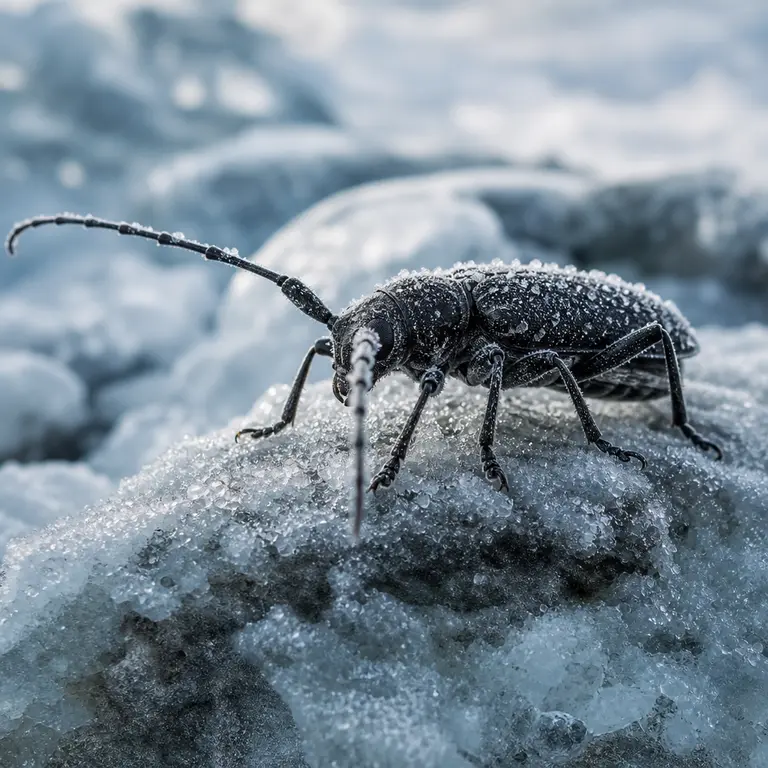
In the boreal forests of Alaska and Siberia, beneath the bark of dead birch trees, a small brown beetle endures winters that would instantly kill most living organisms. Upis ceramboides, a member of the family Cerambycidae, has been documented surviving temperatures as low as -60 degrees Celsius — a thermal extreme that shatters ice crystals inside virtually every other known insect. For decades, researchers assumed it used one of the two standard biological strategies for cold survival: either producing antifreeze proteins that inhibit ice crystal growth, or accumulating glycerol and other small cryoprotectant molecules that lower the freezing point of cellular fluids. In 2009, a team led by biologist Kent Walters at the University of Notre Dame discovered that Upis ceramboides does neither. Its antifreeze agent is a xylomannan glycolipid — a sugar-fat hybrid molecule that had never before been identified as a biological antifreeze in any animal on Earth.
That single discovery quietly rewrote the known inventory of biological antifreeze chemistry. It also raised a set of questions that researchers are still working to answer: how does a molecule derived from plant cell wall sugars end up protecting an insect’s membranes from ice, how does the beetle synthesize or acquire it, and what might it mean for human medicine and the science of preserving living tissues at extreme cold? The story of this overlooked beetle is, in many ways, a story about how much biochemistry remains undiscovered in organisms that have never attracted much scientific glamour.
A Molecule Unlike Any Other
The xylomannan glycolipid found in Upis ceramboides is structurally distinct from the antifreeze proteins documented in Antarctic fish, Arctic beetles, and freeze-tolerant frogs. Those proteins work by adsorbing onto the surfaces of ice crystals and physically blocking their growth — a process called thermal hysteresis. The glycolipid in Upis does not appear to function by the same mechanism. Instead, it seems to integrate into cell membranes and interact with ice in a fundamentally different way, though the precise molecular choreography is still being investigated. What the 2009 study, published in the journal Science, confirmed was that the compound suppressed ice formation in biological tissues at concentrations far below those required by glycerol to achieve comparable protection.
The molecule is composed of a fatty acid chain linked to a polysaccharide backbone rich in xylose, a sugar more commonly associated with plant cell walls than with insect biochemistry. This structural detail is striking on its own terms. Xylose is a pentose sugar that forms the backbone of xylan, one of the most abundant polysaccharides in woody plant tissue. Its appearance in an insect antifreeze compound is not something any biologist would have predicted from first principles. The molecule belongs to the broader class of glycolipids, compounds in which a carbohydrate group is bonded to a lipid, and which are known to play roles in cell membrane structure and signaling across many organisms. But the specific architecture of the Upis xylomannan glycolipid appears to be unique to this beetle, and possibly to a small number of related species that share its extreme overwintering habitat.
This raises a compelling question that researchers have not yet fully answered: Does the beetle synthesize this molecule itself, or does it acquire components from the birch bark microbiome it inhabits? The larval stage of Upis ceramboides is spent inside decaying birch wood, where the beetle feeds on fungal mats colonizing the dead tissue. Fungi are known producers of complex polysaccharides, including xylan-based compounds, which raises the possibility that the beetle’s antifreeze chemistry is partly a product of its microbial environment rather than purely its own genome. If confirmed, that would make the beetle’s cold tolerance a form of extended biochemistry — a trait that depends not just on the organism’s own biosynthetic machinery but on its ecological relationships with other species.
Cold Tolerance as an Evolutionary Arms Race
Upis ceramboides is not the only cold-tolerant insect, but it occupies an extreme end of a spectrum that has fascinated biologists since the mid-twentieth century. The freeze-tolerant wood frog Rana sylvatica, studied extensively by Kenneth Story at Carleton University in Ottawa, survives freezing by flooding its tissues with glucose as a cryoprotectant and tolerating the formation of extracellular ice. The goldenrod gall fly larva, Eurosta solidaginis, another North American cold specialist, uses a combination of glycerol and sorbitol. Antarctic fish of the family Nototheniidae produce antifreeze glycoproteins, first characterized by Arthur DeVries at Stanford in the 1960s. Each of these strategies represents a convergent evolutionary solution to the same thermodynamic problem: water expands when it freezes, and ice crystals rupture cell membranes with lethal efficiency. What makes Upis remarkable is that its solution is chemically novel — a reminder that the catalog of biological antifreeze chemistry is almost certainly incomplete.
The ecological context matters too. Upis ceramboides spends its larval stage inside the wood of dead and dying birch trees, feeding on fungal mats that colonize the decaying wood. The beetle’s overwintering microhabitat beneath bark is slightly buffered from ambient air temperature, but not enough to explain its survival at -60 degrees Celsius. Researchers have noted that the beetle accumulates its glycolipid antifreeze progressively through autumn as temperatures drop, suggesting a seasonally regulated biosynthetic pathway triggered by photoperiod or temperature cues — a form of molecular preparation that mirrors the autumn glycerol accumulation seen in other cold-hardy arthropods.
This seasonal regulation is itself biologically interesting. The capacity to detect shortening days or dropping temperatures and respond by upregulating a specific biosynthetic pathway requires a signaling cascade of considerable sophistication. It implies that the beetle has molecular thermometers or photoperiod sensors that feed into gene expression networks controlling glycolipid production. Understanding those pathways would require detailed transcriptomic and proteomic work that has not yet been published in the open literature, and the beetle remains understudied relative to the biological importance of its capabilities. The evolutionary pressures that produced this chemistry were almost certainly intense: subarctic winters are not marginal stressors but existential ones, and any ancestral beetle that could not survive them left no descendants. The xylomannan glycolipid is, in that sense, a product of millions of years of lethal selection pressure.
Implications for Cryobiology and Medicine
The discovery of the xylomannan glycolipid has attracted interest well beyond entomology. Cryobiology — the science of preserving biological tissues at low temperatures — faces a persistent challenge: conventional cryoprotectants such as dimethyl sulfoxide and glycerol are toxic to human cells at the concentrations required for effective protection. Antifreeze proteins from fish and insects have been tested as additives to preserve donor organs, blood cells, and reproductive tissues, but their production at an industrial scale is expensive, and their toxicity profiles are not fully characterized. A lipid-based antifreeze that integrates into cell membranes rather than flooding the cytoplasm with solutes could offer a fundamentally different approach to the preservation problem. Several research groups have explored the synthesis of structural analogs of the Upis glycolipid for use in organ preservation and the cryogenic storage of stem cells, though no clinical application has yet entered human trials.
The challenge of organ preservation is more urgent than it might appear from outside the medical field. Donor kidneys, livers, and hearts can currently be kept viable for only a matter of hours after removal from a donor, which severely constrains the logistics of transplant medicine and means that many viable organs are discarded because they cannot be transported quickly enough to a compatible recipient. A cryoprotectant compound that could extend that window from hours to days, or that could allow organs to be stored at much lower temperatures without ice-crystal damage, would have an enormous impact on transplant outcomes globally. The fact that a beetle living under birch bark in Alaska has been doing something similar for millions of years makes it an obvious place to look for molecular inspiration.
The beetle also has indirect relevance to astrobiology. One of the central questions in the search for life beyond Earth is whether biochemistry can function at temperatures far below those that support liquid water on the surface. Upis ceramboides demonstrates that complex, regulated biochemistry — including membrane integrity, enzyme function, and seasonal metabolic switching — can persist in organisms that routinely experience temperatures approaching those on the surface of Mars. This does not mean Martian life is plausible, but it expands the empirically documented range of conditions under which Earth life can remain viable, a data point that planetary scientists take seriously when modeling habitability. The beetle’s survival chemistry is a proof of concept for biochemical functionality at thermal extremes, and that concept has value beyond any single application.
The Beetle Nobody Talks About
Despite the significance of the 2009 discovery, Upis ceramboides remains almost entirely absent from popular science coverage. It appears in no major museum exhibit on extreme life, features in no widely read natural history documentary, and is rarely cited outside specialist literature on cryobiology and insect physiology. Part of this obscurity is simply taxonomic: it is a brown beetle of modest size with no dramatic coloration, no venom, and no economic importance as a pest or pollinator. Its habitat — the underside of birch bark in subarctic forests — is not a setting that attracts wildlife photographers or ecotourists.
There is also a broader pattern at work here. The organisms that capture public attention tend to be large, visually striking, or ecologically charismatic. Tardigrades became famous partly because they are microscopically bizarre and can survive vacuum conditions. The wood frog gets occasional press coverage because the idea of a vertebrate freezing solid and thawing back to life is viscerally dramatic. A small brown beetle surviving -60 degrees Celsius through a novel glycolipid chemistry is, to most people, simply not a compelling image, even though the biochemistry involved is arguably more surprising than anything the tardigrade does.
Yet the molecule it produces may be one of the most structurally unusual antifreeze compounds ever characterized in a living organism. Kent Walters and his colleagues at Notre Dame, along with collaborators including John Duman, who has spent decades studying insect cold tolerance, identified the compound using nuclear magnetic resonance spectroscopy and mass spectrometry — tools that were not available to earlier generations of cold-biology researchers. Their work is a reminder that even well-studied ecological niches like subarctic forests continue to yield biochemical surprises, and that the most transformative discoveries in biology sometimes emerge not from exotic rainforests or deep-sea hydrothermal vents, but from the underside of a dead tree in Alaska.
Conclusion
The story of Upis ceramboides is, in miniature, the story of how biology keeps exceeding its own inventory. Every time researchers have felt confident that the major strategies for surviving extreme cold had been cataloged, another organism has produced a chemical solution that did not appear in the existing literature. The xylomannan glycolipid is not a minor variation on a known theme — it is a structurally distinct compound that operates by a mechanism still being characterized, produced by an insect whose biosynthetic relationship with its microbial environment is not yet fully understood, and with potential applications in medicine and materials science that have barely been explored.
The beetle itself asks nothing of us. It has survived Alaskan winters for far longer than our species has existed, and it will likely continue to do so regardless of whether any human ever examines it again. But the questions it raises — about the limits of biochemistry, the origins of novel molecular functions, and the unexplored chemical diversity of organisms we have never thought to study closely — are among the most productive questions in modern biology. The coldest insect on Earth is also, in its quiet way, one of the most instructive.
Sources & Further Reading
- Walters, K.R. et al. A nonprotein thermal hysteresis-producing xylomannan antifreeze in the freeze-tolerant Alaskan beetle Upis ceramboides. Proceedings of the National Academy of Sciences, 2009. https://doi.org/10.1073/pnas.0909872106
- Duman, J.G. Antifreeze and ice nucleator proteins in terrestrial arthropods. Annual Review of Physiology, 2001. https://doi.org/10.1146/annurev.physiol.63.1.327
- Storey, K.B. and Storey, J.M. Freeze tolerance in animals. Physiological Reviews, 1988. https://doi.org/10.1152/physrev.1988.68.1.27
- DeVries, A.L. Glycoproteins as biological antifreeze agents in Antarctic fishes. Science, 1971. https://doi.org/10.1126/science.172.3988.1152