
Giraffes Have the Same Number of Neck Vertebrae as Humans
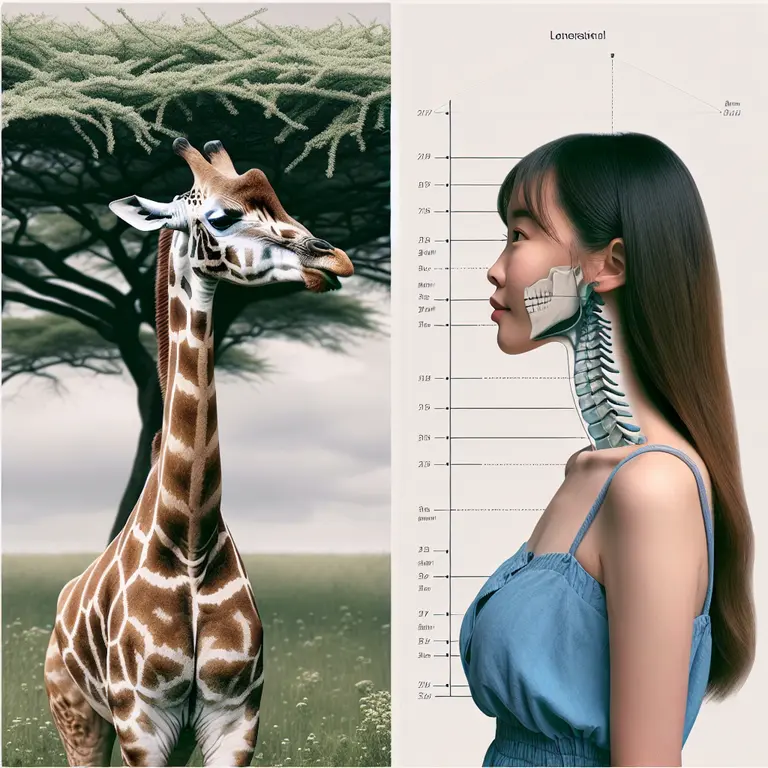
Despite their long necks, giraffes actually possess the same number of neck vertebrae as humans.
 Watch on YouTube
 Watch on Rumble
Introduction
At first glance, one might assume that a giraffe’s exceptionally long neck contains far more bones than a human’s, given the animal’s towering height. The giraffe stands as one of the most visually striking creatures on Earth, its silhouette instantly recognizable against the open skies of the African savanna. Yet beneath that dramatic exterior lies a surprising anatomical truth: like most mammals, giraffes possess exactly seven cervical vertebrae, the same number found in the human neck. What sets giraffes apart is not the count of these bones, but their extraordinary size. In giraffes, each cervical vertebra can measure over ten inches in length, while human cervical vertebrae typically span only about one inch. This single difference in scale, rather than any fundamental change in skeletal architecture, accounts for one of nature’s most iconic features. Understanding why this is the case opens a window into the deeper logic of evolution, physiology, and the remarkable efficiency of biological design.
A Shared Blueprint Across Mammals
The fact that both humans and giraffes share seven cervical vertebrae is not a coincidence. It reflects one of the most consistent patterns in vertebrate biology. With very few exceptions, nearly all mammals, from mice to whales to humans to giraffes, share this same cervical count. The exceptions are rare and notable precisely because they break such a firmly established rule. Manatees and two-toed sloths are among the only mammals known to deviate from this pattern, possessing six and five or six cervical vertebrae, respectively, depending on the species.
This consistency points to a deep evolutionary constraint. The seven-vertebrae arrangement appears to have been locked in early in mammalian evolution, and natural selection has since worked around it rather than through it. Rather than adding or removing vertebrae to produce longer or shorter necks, evolution has instead modified the size, shape, and density of the existing bones. In the giraffe’s case, this modification has been taken to a remarkable extreme. The cervical vertebrae of a fully grown giraffe can each reach lengths exceeding ten inches, and the neck as a whole can stretch up to six feet. This is achieved entirely within the same seven-bone framework that supports the human head.
This shared blueprint is a concept biologists refer to when discussing homologous structures, anatomical features that are similar in different species because they share a common evolutionary origin. The cervical vertebrae of a giraffe and a human are homologous in this sense. They are built from the same ancestral design, serving the same fundamental purpose of supporting and mobilizing the head, yet they have diverged dramatically in their proportions to suit entirely different lifestyles.
The Mechanics of an Elongated Neck
Despite their extraordinary length, a giraffe’s cervical vertebrae retain much of the same basic structure and function found in other mammals. The vertebrae are connected by flexible joints that allow a considerable range of motion, enabling the giraffe to turn, tilt, and extend its head with surprising agility. However, supporting a neck that can weigh up to 600 pounds requires more than just strong bones. Giraffes have developed a suite of specialized adaptations to manage this structural challenge without expending unnecessary energy.
Chief among these is the nuchal ligament, an unusually large and robust band of elastic tissue that runs along the back of the neck. This ligament acts somewhat like a passive suspension system, holding the neck upright and reducing the muscular effort required to keep the head elevated. Humans possess a version of this ligament as well, though far less developed. In giraffes, it is massive and dense, functioning almost like a biological bungee cord that stores and releases energy as the neck moves. Without it, the muscles alone would be insufficient to sustain the giraffe’s posture for any meaningful length of time.
The vertebrae themselves have also been modified beyond simple elongation. They are reinforced by denser bone tissue and articulate with one another through joints capable of bearing substantial compressive loads. The muscles surrounding the neck are correspondingly powerful, though the nuchal ligament does much of the passive work. Together, these adaptations create a system that is mechanically efficient, allowing the giraffe to maintain its posture with relatively little ongoing effort despite the enormous forces involved.
The Cardiovascular Challenge of Height
The elongated neck of a giraffe raises equally fascinating questions about its cardiovascular system. When the head of a fully grown giraffe is held high, the brain can sit as much as eight to nine feet above the heart. Pumping blood to that elevation requires considerable force, and the giraffe’s heart has evolved accordingly. It is exceptionally large and muscular, weighing around 25 pounds and generating blood pressure roughly twice that found in humans. This powerful pump reliably and consistently drives blood upward through the long arterial column of the neck to reach the brain.
However, height introduces a second and equally dangerous problem. When a giraffe bends down to drink water, the head drops dramatically, sometimes falling below the level of the heart. Without compensatory mechanisms, this sudden shift could cause a dangerous surge of blood pressure in the brain, potentially leading to hemorrhage or loss of consciousness. Giraffes have evolved a remarkable set of solutions to this problem. A network of small blood vessels at the base of the brain, known as the rete mirabile, acts as a pressure-regulating system, absorbing and buffering sudden increases in blood flow. Additionally, specialized valves in the jugular veins prevent blood from flowing backward under gravity when the head is lowered.
Giraffes also adopt a characteristic wide-legged stance when drinking, splaying their front legs outward to lower their body closer to the water source. This posture reduces the vertical distance the head must travel, partially mitigating the cardiovascular stress involved. The entire system represents a carefully balanced set of adaptations, each one compensating for a challenge introduced by the animal’s extraordinary proportions.
Evolutionary Advantage and Ongoing Debate
The giraffe’s elongated neck is most commonly explained as an adaptation for feeding, allowing the animal to access leaves and vegetation high in the canopy of acacia trees, food sources that shorter herbivores simply cannot reach. This explanation has intuitive appeal and considerable supporting evidence. Giraffes do indeed feed at heights unavailable to most other savanna animals, and their long necks give them a competitive advantage during periods when lower vegetation is scarce or heavily browsed.
However, researchers have also proposed that sexual selection played a significant role in the neck’s evolution. Male giraffes engage in a behavior called necking, in which they swing their long necks and use their heads as weapons to strike opponents during competition for mates. Studies have shown that males with longer, heavier necks tend to win these contests more often and father more offspring. This raises the possibility that the giraffe’s neck evolved at least partly as a result of competition between males, rather than purely as a feeding adaptation.
The two explanations are not mutually exclusive. Evolution rarely optimizes a single trait for a single purpose, and the giraffe’s neck may well have been shaped by both feeding pressures and sexual competition acting simultaneously over millions of years. What is clear is that the elongation of those seven cervical vertebrae has proven to be one of the most successful morphological experiments in mammalian history.
Conclusion
The giraffe’s neck stands as one of evolution’s most compelling demonstrations of what can be achieved by modifying scale rather than structure. By elongating the same seven cervical vertebrae found in nearly every other mammal, including humans, the giraffe has built a biological system of remarkable complexity and efficiency. Its skeleton, musculature, ligaments, and cardiovascular system have all been reshaped around this central adaptation, producing an animal that is simultaneously familiar in its blueprint and extraordinary in its execution. The shared vertebral count between giraffes and humans is more than a curious fact. It is a reminder that evolution is fundamentally conservative, working with existing designs and pushing them to their limits rather than inventing entirely new ones. In the giraffe, those limits have been stretched quite literally to new heights.