
Rats' Mass Drowning Acts as Survival Strategy for the Colony
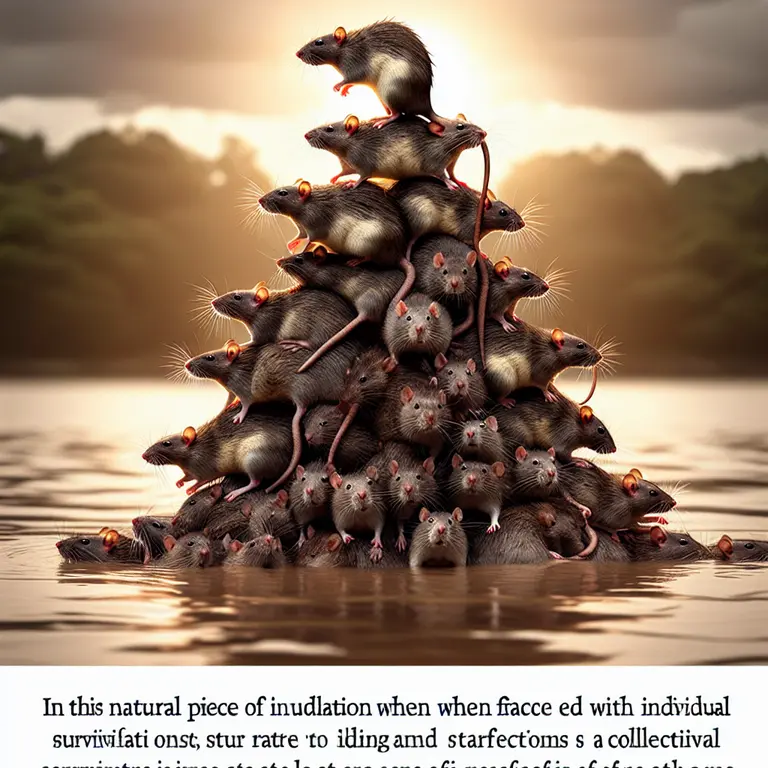
Rats form clusters called "rat kings" during floods, huddling together for warmth and buoyancy, showcasing their remarkable survival instincts and adaptive behavior.
 Watch on YouTube
 Watch on Rumble
When Rats Cluster to Survive: The Strange Science of Rat Kings and Flood Behavior
Few creatures on Earth have earned as complicated a reputation as the rat. Reviled for centuries as harbingers of disease, destroyers of grain stores, and unwelcome residents of human cities, rats have nonetheless persisted and thrived across nearly every continent and climate. Much of their success comes down to an extraordinary capacity for adaptation, one that reveals itself most dramatically under conditions of extreme environmental stress. Among the most fascinating and least understood of these adaptive behaviors is what happens when rats face rising floodwaters. Their response, clustering together in dense, sometimes permanently entangled groups, challenges simple assumptions about animal behavior and raises profound questions about the line between instinct and something that might cautiously be called collective intelligence.
The Phenomenon Known as Rat Kings
The term rat king refers to a grouping of rats whose tails have become knotted, tangled, or fused together, leaving the animals physically bound to one another. The name itself is thought to derive from a German folk concept, Rattenkönig, which imagined the entangled mass as a kind of royalty served by the surrounding colony. While the folklore surrounding the phenomenon is vivid and often gruesome, the biological reality is no less striking.
Rat kings have been documented across several centuries and in multiple countries, with the majority of verified specimens originating in Europe, particularly in Germany and Scandinavia. The rats most commonly involved are black rats (Rattus rattus), which historically lived in close proximity to humans in attics, barns, and granaries. These tight living conditions, combined with exposure to cold temperatures, sticky substances like tree resin or frozen waste, and the general chaos of flooding or structural collapse, created the conditions under which tails could become irreversibly tangled.
What makes rat kings particularly compelling from a scientific standpoint is that the animals in such a formation often continue to live for some time after becoming entangled. Researchers examining preserved specimens have found healed scar tissue around the tails, suggesting that the rats did not die immediately upon entanglement but survived long enough for biological repair processes to begin. This implies that the surrounding colony may have continued to feed and support the entangled individuals, a behavior that suggests a degree of social cohesion many people do not associate with rodents.
Flooding, Clustering, and the Logic of Collective Survival
While rat kings represent the more dramatic and permanent end of clustering behavior, the broader phenomenon of rats huddling together during floods is both more common and more clearly understood. When floodwaters rise, rats face a convergence of threats: hypothermia from cold water, exhaustion from sustained swimming, and exposure to predators who exploit the chaos of a flood to hunt. In response, rats instinctively gather into tight groups, piling onto one another to conserve heat, reduce individual exposure to water, and form a floating or elevated mass that keeps more animals alive longer.
This behavior has been observed in urban flooding events, where rat populations displaced from their underground tunnel systems are forced to the surface and into open water. The rats that find themselves on the outer edges or the bottom of such a cluster face the greatest risk, as they bear the physical burden of supporting those above them and are most exposed to cold and predation. In some documented cases, the rats at the base of such formations do not survive, effectively sacrificing their own lives to extend the survival window for others in the group.
Whether this constitutes genuine altruism in any meaningful sense is a question that biologists approach with caution. Most researchers prefer to describe the behavior in terms of evolutionary advantage rather than conscious self-sacrifice. Groups that cluster effectively produce more survivors, and those survivors carry forward the genetic and behavioral tendencies that enabled clustering. Over generations, this creates a population that defaults to collective behavior under stress, not because individual rats are making moral decisions, but because the behavior itself has been selected for by the pressures of survival.
Historical Records and Preserved Evidence
One of the most significant historical specimens of a rat king was discovered in 1828 in Buchheim, Germany. This particular formation consisted of 32 rats whose tails had fused together due to frozen excrement and physical entanglement. The specimen was preserved and is still held in the Mauritianum Museum in Altenburg, Germany, where it remains one of the most visited and discussed objects in the collection. Its preservation has allowed researchers over the years to study the animals' physical condition, the nature of the entanglement, and the likely circumstances under which it formed.
Other notable specimens have been found in the Netherlands, France, and across Scandinavia, with the oldest credible written accounts dating to the sixteenth century. Some historians of natural science have suggested that rat kings may have been more common in earlier centuries when black rats lived in far greater numbers in close contact with humans, and when the cold stone floors and walls of medieval buildings created ideal conditions for tail entanglement. As brown rats, or Rattus norvegicus, gradually displaced black rats across much of Europe beginning in the eighteenth century, the conditions for rat king formation may have become less common, since brown rats tend to burrow rather than nest in elevated, enclosed spaces.
Scientific Perspectives and Evolutionary Context
Ken Catania, a neuroscientist at Vanderbilt University, has contributed significantly to the understanding of how mammals respond to stress and danger through collective behavior. His research on sensory systems in small mammals, including rats and moles, has illuminated how these animals process environmental information and coordinate responses with others of their kind. His broader findings support the view that clustering under conditions of extreme stress is a deeply embedded mammalian instinct, one that appears across many species and contexts, from huddling penguins on Antarctic ice to primate groups responding to predator threats.
From an evolutionary perspective, the clustering behavior of rats fits within a well-established framework of kin selection and group survival strategies. Rats are highly social animals that live in structured colonies with recognizable hierarchies and long-term social bonds. Their response to flooding is not random or chaotic but reflects an underlying social architecture that activates under pressure. The colony, in effect, becomes a single adaptive unit, pooling resources and risks in ways that maximize the number of survivors even at the cost of some individuals.
Climate Change and the Future of Flood Behavior
Modern accounts of dramatic rat clustering during floods have become more frequent in recent decades, a trend that researchers and urban wildlife managers attribute at least in part to the increasing frequency and severity of flooding events associated with climate change. Cities like New York, Jakarta, and Mumbai, which have large and well-established rat populations living in extensive underground infrastructure, have reported unusual surface behavior during major flood events, including large groups of rats moving together through streets and gathering on elevated surfaces.
As extreme weather becomes more common, understanding how rat populations respond to flooding has practical implications beyond the purely scientific. Rats displaced by floods can carry disease, damage infrastructure, and create new population pressures in areas where they were not previously established. Knowing that their behavior under these conditions is governed by specific biological imperatives rather than randomness allows urban planners and public health officials to anticipate and manage these movements more effectively.
Conclusion
The behavior of rats during flooding, whether expressed through the temporary clustering of a frightened colony or the permanent entanglement of a rat king, offers a window into the deep logic of survival that underlies animal life. These creatures, so often reduced in the popular imagination to symbols of filth or danger, reveal under pressure a complexity of social behavior that commands genuine scientific attention. Their capacity to adapt, to pool resources, and to endure conditions that would overwhelm less socially organized animals is a testament to the power of evolutionary pressure over time. In studying what rats do when the water rises, researchers find not just curiosity but insight into the fundamental mechanisms that allow life to persist against extraordinary odds.