
The Blazing Fast Eating Speed of the Star-Nosed Mole
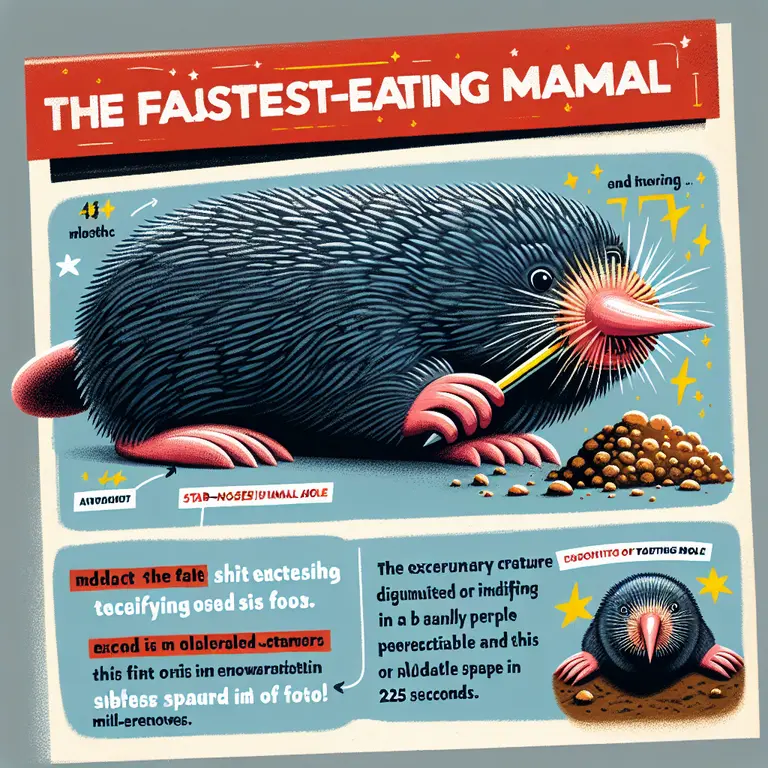
The star-nosed mole, with 22 sensitive tentacles, identifies and eats food in 225 milliseconds, making it the fastest-eating mammal and a marvel of evolution.
 Watch on YouTube
 Watch on Rumble
The Star-Nosed Mole: Nature’s Fastest Eater and Its Remarkable Sensory World
In the fringes of nature, some creatures have evolved with unique capabilities that offer exceptional advantages over their competitors. Evolution, operating across millions of years and countless generations, has produced organisms so specialized that they seem almost impossible by ordinary biological standards. One such creature is the Condylura cristata, commonly known as the star-nosed mole. This small, semi-aquatic mammal has gained significant prominence in scientific circles due to its unparalleled eating speed and extraordinary sensory apparatus. The star-nosed mole can identify and consume small pieces of food in an average time of about 225 milliseconds, far faster than a human eye blink, which typically lasts between 300 and 400 milliseconds. In a world where survival often depends on the narrowest of margins, the star-nosed mole has evolved into one of the most efficient predators relative to its size ever documented by science.
A Face Unlike Any Other: The Anatomy of the Star Nose
The star-nosed mole gets its name from its most visually striking feature: a circle of 22 pink, fleshy tentacles arranged symmetrically at the end of its snout, resembling a biological star. At first glance, this structure might appear to be an evolutionary curiosity or even a disadvantage, drawing unnecessary attention in an environment full of predators. In reality, this star is one of the most sophisticated and sensitive touch organs found anywhere in the mammalian world. It comprises over 100,000 nerve fibers packed into an area roughly the size of a human fingertip, which is double the number of nerve fibers found in an entire human hand.
Each of the 22 tentacles is covered in tiny sensory receptors known as Eimer’s organs. These microscopic structures, first described in the nineteenth century by the German zoologist Theodor Eimer, are found in many mole species, but the star-nosed mole possesses them in extraordinary abundance. While a common European mole might have around 1,500 Eimer’s organs distributed across its snout, the star-nosed mole carries approximately 25,000 of them concentrated within its 22 tentacles. This concentration allows the mole to gather a staggering amount of tactile information from its environment almost instantaneously.
What makes the star even more remarkable is how it is represented in the mole’s brain. Neuroscientists have mapped the somatosensory cortex of the star-nosed mole and discovered that the two smallest tentacles at the bottom of the star, which account for only a tiny fraction of the star’s total surface area, take up a disproportionately large portion of the brain’s sensory processing real estate. This region, sometimes called the star-nosed mole’s fovea by analogy with the high-resolution center of the human eye, functions as the animal’s primary tool for close inspection of potential food items. The mole first touches objects with its outer tentacles, then moves the item toward its central tentacles for a final, high-resolution assessment.
Speed, Sensitivity, and the Science Behind the Fastest Eater
The astonishing feeding speed of the star-nosed mole was rigorously documented in experiments led by biologist Kenneth Catania at Vanderbilt University, with the findings published in the prestigious journal Nature in 2005. Using high-speed video recordings that capture motion far beyond what the human eye can perceive, Catania revealed in precise detail how this peculiar mammal navigates its sensory world. The recordings showed that the mole uses its star tentacles to feel out an object and decide whether it is edible in as little as eight milliseconds. Within the next 9 milliseconds, the mole positions its nostrils around the object to detect its scent, adding chemical confirmation to the tactile assessment already completed. If the object passes both tests and is determined to be consumable, the mole ingests it within a timeframe that leaves human observers barely able to register what has occurred.
Catania’s research also revealed something counterintuitive about the mole’s decision-making process. Despite operating at such extreme speeds, the animal does not simply consume everything it touches. It makes genuine discriminations between edible and inedible objects, rejecting unsuitable items with the same efficiency it uses to consume suitable ones. This means the speed is not the result of indiscriminate behavior but of a sensory and neural system that has been refined to process complex information at a rate that challenges our assumptions about the limits of biological computation. The star-nosed mole essentially runs a rapid-fire quality-control operation, touching dozens of objects per second underground and making accurate judgments about each one.
Catania has also drawn a compelling comparison between the star-nosed mole’s tactile system and the visual system of primates. Just as humans and other primates use rapid eye movements called saccades to direct the high-resolution fovea toward objects of interest, the star-nosed mole uses rapid movements of its star to direct its most sensitive tentacles toward objects that its outer tentacles have flagged as potentially interesting. This parallel suggests that evolution has independently arrived at similar organizational strategies for sensory efficiency across dramatically different biological systems, a concept known as convergent evolution.
Survival in a Demanding Environment
Scientists believe this rapid feeding habit is directly tied to the star-nosed mole’s survival in some of North America’s most demanding habitats. These animals inhabit the wet, low-lying soils and marshlands of eastern Canada and the northeastern United States, environments that are rich in invertebrate prey but also highly competitive and physically challenging. Unlike many burrowing mammals that live in dry, stable tunnels, the star-nosed mole frequently forages underwater, using its star to probe the muddy beds of streams and wetlands for aquatic insects, small crustaceans, and worms. The ability to assess and consume prey quickly is, therefore, not merely convenient but essential, as each moment spent foraging in cold water represents an energetic cost the animal must offset with caloric gain.
The rapid feeding ability also maximizes the mole’s chances of exploiting fleeting opportunities in unpredictable environments. Underground food sources are unevenly distributed, and a mole that hesitates risks losing a prey item to water movement, the escape of a living organism, or interference from a competitor. By compressing the identification-to-consumption cycle into a fraction of a second, the star-nosed mole converts every viable encounter into a reliable meal with a consistency that slower-feeding animals simply cannot match. This efficiency is thought to be one of the key reasons the species has remained largely unchanged for millions of years, a testament to how completely its adaptations suit its ecological niche.
Conclusion
The star-nosed mole stands as one of evolution’s most instructive achievements, combining anatomical strangeness with functional brilliance in a way that continues to surprise researchers decades after its initial scientific documentation. Its exceptional sensory system and rapid feeding capabilities have significantly expanded our understanding of how nervous systems can be organized and optimized for specific environmental pressures. The work of Kenneth Catania and others in this field has not only illuminated the biology of a single obscure species but has also provided broader insights into mammalian sensory processing, neural mapping, and the evolutionary logic behind extreme specialization. The star-nosed mole reminds us that nature’s most remarkable innovations are often hiding in the most unexpected places, beneath the soil and mud of an ordinary wetland, operating at speeds the human eye cannot even follow.