
Pyura Chilensis: The Bizarre 'Living Rock' of Chile and Peru
Pyura chilensis is a sessile sea creature that looks exactly like a rock, reproduces alone, and pumps blood loaded with a rare metal almost unknown in biology.
 Watch on YouTube
 Watch on Rumble
The Thing That Sits on the Shore and Defies Classification
On the rocky coastlines of Chile and Peru, fishermen have been cracking open what appear to be ordinary boulders for centuries. Inside, they find something that looks disturbingly like raw organ meat — red, fleshy, and unmistakably alive. The creature is Pyura chilensis, a tunicate sometimes called the living rock, and it is one of the most biologically improbable animals on Earth. It is not a plant, not a fungus, and not a mollusk. It is, taxonomically speaking, closer to a vertebrate than to an oyster, which makes its existence all the more disorienting to anyone encountering it for the first time.
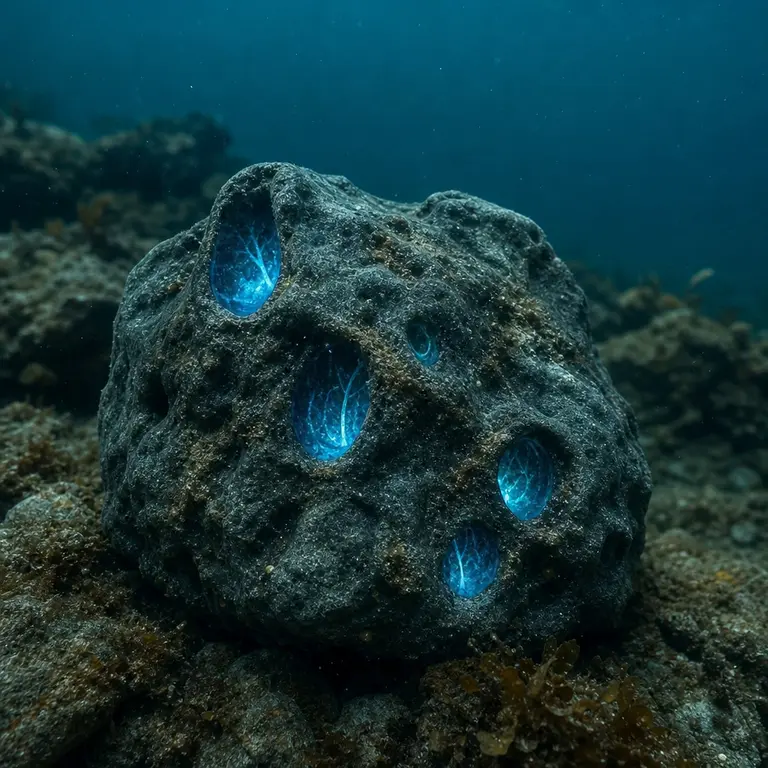
Most people who stumble across Pyura chilensis on a beach assume they have found a geological formation. The outer surface is encrusted with sediment, algae, barnacles, and the debris of a life spent pressed against rock in the intertidal zone. Nothing about the exterior suggests biology. But the interior is another matter entirely. Cracking open the calcified tunic reveals chambers of vivid red tissue, glistening and unmistakably animal, surrounded by a fluid that changes color when exposed to air. The experience has been described by marine biologists as one of those rare moments when the natural world refuses to behave as expected.
An Unlikely Relative: The Evolutionary Position of Tunicates
Pyura chilensis belongs to the class Ascidiacea, a group of filter-feeding invertebrates that anchor themselves to hard surfaces and spend their adult lives completely immobile. They draw water in through one siphon, filter out microscopic food particles, and expel the filtered water through a second siphon. The process is efficient and entirely passive, requiring no locomotion, no active hunting, and no apparent awareness of the surrounding environment. In behavioral terms, the adult tunicate is about as far from a vertebrate as an animal can get.
And yet, taxonomy tells a different story. The larvae of tunicates are free-swimming and possess a notochord, which is the primitive precursor to a spine. This structure places tunicates firmly within the phylum Chordata, alongside fish, amphibians, reptiles, birds, and mammals. The implications of this classification are genuinely strange. The bleeding rock anchored to a Chilean beach shares a deeper evolutionary lineage with you than it does with a clam, an oyster, or a sea urchin. When the tunicate larva settles onto a rock and undergoes metamorphosis into its sessile adult form, it actually reabsorbs its own notochord and loses the very structure that defines its place in the tree of life. It essentially abandons its vertebrate credentials and spends the rest of its existence as something that looks, from the outside, like geology.
This metamorphic transformation has fascinated developmental biologists for decades. The tunicate larva is considered one of the most useful model organisms for studying the evolutionary origins of the vertebrate body plan precisely because it shows, in compressed form, the transition from a mobile, notochord-bearing ancestor to a sessile filter feeder. Understanding how and why this transformation occurs at the molecular level has contributed meaningfully to broader questions about vertebrate evolution.
Vanadium in the Blood: A Metal Almost Nowhere Else in Biology
What truly separates Pyura chilensis from almost every other organism on the planet is the fluid that flows through its body. The creature produces a blood-like fluid called hemovanadin, which contains extraordinarily high concentrations of vanadium, a rare transition metal that plays almost no role in the biochemistry of any other known animal. The vanadium concentration in Pyura chilensis tissue can reach levels up to ten million times greater than the vanadium found in the surrounding seawater. To put that figure in perspective, the animal is not merely accumulating a trace element. It is performing a feat of biological concentration that has no clear parallel in the animal kingdom.
Scientists do not fully understand why this creature accumulates vanadium at such extreme levels. Hemovanadin does not transport oxygen the way hemoglobin does in mammals or hemocyanin does in crustaceans. Its precise biological function remains a subject of active research and genuine scientific debate. Some hypotheses suggest it plays a role in defense against predators or microbial infection, since vanadium compounds can be toxic to many organisms. Others propose that it may assist in structural integrity, helping to maintain the firmness of the tunic, or that it acts as a chemical deterrent against fouling organisms that might otherwise colonize the tunicate’s surface and compete for space and resources.
What is confirmed is that when the animal is cut, the fluid that emerges turns a vivid blue-green color upon contact with air, a reaction caused by the oxidation of vanadium compounds. This color change is not a gradual shift but a rapid and striking transformation that has startled many an unsuspecting beachcomber who cracked open what they assumed was a rock. The vanadium-binding proteins responsible for this chemistry are structurally unlike anything found in other animal blood proteins, which has made them a subject of interest in biochemistry and materials science. Researchers studying how biological systems handle and concentrate metals have identified hemovanadin as a potential template for understanding metal sequestration mechanisms, with potential applications in industrial chemistry and environmental remediation.
Hermaphroditism and the Problem of Lonely Reproduction
Pyura chilensis is a simultaneous hermaphrodite, meaning each individual produces both eggs and sperm at the same time. When two individuals are in close proximity, they release their gametes into the water column and cross-fertilize. This is the preferred reproductive strategy, as cross-fertilization maximizes genetic diversity and reduces the expression of harmful recessive traits in offspring. But when a single specimen is isolated, which happens frequently because these animals attach themselves to scattered rocks along exposed coastlines, it can self-fertilize. This makes Pyura chilensis one of the relatively few animals capable of reproducing entirely on their own, without any genetic contribution from another individual.
Self-fertilization in animals carries significant genetic risks. The primary concern is inbreeding depression, a phenomenon in which harmful recessive alleles that would normally be masked by dominant versions from a second parent are instead expressed at higher rates in offspring. Over successive generations, isolated self-fertilizing populations tend to accumulate genetic defects and lose the adaptive flexibility conferred by recombination between genetically distinct individuals. Research published in marine biology journals has confirmed that Pyura chilensis does exhibit reduced genetic diversity in isolated populations compared to dense aggregations, suggesting the evolutionary cost of solitary reproduction is measurable and real.
Nevertheless, the strategy works well enough that the species thrives across thousands of kilometers of Pacific coastline. Dense colonies can form when larvae settle near existing adults, creating clusters of dozens or hundreds of individuals that look, from a distance, like nothing more than an unusual reef formation. These aggregations benefit from cross-fertilization and show markedly higher genetic variability than isolated individuals. The population structure of Pyura chilensis is therefore somewhat unusual, existing on a spectrum between genetically impoverished isolated individuals and relatively diverse communal clusters, with the balance between these two states shifting depending on larval dispersal patterns and local oceanographic conditions.
From Eerie Biology to the Dinner Table
Despite its alien appearance and peculiar chemistry, Pyura chilensis is a traditional food in Chile, where it is known locally as piure. It is eaten raw, sometimes accompanied by lemon juice and coriander, or incorporated into stews, rice dishes, and empanadas. The flavor has been described by those who have eaten it as intensely bitter, extremely salty, and strongly iodine-forward, with a mineral quality that lingers long after the meal is finished. Chilean food writers have noted that its flavor profile is unlike that of any other seafood, which makes sense given its biochemistry. For coastal communities in northern Chile and parts of Peru, it is not an exotic novelty but an ordinary ingredient, available at fish markets and prepared in home kitchens with the same casualness that other cultures bring to oysters or mussels.
The vanadium content in consumed tissue has raised occasional questions among toxicologists, since vanadium is toxic to mammals at high doses. However, studies examining the dietary exposure of coastal Chilean communities have not identified clinical vanadium toxicity as a public health concern. This is likely because the quantities consumed in normal dietary patterns remain well below harmful thresholds, and because cooking processes may reduce the bioavailability of vanadium compounds. The broader scientific community has recently shown renewed interest in Pyura chilensis not just as a culinary curiosity but as a potential source of novel bioactive compounds. Its unique vanadium-binding proteins and unusual secondary metabolites are being examined for possible pharmaceutical applications, particularly in antimicrobial resistance research, where the discovery of novel chemical structures is considered urgent. The same biochemical strangeness that makes the animal so difficult to classify may ultimately make it useful in ways that extend far beyond its traditional role as a regional delicacy.
Why This Animal Matters Now
The renewed scientific attention to Pyura chilensis comes at a time when marine biodiversity is under severe pressure from ocean warming, acidification, and coastal development. Tunicates as a group are known to be sensitive indicators of water quality and temperature shifts. Some species are invasive and spreading rapidly into new habitats as ocean temperatures rise, colonizing regions where they were previously absent and disrupting established ecological communities. Others, like Pyura chilensis, are highly localized and could be vulnerable to environmental disruption in ways that are not yet fully mapped. The intertidal zone where Pyura chilensis lives is one of the most thermally variable and physically demanding habitats on Earth, and organisms adapted to its specific conditions may have limited capacity to adjust if those conditions shift substantially.
Beyond conservation concerns, the creature raises a philosophical question about the limits of intuitive biology. It looks like a rock. It bleeds an impossible color. It can reproduce with no partner. It is more closely related to a human being than to a snail. And it has been sitting on South American beaches, quietly accumulating one of the rarest metals in biochemistry, for millions of years, largely unnoticed by science until very recently. In an era when researchers are increasingly turning to extreme and unusual organisms for inspiration in materials science, drug development, and synthetic biology, Pyura chilensis is exactly the kind of creature that rewards sustained attention. The fisherman who cracks it open looking for food and the biochemist who sequences its proteins are both, in their own way, responding to the same provocation: the unsettling realization that something this strange has been hiding in plain sight all along.