
The Curious Case of Tequila and Its Blue Agave Connection
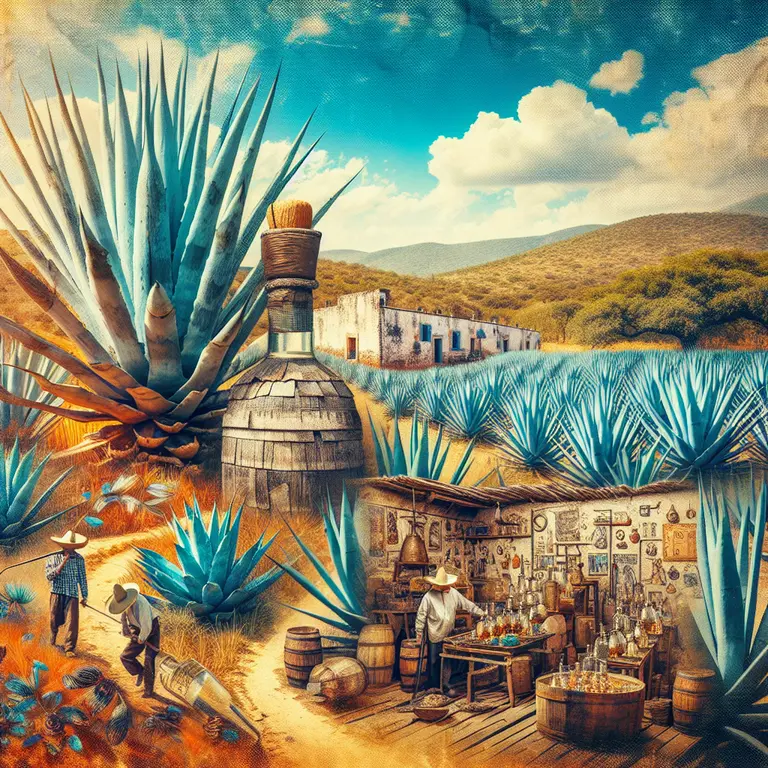
Tequila, the popular alcoholic beverage, is uniquely tied to a very specific plant, the Blue Agave, and its history is riddled with fascinating intricacies.
 Watch on YouTube
 Watch on Rumble
Tequila and the Blue Agave: A Spirit Rooted in Centuries of Culture and Agriculture
Tequila is one of the most recognized spirits in the world, pouring freely at celebrations from Mexico City to Manhattan. Whether downed in a salt-rimmed shot or sipped slowly in a well-crafted cocktail, it carries with it a reputation for festivity and social ritual. Yet beneath the familiar clink of glasses lies a far more complex story — one that stretches back centuries, winds through volcanic highlands, and depends almost entirely on a single, slow-growing plant. The Blue Agave is not merely an ingredient in tequila; it is the biological, cultural, and economic foundation upon which the entire industry stands. To understand tequila is to understand this plant, the people who cultivate it, and the delicate balance between tradition and modernity that defines its production today.
Historical Background
The story of tequila does not begin with distilleries or export markets. It begins with the Aztecs, who long before Spanish colonization had developed a sophisticated relationship with the agave plant. From its fermented sap, they produced pulque, a thick, milky, mildly alcoholic beverage that occupied a sacred place in Mesoamerican religious and social life. Pulque was not simply a drink — it was an offering, a ritual substance consumed during ceremonies honoring the gods, and its production was carefully regulated within Aztec society. Excessive or unsanctioned consumption was, in some periods, punishable by death.
When Spanish conquistadors arrived in the sixteenth century, they brought with them the technology of distillation, a process unknown in pre-Columbian Mesoamerica. Applying this technique to fermented agave juice, they produced a far stronger and more shelf-stable spirit known as mezcal. The word itself derives from the Nahuatl term meaning “cooked agave,” a reference to the process of roasting the plant’s core before fermentation. For centuries, mezcal was produced across wide regions of Mexico using dozens of different agave species, each imparting its own flavor and character.
Over time, a particular variety of mezcal produced in and around the town of Tequila in the state of Jalisco began to attract special attention. Made exclusively from the Blue Weber Agave and benefiting from the region’s unique volcanic soil and climate, this spirit developed qualities that set it apart from other mezcals. By the late nineteenth century, large-scale commercial production had begun, and by the twentieth century, tequila had secured its own legal identity, separate from mezcal, with formal protections and international recognition. What had once been a regional craft had become a global industry.
The Significance of Blue Agave
The Blue Agave, known formally as Agave tequilana Weber, is not simply the preferred raw material for tequila — it is the only legally permitted one. Under Mexican law, specifically the official standard NOM-006-SCFI-2012, tequila must be produced from Blue Weber Agave grown within designated geographic zones. These zones include the entirety of Jalisco and selected municipalities in four other states: Guanajuato, Michoacan, Nayarit, and Tamaulipas. This designation is not arbitrary. It reflects the scientific and sensory reality that the volcanic red clay soils of these regions, particularly the highlands and lowlands of Jalisco, produce Blue Agave with a distinctive sugar profile and aromatic complexity that cannot be replicated elsewhere.
The plant itself is a remarkable organism. A member of the Asparagaceae family — more closely related to asparagus than to the cacti it superficially resembles — the Blue Agave spends most of its life accumulating sugars in its core, known as the pina due to its resemblance to a pineapple. These sugars, primarily fructans rather than the simpler sugars found in most fermentable crops, must be converted through cooking before yeast can act upon them. The result is a fermentable juice with a flavor complexity that reflects both the plant’s biology and its environment in ways no artificial substitute can replicate.
The legal protection surrounding Blue Agave also serves a cultural purpose. It ties tequila irrevocably to a specific place and people, functioning similarly to the appellation controls that govern Champagne or Scotch whisky. This geographic and botanical exclusivity has helped preserve traditional production knowledge across generations, even as the industry has scaled dramatically to meet global demand.
Cultivation and Harvesting
Growing Blue Agave is an exercise in patience that few modern agricultural industries can match. From planting to harvest, a single agave plant requires between seven and ten years of careful tending before it is ready to be processed. During this time, farmers known as jimadores must monitor the plants for disease, manage competing vegetation, and make ongoing decisions about which plants to propagate and which to cull. The work is physically demanding and requires a depth of botanical knowledge that is typically passed down through families over generations.
Harvesting itself is performed almost entirely by hand. When a plant reaches maturity, the jimador uses a specialized circular blade called a coa to strip away the long, spiny leaves, exposing the pina beneath. A single pina can weigh anywhere from 40 to 200 pounds, and harvesting requires both precision and strength. The timing of the harvest is critical — cut too early, and the plant will not have accumulated sufficient sugars; cut too late, and the plant may have already sent up its flowering stalk, diverting its energy away from the pina and dramatically reducing its fermentable sugar content.
This long production cycle creates economic pressures that are unlike those faced by producers of annual crops. A farmer planting agave today is making a bet on what the market will look like a decade from now. When global demand for tequila surged in the 1990s and again in the 2010s, the industry faced severe agave shortages because the supply pipeline could not respond quickly enough. Conversely, periods of overplanting have led to dramatic price crashes that devastated farming communities. Managing this inherent volatility remains one of the central challenges of the industry.
Biodiversity Risks and Sustainability Concerns
Perhaps the most underappreciated threat facing tequila production is the biological vulnerability created by monoculture farming. The vast majority of Blue Agave plants cultivated today are propagated vegetatively — that is, through offshoots called hijuelos rather than through seeds. This means that the plants in any given field are genetically identical to one another and to the plants in neighboring fields across the region. While this uniformity ensures consistency of flavor and sugar content, it also means that the entire crop base shares the same genetic weaknesses.
The danger this poses became starkly apparent in the late twentieth century when a combination of fungal disease and bacterial infections devastated agave crops across Jalisco. Because the plants were genetic clones, a pathogen that infected one could infect all. The episode drew uncomfortable comparisons to the Gros Michel banana, a variety that dominated global markets until the 1950s, when it was virtually wiped out by a fungal disease, forcing the industry to switch to the Cavendish variety still sold today. Some researchers have warned that without deliberate efforts to reintroduce genetic diversity into Blue Agave cultivation, tequila could face a similarly catastrophic reckoning.
Sustainability concerns extend beyond disease risk. The harvesting of wild agave for artisanal mezcal production has raised concerns about the depletion of native populations, and even within the tequila industry, questions persist about water usage, soil health, and the long-term viability of current farming practices. A growing number of producers are now working with agronomists and conservation organizations to develop more ecologically sound cultivation methods, including the reintroduction of seed-based propagation and the preservation of agave genetic diversity in dedicated seed banks. These efforts represent a meaningful, if still nascent, attempt to reconcile industrial scale with ecological responsibility.
Conclusion
Tequila is far more than a party staple or a cocktail ingredient. It is the living product of a relationship between people and a plant that spans centuries, shaped by indigenous ritual, colonial transformation, legal protection, and the pressures of a globalized economy. The Blue Agave at its heart is a slow, demanding, ecologically sensitive organism that resists the pace of modern commerce and insists on its own timeline. Understanding the depth of that relationship — the years of cultivation, the ancestral knowledge of the jimadores, the biological risks of monoculture, and the ongoing effort to sustain these practices — does not diminish the pleasure of a well-made margarita. If anything, it enriches it. Every bottle of tequila is a decade in the making, and that fact alone deserves a moment of genuine appreciation.