
The Forgotten Science of Bog Butter: Iron Age Food
For over two millennia, people across Ireland and Scotland buried large quantities of butter in peat bogs. The practice remains only partially understood, and recent chemical analysis is finally revealing what these ancient deposits can tell us about Iron Age diet, ritual, and trade.
A Strange Discovery Beneath the Peat
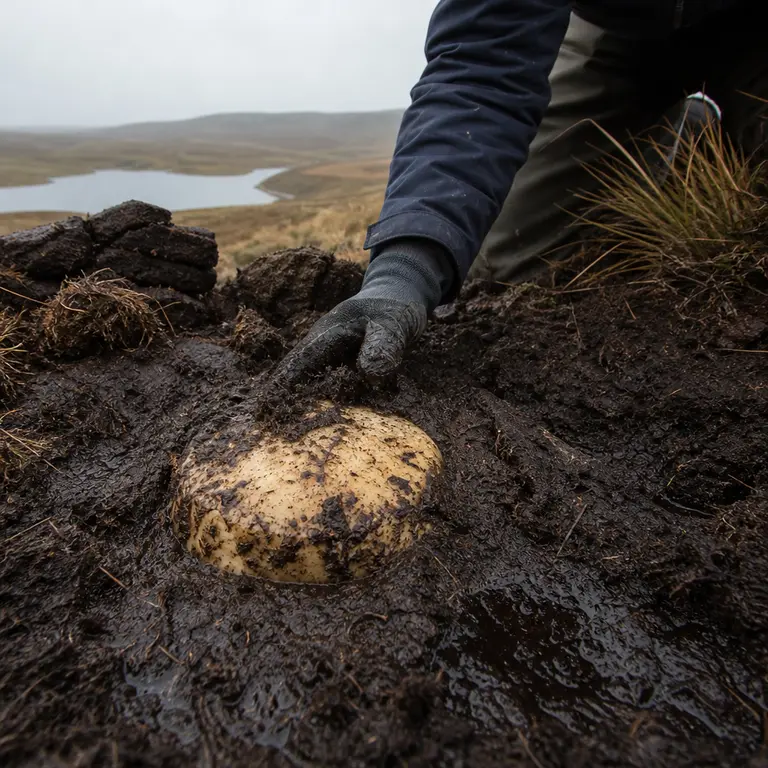
In the summer of 1859, a laborer cutting peat near Tullamore in County Offaly, Ireland, pulled from the ground a wooden container packed with a waxy, yellowish substance. It smelled faintly rancid, faintly earthy, and had the texture of crumbling cheese. The local museum identified it as butter — ancient butter — buried so long ago that the peat had transformed it into something almost unrecognizable. This was not an isolated find. Dozens of similar deposits had already surfaced across Ireland, and dozens more would follow across Scotland and Scandinavia in the decades ahead. Collectively, these finds came to be known as bog butter, and they represent one of the most puzzling and underexamined food-related phenomena in European prehistory.
The National Museum of Ireland alone holds more than 270 recorded bog butter finds. Some are wrapped in animal hides, others packed into wooden casks, bark containers, or wicker baskets. The oldest confirmed samples date to approximately 3,500 years ago, placing them firmly in the Bronze Age, though the practice of burying dairy fat in peat bogs appears to have peaked during the Iron Age, roughly 800 BCE to 400 CE, and continued sporadically into the early medieval period. One sample recovered from Tullyallen in County Louth was dated by radiocarbon analysis to around 400 CE, suggesting the custom persisted for well over a millennium. That span of time is remarkable in itself. It means that burying butter in bogs was not a passing habit or a response to a single unusual circumstance, but a sustained cultural practice maintained across generations, perhaps across dozens of generations, by communities who clearly found it worthwhile.
What makes bog butter so compelling is precisely this combination of the familiar and the deeply foreign. Butter is one of the most ordinary foods in the world. It sits in refrigerators in billions of homes. It has been churned, spread, melted, and traded in virtually every dairy-farming culture on earth. And yet here it is, packed into wooden vessels and pressed into the ground of ancient bogs, waiting for modern hands to pull it out thousands of years later. That strangeness demands explanation, and the explanations that researchers have developed over the past two decades are considerably more interesting than anyone initially expected.
The Iron Age Context
To understand why people buried butter in bogs, it helps to understand the world they inhabited. Iron Age Ireland and Scotland were pastoral societies. Cattle were not merely livestock but a primary measure of wealth, social standing, and political power. The Brehon Laws of early medieval Ireland, which preserved customs stretching back centuries, assigned precise legal values to cows and their products. A milch cow — a cow actively producing milk — was one of the most valuable assets a household could possess, and the products of that cow, including butter, were correspondingly significant. Butter, churned from the milk of cattle, was both a calorie-dense food and a tradeable commodity of genuine economic significance.
Peat bogs offered a natural refrigerator of sorts. The cold, anaerobic, and acidic environment of a bog dramatically slows the bacterial processes that cause organic matter to decay. The same chemistry that preserved the famous bog bodies — human remains so well-preserved that facial expressions and stomach contents remain readable — also preserved fat. Burying butter in a bog could extend its usable life considerably, and some researchers have proposed that this was straightforwardly practical: a way to store a seasonal surplus of dairy production against leaner months, or to age and develop the flavor of a fatty product the way one might age cheese.
But the practical explanation does not account for everything. Many bog butter deposits are extraordinarily large — some weigh over 30 kilograms — and were buried in locations that seem deliberate rather than merely convenient. Several finds were placed near boundaries between landholdings, near ancient trackways, or at the edges of lakes and pools that fed into bogs. These spatial patterns have led archaeologists to propose a ritual dimension: that some butter was buried as an offering to the gods or spirits associated with liminal, watery places, much as weapons, jewelry, and other valuables were cast into lakes and rivers across Celtic Europe during the same period.
This interpretation gains further weight when considered alongside the broader archaeology of Iron Age votive practice. Across the Celtic world, from Ireland to Gaul, communities regularly deposited objects of value in watery or marginal places. The logic, as best as scholars can reconstruct it, involved a kind of reciprocal exchange with supernatural forces — giving up something of worth in order to secure protection, fertility, or favor. Butter, as one of the most economically significant products of a pastoral economy, would have been an entirely appropriate offering within that framework. The fact that some deposits appear never to have been retrieved, even when retrieval would have been straightforward, supports the idea that at least some of this material was never intended to be reclaimed.
What the Chemistry Reveals
For most of the 19th and 20th centuries, bog butter was analyzed primarily by visual inspection and basic organic chemistry. Researchers could confirm that the substance was dairy fat, sometimes mixed with meat fat, but little more. The situation changed substantially in the early 2000s when gas chromatography and compound-specific isotope analysis became routinely available to archaeologists.
A landmark study published in 2019 in the journal Scientific Reports by researchers from University College Dublin and Queen’s University Belfast applied lipid biomarker analysis to 32 bog butter samples from Irish collections. The results were striking. The majority of samples were confirmed as dairy fat, consistent with churned butter. A smaller subset showed signatures consistent with rendered animal fat — possibly tallow or lard — suggesting that not everything labeled bog butter was actually butter in the modern sense. The isotope ratios also indicated that the animals whose milk produced the butter were grazing on plants consistent with those of Irish lowland pastures, providing the first direct chemical link between the deposits and specific agricultural landscapes.
Further, the researchers found that some samples had been heated before burial, which would have extended their shelf life even further by driving off residual water and killing surface bacteria — a technique analogous to modern clarified butter or ghee. This suggests a level of deliberate food technology rather than simple improvised storage. The people making these deposits were not simply throwing surplus dairy into a convenient hole in the ground. They were applying knowledge about fat chemistry, even if they would not have described it in those terms, to produce a product specifically designed to survive long-term burial.
This finding has broader implications for our understanding of Iron Age food knowledge. It suggests that communities in northwestern Europe were employing sophisticated preservation techniques well before the Roman influence sometimes credited with introducing culinary complexity to the region. The technology of clarification, the understanding that removing water from fat extends its stability, represents a form of applied science that was clearly well established in Ireland and Scotland long before any written record of it survives.
Flavor, Function, and the Question of Taste
Several accounts exist of people actually tasting bog butter. The reports, from the 19th century onward, are consistent: the substance is described as intensely pungent, cheesy, and not entirely unpleasant in small quantities. One 19th-century report from a Scottish museum curator noted that local people near the find site expressed no surprise at the discovery and suggested it would still be edible, if strong. There is at least one documented case of a 20th-century food writer who tasted a small sample under controlled conditions and described it as resembling a very aged, slightly smoky blue cheese.
This raises a genuine question that food historians have only recently begun to take seriously: was the aging of bog butter intentional, as a flavor-development process rather than merely a preservation strategy? In many traditional cultures, fermented and aged dairy products hold high prestige. The deliberate burial of butter to transform its flavor over months or years would not be without parallel — it resembles the Icelandic practice of burying skyr, or the aging of certain Scandinavian cheeses in brine pits, or the production of hakarl, the fermented shark that remains a cultural touchstone in Iceland despite its extreme pungency. If Iron Age communities were intentionally producing a luxury-aged fat product, that would substantially complicate the narrative of ancient dairy as purely a subsistence food.
It would also suggest a continuity of culinary ambition that is often written out of popular accounts of prehistoric life. The image of ancient people eating whatever they could get, without preference or refinement, is almost certainly wrong, and bog butter may be one of the clearest pieces of evidence against it. A community that buries fat in carefully selected locations, in purpose-built containers, after pre-treating it to improve its longevity, and then either retrieves it after a period of aging or offers it as a high-value gift to supernatural powers, has a sophisticated relationship to food that goes well beyond mere survival.
The Present-Day Hook: New Digitization and Ongoing Analysis
In 2023, the National Museum of Ireland announced an expanded digitization project covering its entire collection of bog finds, including the bulk of its 270-plus bog butter samples. The project, part of a broader European initiative to make museum collections accessible to remote researchers, has made high-resolution imaging, radiocarbon dates, and existing chemical data available through an open-access portal for the first time. This has allowed researchers in Denmark and the Netherlands, where similar but less-studied deposits exist, to begin comparative analyses without requiring physical access to the Irish samples.
A follow-up lipid study drawing on the newly digitized catalog data is currently underway at Uppsala University in Sweden, with preliminary findings expected in 2025. The digitization effort has also prompted renewed public interest: the museum’s bog butter holdings were featured in a temporary exhibition in Dublin in late 2023, highlighting how much of the collection had never been on public display. For a category of artifact that spent most of the past century sitting in storage jars in museum basements, that represents a significant shift in visibility.
The next frontier in bog butter research is likely to involve ancient DNA and proteomics — the analysis of ancient proteins preserved within the fat matrix. Researchers have already begun exploring whether genetic material preserved in fat could identify the specific cattle breeds involved in producing the milk, which would open a window into the history of livestock domestication and selective breeding in northwestern Europe. Proteins survive in fat under certain conditions, and the bog environment, which has already proven so effective at preserving organic material, may have protected molecular information that would be unrecoverable in almost any other context.
A Legacy Written in Fat
Bog butter sits at the intersection of food history, archaeology, ritual studies, and organic chemistry in a way that few other finds can match. It is simultaneously mundane — it is, after all, butter — and deeply strange, a product of human hands that survived thousands of years in conditions that destroyed almost everything else its makers left behind.
The finds challenge easy assumptions about ancient life. Iron Age communities in Ireland and Scotland were not simply surviving; they were managing complex food systems, making deliberate choices about storage and preservation, and possibly producing luxury goods that required patience and skill. The bogs preserved not just the fat itself but a record of agricultural practice, animal husbandry, trade, and possibly religious belief that would otherwise be entirely invisible to us.
What began as a laborer’s puzzling find in a County Offaly peat bog in 1859 turns out to be one of the more information-rich artifacts the ancient world left behind, and one of the least examined. As the science continues to improve and the collections become more accessible, bog butter is likely to keep yielding surprises — a reminder that the most ordinary things, given enough time and the right conditions, can become the most revealing.
Sources & Further Reading
- Berstan, R. et al. Direct chemical evidence for widespread dairying in prehistoric Britain. Proceedings of the National Academy of Sciences, 2008.
- Hanrahan, L. et al. Characterisation of bog butter using a multi-analytical approach. Scientific Reports, 2019. https://www.nature.com/articles/s41598-019-54029-8
- National Museum of Ireland. Bog Butter Collection and Digitization Initiative. NMI, 2023. https://www.museum.ie
- Caulfield, S. and Sheridan, A. Bog Butter: Archaeological and Chemical Analysis. Journal of Irish Archaeology, 2004.