
The Accidental Origin of Meringue: a Cooking Catastrophe
How a Swiss pastry chef's desperate attempt to salvage a kitchen disaster led to the invention of meringue in the 1700s.
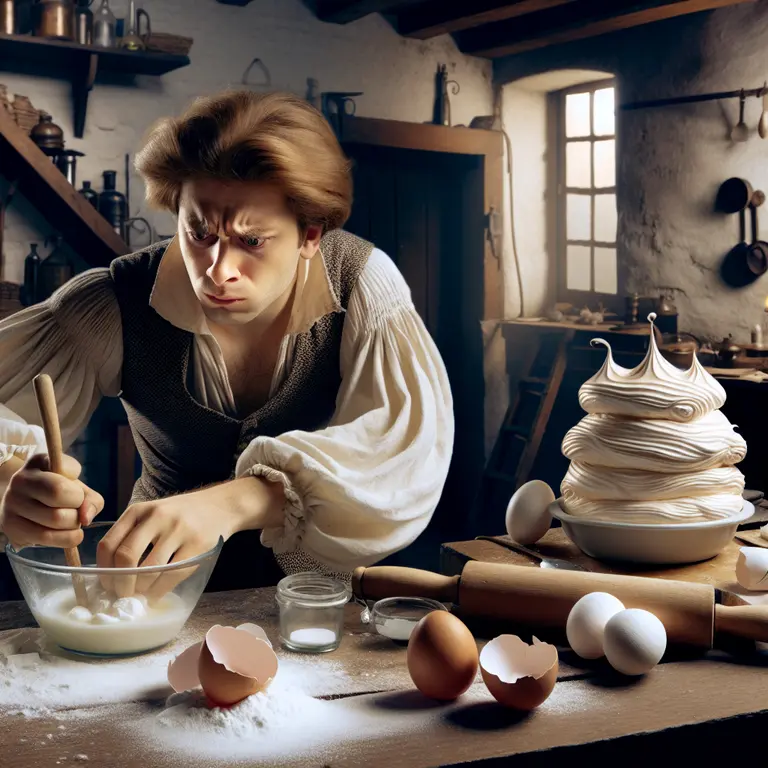
In the world of culinary arts, some of the most extraordinary creations emerge not from careful planning but from fortunate accidents. Meringue—that airy, ethereal confection of whipped egg whites and sugar—stands as perhaps the most elegant example of serendipity in the kitchen. This seemingly simple creation, which forms the foundation of countless sophisticated desserts from pavlovas to lemon meringue pie, wasn’t born of methodical experimentation or ancient tradition, but rather from what culinary historians recognize as essentially a kitchen disaster.
The Accidental Discovery
In the small Swiss town of Meiringen in the early 1700s, a pastry chef named Gasparini faced what would have been considered a significant kitchen mishap. According to culinary historians, while preparing an entirely different recipe, he accidentally added an excessive amount of sugar to a batch of egg whites. In an era when sugar was considered a luxury ingredient—often displayed prominently in wealthy households as a status symbol and sometimes kept under lock and key—wasting such a valuable commodity was unthinkable.
Rather than discard these expensive ingredients, Gasparini demonstrated the resourcefulness that often characterizes great chefs. He attempted to salvage his mistake by experimenting, vigorously whisking the overly sweetened egg-white mixture and then baking it for an unusually long time at a low temperature. His improvisation was guided less by scientific understanding and more by practical necessity and intuition.
The result transcended mere salvage—it was a culinary revelation. What emerged from his oven featured a delicately crisp exterior that gave way to a marshmallow-like interior that quite literally dissolved on the tongue. Gasparini, recognizing the uniqueness of his creation, named it after his hometown of Meiringen, though as the technique spread through European kitchens, particularly in France, the spelling evolved to “meringue” to accommodate French phonetics and linguistic patterns.
The Science Behind the Magic
What makes the origin story of meringue particularly remarkable is that this seemingly technically precise creation—which professional pastry chefs spend years mastering—emerged from improvisation rather than deliberate design. Today, food scientists understand the complex chemical and physical transformations that give meringue its distinctive texture.
The process begins at the molecular level. When egg whites are subjected to mechanical agitation through whisking, their protein structures—primarily ovalbumin, conalbumin, and ovomucoid—undergo a process called denaturation. These proteins, usually tightly folded globular structures, unfold and stretch, exposing hydrophobic regions that were previously hidden within their folds. As these proteins unfold, they begin to interact with one another, forming new bonds at the air-water interface of the tiny bubbles introduced by whisking.
The addition of sugar plays several crucial roles in this delicate system. First, it stabilizes the foam by increasing the viscosity of the liquid phase, slowing the drainage of liquid between the air bubbles. Second, sugar interacts with the egg proteins, preventing them from bonding too tightly to one another, which would otherwise cause the foam to collapse. Finally, during the slow baking process, sugar partially crystallizes, contributing to the distinctive texture of the finished meringue.
The precision of modern meringue preparation—with its careful ratios, specific temperatures, and exact techniques—stands in stark contrast to its haphazard origins. This transformation from accident to exacting technique mirrors many developments in the history of science and technology, where chance observations become the foundation for rigorous methodologies.
Beyond Desserts: Meringue’s Surprising Connections
Curiously, this culinary accident connects to material science in unexpected ways that Gasparini could never have anticipated. The fundamental structure of meringue—essentially a solid foam with trapped air pockets—mirrors sophisticated engineered materials developed centuries later. Modern aerogels, metallic foams, and certain types of insulation used in aerospace, automotive, and building construction all rely on similar principles to create stable networks that trap air, producing lightweight yet structurally sound materials.
Materials scientists studying food structures have noted that meringue represents an early example of what we now call a “solid foam”—a category that includes modern materials such as expanded polystyrene and metallic foams used for impact absorption. The protein network in meringue, reinforced by sugar crystallization, creates a remarkably stable structure with exceptional insulating properties, which explains why baked Alaska can paradoxically contain ice cream within a hot meringue shell.
Some researchers in biomimetic engineering—the field that draws inspiration from biological structures to solve engineering problems—have studied food foams, such as meringue, to develop new lightweight structural materials. The efficient way meringue distributes material to maximize strength while minimizing weight parallels the use of advanced composite materials in everything from aircraft components to sporting equipment.
The Historical Context and Cultural Impact
The meringue creation story challenges our assumption that sophisticated culinary techniques emerge from methodical experimentation. In reality, many kitchen staples we take for granted—from chocolate chip cookies to Worcestershire sauce—were born from mistakes, accidents, or improvisations that were recognized as valuable and subsequently refined.
Perhaps most surprising is how meringue, despite its seemingly simple composition, remained physically impossible throughout most of human history. Before the invention of efficient whisks and beaters in the 18th century, creating the necessary foam structure by hand would have been prohibitively laborious, if not impossible, at any significant scale. The emergence of this dessert required the convergence of several factors: the availability of refined sugar, the development of appropriate cooking implements, and the cultural context that valued experimentation in food preparation.
As meringue spread across Europe, it evolved into distinct regional variations. The French developed a technique for a drier, crisper meringue; the Italians created a more stable version using hot sugar syrup; and the Swiss (honoring its origins) perfected a method involving gentle heat during the whipping process. Each variation reflected not only different culinary preferences but also adaptations to local ingredients, climate conditions, and available cooking equipment.
The Legacy of Sweet Mistakes
The story of meringue’s accidental creation offers a profound lesson that extends beyond the kitchen: innovation often emerges not from perfect execution of plans but from creative responses to unexpected outcomes. In both culinary arts and scientific discovery, the ability to recognize value in apparent failures has driven progress throughout human history.
Today, as molecular gastronomy and food science continue to evolve, chefs and researchers alike look back at traditional techniques like meringue-making with new appreciation. What was once considered merely a delicious dessert is now understood as a sophisticated exercise in protein chemistry, foam physics, and structural engineering—all born from a pastry chef’s determination not to waste expensive ingredients.
The next time you enjoy the delicate crunch and melt-in-your-mouth sweetness of a meringue, remember that you’re tasting not just a dessert, but a moment of culinary history when accident transformed into art, a testament to human ingenuity and the sometimes sweet rewards of mistakes.